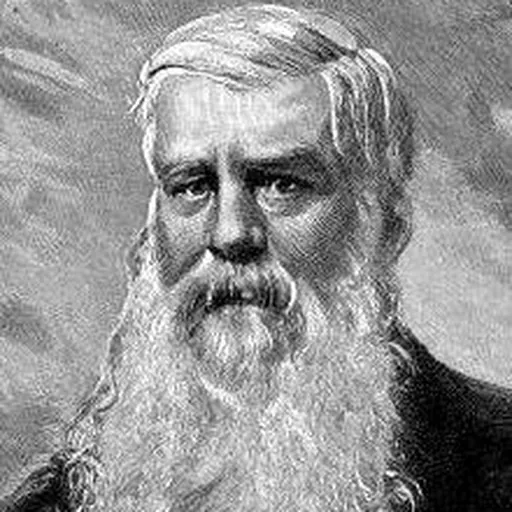
About G. A. Henty
Lived 1832 – 1902 (aged 69). G. A. Henty was a British war correspondent, writer and children's writer.
George Alfred Henty (8 December 1832 – 16 November 1902) was an English novelist and war correspondent. He is best known for his works of adventure fiction and historical fiction, including The Dragon & The Raven, For The Temple (1888), Under Drake's Flag (1883) and In Freedom's Cause (1885).
Biography
G. A. Henty was born and baptised in Godmanchester, near Huntingdon, but spent some of his childhood in Canterbury before his family moved to London. He was a sickly child who had to spend long periods in bed. During his frequent illnesses he became an avid reader and developed a wide range of interests which he carried into adulthood. He attended Westminster School, London, as a half-boarder when he was fourteen, and later Gonville and Caius College, Cambridge, where he was a keen sportsman.
He left the university early without completing his degree to volunteer for the (Army) Hospital Commissariat of the Purveyors Department when the Crimean War began. He was sent to the Crimea and while there he witnessed the appalling conditions under which the British soldier had to fight. His letters home were filled with vivid descriptions of what he saw. His father was impressed by his letters and sent them to the Morning Advertiser newspaper which printed them. This initial writing success was a factor in Henty's later decision to accept the offer to become a special correspondent, the early name for journalists now better known as war correspondents.
Shortly before resigning from the army as a captain in 1859 he married Elizabeth Finucane. The couple had four children. Elizabeth died in 1865 after a long illness and shortly after her death Henty began writing articles for the Standard newspaper. In 1866 the newspaper sent him as their special correspondent to report on the Austro-Italian War where he met Giuseppe Garibaldi. He went on to cover the 1868 British punitive expedition to Abyssinia, the Franco-Prussian War, the Ashanti War, the Carlist Rebellion in Spain and the Turco-Serbian War. He also witnessed the opening of the Suez Canal and travelled to Palestine, Russia and India.
Henty was a strong supporter of the British Empire all his life; according to literary critic Kathryn Castle: "Henty ... exemplified the ethos of the [British Empire], and glorified in its successes". Henty's ideas about politics were influenced by writers such as Sir Charles Dilke and Thomas Carlyle. Blackie, who published his children's fiction in the UK, and W. G. Blackie estimated in February 1952 that they were producing about 150,000 Henty books a year at the height of his popularity, and stated that their records showed they had produced over three and a half million Henty books. He further estimated that considering the US and other overseas authorised and pirated editions, a total of 25 million was not impossible.
His children's novels typically revolved around a boy or young man living in troubled times. These ranged from the Punic War to more recent conflicts such as the Napoleonic Wars or the American Civil War. Henty's heroes – which occasionally included young ladies – are uniformly intelligent, courageous, honest and resourceful with plenty of 'pluck' yet are also modest. These themes have made Henty's novels popular today among many conservative Christians and homeschoolers.
Influence G. A. Henty's commercial popularity encouraged other writers to try writing juvenile adventure stories in his style; "Herbert Strang", Henry Everett McNeil, Percy F. Westerman and Captain Frederick Sadleir Brereton all wrote novels in "the Henty tradition", often incorporating then-contemporary themes such as aviation and First World War combat. By the 1930s, however, interest in Henty's work was declining in Britain, and hence few children's writers there looked to his work as a model.
Don’t just read it —
keep it.
Full-length biographies made to live with: read them, listen on the way to work, watch them tonight.
- E-book
- Audio
- Video
Instant download · yours to keep · every purchase keeps this site free
Important facts
People in G. A. Henty's life
Named in this biography and alive at the same time

Related people
Same field, nearest in time


Contemporaries
People whose lives overlapped G. A. Henty's



Frequently asked questions
Who was G. A. Henty?
British novelist (1832–1902)
When was G. A. Henty born?
G. A. Henty was born on 8 December 1832 in Cambridge.
When did G. A. Henty die?
G. A. Henty died on 16 November 1902 in Weymouth.
What was G. A. Henty's occupation?
G. A. Henty was a war correspondent, writer and children's writer.
What nationality was G. A. Henty?
G. A. Henty was British.
Sources & further reading
Cite this page
APA: Biography.guide. (2026). G. A. Henty. https://biography.guide/g-a-henty/
MLA: "G. A. Henty." Biography.guide, https://biography.guide/g-a-henty/.
Chicago: "G. A. Henty." Biography.guide. https://biography.guide/g-a-henty/.
Data last updated: 2026-09-23 · Spot an error? Report a correction.
Portrait: Wikimedia Commons · author & licence
Page generated 2026-09-27 05:06 UTC