
Andrew Barton Paterson
Australian journalist, author and poet
About Andrew Barton Paterson
Lived 1864 – 1941 (aged 76). Andrew Barton Paterson was an Australian war correspondent, poet, journalist, writer, poet lawyer and lawyer.
Andrew Barton "Banjo" Paterson (17 February 18645 February 1941) was an Australian bush poet, journalist and author, widely considered one of the greatest writers of Australia's colonial period.
Born in rural New South Wales, Paterson worked as a lawyer before transitioning into literature, where he quickly gained recognition for capturing the life of the Australian bush. A representative of the Bulletin School of Australian literature, Paterson wrote many of his best known poems for the nationalist journal The Bulletin, including "Clancy of the Overflow" (1889) and "The Man from Snowy River" (1890). His 1895 ballad "Waltzing Matilda" is regarded widely as Australia's unofficial national anthem and, according to the National Film and Sound Archive, has been recorded more than any other Australian song.
Early life
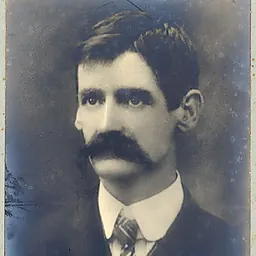
Andrew Barton Paterson was born on 17 February 1864 at the property "Narrambla", near Orange, New South Wales, the eldest son of Andrew Bogle Paterson, a Scottish immigrant from Lanarkshire, and Australian-born Rose Isabella Barton, Paterson's family lived on the isolated Buckinbah Station near Yeoval NSW until he was five when his father lost his wool clip in a flood and was forced to sell up. He left the prestigious school at 16 after failing an examination for a scholarship to the University of Sydney. As one of its most popular writers through the 1890s, he formed friendships with other significant writers in Australian literature, such as E.J. Brady, Harry "Breaker" Morant, Will H. Ogilvie, and Henry Lawson. In particular, Paterson became engaged in a friendly rivalry of verse with Lawson about the allure of bush life. His graphic accounts of the relief of Kimberley, surrender of Bloemfontein (the first correspondent to ride in) and the capture of Pretoria attracted the attention of the press in Britain.
Paterson was also was a correspondent during the Boxer Rebellion from 1901 to 1902, where he met George "Chinese" Morrison and later wrote about his meeting.
Paterson was editor of Samuel Bennett's Evening News from 1903 to 1908,
Hiatus and military service In 1908, after a trip to the United Kingdom he decided to abandon journalism and writing and moved with his family to a property near Yass.
In World War I, Paterson failed to become a correspondent covering the fighting in Flanders, but did become an ambulance driver with the Australian Voluntary Hospital, Wimereux, France. He returned to Australia early in 1915 and, as an honorary vet, travelled on three voyages with horses to Africa, China and Egypt. He was commissioned in the 2nd Remount Unit, Australian Imperial Force on 18 October 1915, He was repatriated to Australia and discharged from the army having risen to the rank of major in April 1919. His wife had joined the Red Cross and worked in an ambulance unit near her husband.
In December 1938, Paterson was appointed Commander of the British Empire (CBE).
He died of a heart attack in Sydney on 5 February 1941, aged 76.
Personal life
On 8 April 1903, he married Alice Emily Walker, of Tenterfield Station, in St Stephen's Presbyterian Church, in Tenterfield, New South Wales. Their first home was in Queen Street, Woollahra. The Patersons had two children, Grace (born in 1904) and Hugh (born in 1906).
Paterson had been previously engaged to Sarah Riley for eight years, but this was abruptly called off in 1895 following a visit to her at Dagworth Station in Queensland where she was visiting the Macpherson family. It was here that Paterson met his fiancée's best friend from school days, Christina Macpherson, who composed the music for which he then wrote the lyrics of the famous Waltzing Matilda. However, following this collaboration Paterson was suddenly asked to leave the property, leading historians to conclude that he was a womaniser and had engaged in a scandalous romantic liaison with Macpherson.
Works
The publication of The Man from Snowy River and five other ballads in The Bulletin made "The Banjo" a household name. In 1895, Angus & Robertson published these poems as a collection of Australian verse. The book sold 5000 copies in the first four months of publication.
In 1895, Paterson headed north to Dagworth station near Winton, Queensland. Travelling with fiancée, Sarah Riley, they met with her old school friend, Christina Macpherson, who had recently attended a race at Warrnambool in Victoria. She had heard a band playing a tune there, which became stuck in her head and replayed it for Paterson on the autoharp. The melody also resonated with him and propelled him to write "Waltzing Matilda" While there has been much debate about what inspired the words, the song became one of his most widely known and sung ballads.
In addition, he wrote the lyrics for songs with piano scores, such as "The Daylight is Dying" and Last Week. These were also published by Angus & Robertson between the years 1895 to 1899. In 1905, the same publishers released Old Bush Songs, a collection of bush ballads Paterson had been assembling since 1895.
Although for most of his adult life, Paterson lived and worked in Sydney, his poems mostly presented a highly romantic view of the bush and the iconic figure of the bushman. Influenced by the work of another Australian poet, John Farrell, his representation of the bushman as a tough, independent and heroic underdog became the ideal qualities underpinning the national character. His work is often compared to the prose of Henry Lawson, particularly the seminal work, "The Drover's Wife", which presented a considerably less romantic view of the harshness of rural existence of the late 19th century.
Paterson authored two novels; In No Man's Land (later titled An Outback Marriage) (1900) and The Shearer's Colt (1936), wrote many short stories; Three Elephant Power and Other Stories (1917), and wrote a book based on his experiences as a war reporter, Happy Dispatches (1934). He also wrote a book for children, The Animals Noah Forgot (1933).
Contemporary recordings of many of Paterson's well known poems have been released by Jack Thompson, who played Clancy in the 1982 film adaptation of "The Man from Snowy River". While having no connection to the movie, an Australian television series of the same name was broadcast in the 1990s.
Media reports in August 2008 stated that a previously unknown poem had been found in a war diary written during the Boer War.
Legacy
Banjo Paterson's image appears on the $10 note, along with an illustration inspired by "The Man From Snowy River" and, as part of the copy-protection microprint, the text of the poem itself.
Artist Violet Bowring painted a portrait of her one-time neighbour Banjo Paterson, now hanging in Sydney’s Australian Club, and used as the cover illustration of a book The Best of Banjo Paterson, compiled by Walter Stone, published in 1977.
In 1981, he was honoured on a postage stamp issued by Australia Post.
A.B. Paterson College, at Arundel on the Gold Coast, Australia, is named after Paterson.
The A. B. "Banjo" Paterson Library at Sydney Grammar School was named after Paterson.
The Festival of Arts in Orange, New South Wales, presents a biennial Banjo Paterson Award for poetry and one-act plays and there is also an annual National Book Council Banjo Award. Orange also has an annual Banjo Paterson Poetry Festival.
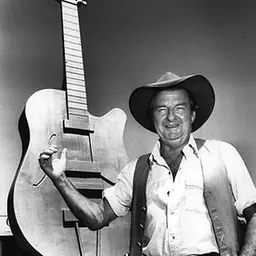
In 1983, a rendition of "Waltzing Matilda" by country-and-western singer Slim Dusty was the first song broadcast by astronauts to Earth.
He topped the list of The Greatest of All - Our 50 Top Australians published in The Australian on 27 June 2013.
Don’t just read it —
keep it.
Full-length biographies made to live with: read them, listen on the way to work, watch them tonight.
- E-book
- Audio
- Video
Instant download · yours to keep · every purchase keeps this site free
Important facts
People in Andrew Barton Paterson's life
Named in this biography and alive at the same time






Related people
Same field, nearest in time



Contemporaries
People whose lives overlapped Andrew Barton Paterson's



Frequently asked questions
Who was Andrew Barton Paterson?
Australian journalist, author and poet (1864 - 1941)
When was Andrew Barton Paterson born?
Andrew Barton Paterson was born on 17 February 1864 in Orange.
When did Andrew Barton Paterson die?
Andrew Barton Paterson died on 5 February 1941 in Sydney.
What was Andrew Barton Paterson's occupation?
Andrew Barton Paterson was a war correspondent, poet, journalist, writer, poet lawyer and lawyer.
What nationality was Andrew Barton Paterson?
Andrew Barton Paterson was Australian.
Sources & further reading
· Wikipedia: Andrew Barton Paterson
Cite this page
APA: Biography.guide. (2026). Andrew Barton Paterson. https://biography.guide/andrew-barton-paterson/
MLA: "Andrew Barton Paterson." Biography.guide, https://biography.guide/andrew-barton-paterson/.
Chicago: "Andrew Barton Paterson." Biography.guide. https://biography.guide/andrew-barton-paterson/.
Data last updated: 2026-09-25 · Spot an error? Report a correction.
Page generated 2026-09-27 05:12 UTC