
Caroline Matthews
British physician and war correspondent
About Caroline Matthews
Lived 1877 – 1927 (aged 49–50). Caroline Matthews was a British war correspondent, known for 1908 Messina earthquake, Serbia and World War I.
Caroline Twigge Matthews, MBChB (25 September 1877–1927) was a British doctor and war correspondent, and was dubbed a "war heroine". She served in the Italian Red Cross in the 1908 Messina earthquake, and in military hospitals during the Balkans War and First World War, and was taken as a prisoner of war. She was awarded King Victor Emmanuel's Medal, the Italian Red Cross Medal, King Victor Emmanuel's Commemoration Medal and the Montenegrin Order of Danilo. When she died, the press said she was "The Florence Nightingale of the Balkans."
Early life and education
Caroline Twigge was born on 25 September 1877, to Liverpool parents, John Twigge (1848–1908) and his wife Caroline Sara Twigge, née Sargeant (born 1847), She had two brothers, John S. Twigge (born 1872) who was to become a curate at Waverton-cum-Dundraw, Cumbria before in 1896, being ordained in Carlisle Cathedral to serve in the parish of Ravenstondale, Westmorland. Her younger brother, Herbert L. Twigge (born 1875), had already followed their father into business as a rice and fruit merchant in 1901. and at three addresses during her studies, finally at Masson Hall, George Square. In 1902–1903, her final year as a student, the family holidayed together in Aboyne, Scotland.
Matthews passed the third level professional examinations in medicine and surgery in July 1903, and qualified in medicine on 17 October 1903,
She married Joseph Matthews, a surgeon who was a widower and almost thirty years her senior, in 1907, in the Sheriff Court in St Giles district, Edinburgh, but at the date of her death, she was already a widow.
Career
Messina and Calabria disaster Matthews served voluntarily in the 1908 Messina earthquake, when the city lost almost half its population including nurses and doctors. She was among those involved in the international relief effort who were awarded King Victor Emmanuel's Medal.
She had been expected to take up a medical role with a leper community in China but did not get there, Matthews was said to have been simply treated as one of the soldiers when attached to the Grenadiers and had seen "horrors unspeakable" or "gruesome sights", including an "inferno worse than that depicted by Dante", whilst working to save lives in this destructive disaster. In 1910, Matthews was the only woman, and the only English speaker, among the soldiers assisting civilians in the village of Cinquefronde, Calabria, where a smallpox infection was also rife and the town was placed "under the yellow flag". She herself had to rest with an unspecified "serious illness" in Rome, before being able to return home.
Her former associates at The Gentlewoman magazine's Children's Salon wrote rather romantically of her: "Sturdily the stranger in the camp, [she] worked with a will, sharing the hardship of the men." Matthews also spoke of the continuing patriotic attitude of the Montenegrin people, despite their extremes of poverty and severity of many people's injuries. In her article, she also comments on the relative comfort of the Turkish prisoners of war.
In November 1912, in The Gentlewoman, an item titled "A Lady Doctor at the Front", tells that she was in Syria before volunteering for military hospital work, and thus was inappropriately clothed for the Balkan weather. Her recollections give gossipy details of her journey, contrasting with a matter of fact approach to detailing the wounded in body and mind she came across during concerns with poor quality hygiene and a lack of resources, in the military hospital. She recounts there were 4,000 wounded treated per week, with only amateur nurses and even children as "ward orderlies", but surprisingly only 16 deaths, despite her own language problems and lack of support from Russian doctors. She also praises the courage and chivalry of the injured men, whom she calls "brave, patient, grateful" ... but longing to be "out" serving at the front again.
First World War
As the First World War began, Matthews again volunteered, this time to serve in Serbia, at her own expense, She said (unlike many middle- or upper-class women of the day who lacked her resilience) that as she used her skills, she felt that 'Life was worth living in these days.'
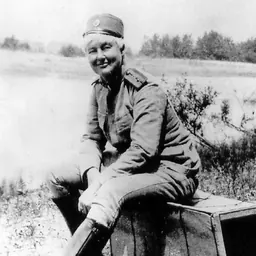
Her final role in the field was in volunteering to stay with the wounded, and in charge of the military hospital at Uzsitsi, As she had later refused to treat the occupying army who had stolen patients' blankets, she was accused of espionage, and taken as a prisoner to Belgrade. Her dress in breeches and an officer-like coat had drawn comment, but was most practical for riding. Matthews also wrote a series of articles on the same themes for The Courier, titled "In the Hands of the Hun – The Experiences of a Woman Doctor in Serbia".
Her war experiences, together describing "perhaps the most extraordinary time of a varied life", were published by Mills & Boon in a book Experiences of a Woman Doctor in Serbia in 1916, which she dedicated "in love and gratitude to Amy M. Johns, a friend in a thousand".
The book was described by The Courier as "a graphic panorama" and "a thrilling narrative". She gave details, such as working amicably with the Hungarian chief medical officer during a deadly diphtheria outbreak, who was to be replaced by a "coward" CMO, who would not enter the cholera ward, but left Matthews in charge.
In her own words, quoted in The Yorkshire Post, despite experiencing evil spirits in men's eyes, cunning and blood-lust, Matthews had "never met before such peculiarly fiendish expressions of absolute hatred as were directed towards me by those Teutonic officers".
Her work was compared with autobiographical writing from another woman who became a volunteer fighter in the Serbian army, Flora Sandes, Matthews' stories and the consideration of her bravery in press reports, travelled to Australia, as well as across the regional press in Britain. It was said that her Experiences book could be seen as "a monument to the almost superhuman courage and daring of Dr Caroline Matthews"; to whom she had dedicated her 1916 Experiences book. Amy Johns wrote a poem to Matthews, as the foreword:
Matthews and Johns went travelling together, after the war, in India for more than a year, but Johns died suddenly in 1923, on a train from Dover to London on her return, Matthews' own estate was valued as £1904.
Death and memorial Matthews' health was indeed harmed from her war experiences, and she died of pneumonia after influenza The funeral was taken by the local vicar, Reverend A. A. Gibson, and was given "very many floral tributes" with a range of "expressions of affection and regret". mentioned in her book, as well as some of her field medical equipment, and medals, are in the Science Museum or Wellcome library medical collection.
Don’t just read it —
keep it.
Full-length biographies made to live with: read them, listen on the way to work, watch them tonight.
- E-book
- Audio
- Video
Instant download · yours to keep · every purchase keeps this site free
Important facts
People in Caroline Matthews's life
Named in this biography and alive at the same time



Related people
Same field, nearest in time


Contemporaries
People whose lives overlapped Caroline Matthews's




Frequently asked questions
Who was Caroline Matthews?
British physician and war correspondent
When was Caroline Matthews born?
Caroline Matthews was born in 1877 in Liverpool.
When did Caroline Matthews die?
Caroline Matthews died in 1927 in London.
What was Caroline Matthews's occupation?
Caroline Matthews was a war correspondent.
What was Caroline Matthews known for?
Caroline Matthews was known for 1908 Messina earthquake, Serbia and World War I.
What nationality was Caroline Matthews?
Caroline Matthews was British.
Sources & further reading
· Wikipedia: Caroline Matthews
Cite this page
APA: Biography.guide. (2026). Caroline Matthews. https://biography.guide/caroline-matthews/
MLA: "Caroline Matthews." Biography.guide, https://biography.guide/caroline-matthews/.
Chicago: "Caroline Matthews." Biography.guide. https://biography.guide/caroline-matthews/.
Data last updated: 2026-09-22 · Spot an error? Report a correction.
Page generated 2026-09-27 05:20 UTC