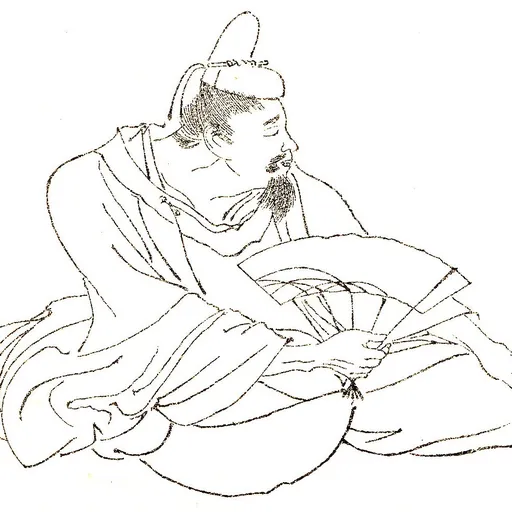
Fujiwara no Sukemasa
Japanese noble, statesman and calligrapher
About Fujiwara no Sukemasa
Lived 944 – 998 (aged 53–54). Fujiwara no Sukemasa was a Japanese calligrapher, politician and beamter.
was a Japanese noble, statesman, and renowned calligrapher of the middle Heian period. Grandson and adopted son of the daijō-daijin Fujiwara no Saneyori and son of major general of the imperial guard , he is honored as one of the Sanseki, a group of outstanding calligraphers.
Life In 961, Sukemasa was conferred the and appointed as a chamberlain. He passed through two minor military positions until, in 967, his adoptive father Fujiwara no Saneyori was appointed as regent to the newly ascended Emperor Reizei. Sukemasa was promoted that year to , and again in 968 to .
In 969, Emperor En'yū ascended to the throne, and Sukemasa rose gradually as a in the Daijō-kan. In 978 he was promoted to sangi, joining the ranks of the kugyō, and in 984 gained the .
In the following courts of Emperor Kazan and Emperor Ichijō, Sukemasa was repeatedly passed over for promotion in favor of Kazan's relative Fujiwara no Yoshichika and then Ichijō's relatives Fujiwara no Michitaka, Fujiwara no Michikane, and Fujiwara no Michinaga. In 991, he resigned his post as sangi and moved to Kyushu as vice-minister of the Dazaifu. In 992, he was promoted to the .
Sukemasa died on August 19, 998, at the age of 55.
Personality and anecdotes Sukemasa was recognized for his excellent calligraphy early on and was particularly esteemed as the leading practitioner of cursive script. His work adorned the folding screens used at the feasts following the coronations of Emperors En'yū, Kazan, and Ichijō. He is counted among the Sanseki group of great calligraphers, along with Ono no Michikaze and Fujiwara no Yukinari, and his flowing and lively handwriting is known in Japanese as . Several examples of original notes he wrote remain, including the National Treasures of Japan and .
However, Sukemasa loved sake, and disgraced himself on numerous occasions. He was extremely neglectful of his duties and lacking in common sense, and the Ōkagami calls him a "slovenly man" (如泥人). That said, some of his documents as a sangi remain, and he did seem to have some views on ancient practices and customs, in which his family was well versed.
The Ōkagami contains two anecdotes about Sukemasa. In one, as Sukemasa returns to Kyōto from his assignment to Kyushu, he receives an oracle from Ōyamazumi Shrine in a dream and then writes down the shrine's motto on its gate. In the other, the regent Fujiwara no Michitaka commands Sukemasa to write a poem on a sliding screen for his new palace, but Sukemasa arrives late and ruins Michitaka's mood.
Extant works
, held by The Kagawa Museum – The term refers to kanshi or waka transcribed in a particular format. This is the only such work remaining from the Heian period. , held by the Hatakeyama Memorial Museum of Fine Art – Written in 991 as Sukemasa was en route to his assignment in Kyushu and suddenly remembered in Shimonoseki that he had forgotten to greet the regent Fujiwara no Michitaka before his departure. In this letter of apology, he asked his nephew to smooth things out between them. The sense of speed in its cursive calligraphy style gives it a unique character. , held by the Museum of the Imperial Collections – a letter , held by the – Written in 982 while Sukemasa was serving as governor of Iyo Province, this was a letter of apology addressed to the regent Fujiwara no Yoritada via his household steward. Sukemasa apologizes for neglecting his paperwork, leaving the New Year's banquet before Yoritada himself, and failing to attend Yoritada's daughter Junshi's wedding to Emperor En'yū. – a letter , held by the – a letter
Genealogy Father: Mother: daughter of Wife: , daughter of Son: Daughter: wife of
Don’t just read it —
keep it.
Full-length biographies made to live with: read them, listen on the way to work, watch them tonight.
- E-book
- Audio
- Video
Instant download · yours to keep · every purchase keeps this site free
Important facts
People in Fujiwara no Sukemasa's life
Named in this biography and alive at the same time


Related people
Same field, nearest in time



Contemporaries
People whose lives overlapped Fujiwara no Sukemasa's


Frequently asked questions
Who was Fujiwara no Sukemasa?
Japanese noble, statesman and calligrapher
When was Fujiwara no Sukemasa born?
Fujiwara no Sukemasa was born in 944.
When did Fujiwara no Sukemasa die?
Fujiwara no Sukemasa died on 19 August 998.
What was Fujiwara no Sukemasa's occupation?
Fujiwara no Sukemasa was a calligrapher, politician and beamter.
What nationality was Fujiwara no Sukemasa?
Fujiwara no Sukemasa was Japanese.
Sources & further reading
· Wikipedia: Fujiwara no Sukemasa
· DBpedia: Fujiwara no Sukemasa
Cite this page
APA: Biography.guide. (2026). Fujiwara no Sukemasa. https://biography.guide/fujiwara-no-sukemasa/
MLA: "Fujiwara no Sukemasa." Biography.guide, https://biography.guide/fujiwara-no-sukemasa/.
Chicago: "Fujiwara no Sukemasa." Biography.guide. https://biography.guide/fujiwara-no-sukemasa/.
Data last updated: 2026-09-23 · Spot an error? Report a correction.
Portrait: Wikimedia Commons · author & licence
Page generated 2026-09-27 05:07 UTC