
About Ibn Muqla
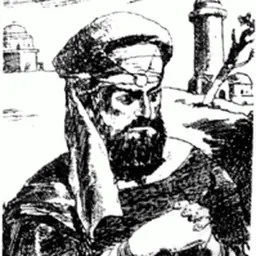
Lived 886 – 940 (aged 53–54). Ibn Muqla was an Arab calligrapher, minister, writer, abbasid and vizier (Abbasid Caliphate), known for Islamic calligraphy.
Ibn Muqla was a polymath, calligrapher, vizier, and poet prominent in Baghdad during the Islamic Golden Age.
Born in 9th century Baghdad, Ibn Muqla systematized Arabic calligraphy through geometric and mathematical principles, revolutionizing the art form and beginning the classical Islamic calligraphic tradition. Rising to high state posts as a young man, his career culminated in his assumption of the senior ministerial title of the Abbasid Caliphate, the vizierate, thrice: in 928–930, 932–933 and 934–936. Unable to successfully challenge the growing power of regional emirs, he lost his position to the first amir al-umara, Ibn Ra'iq, and died in prison.
He is widely celebrated for inventing the Thuluth style of Islamic calligraphy along with five other styles–including Naskh, a smooth cursive style that replaced the older Kūfi style as the primary script for writing manuscripts of the Qur'an. His skill in the art of calligraphy was so great that his contemporaries are recorded to have attributed religious and prophetic attributes to his abilities, with one contemporary calling him a "prophet of calligraphy." His career in public service began when he served as tax collector. His rise to power in the central government came in 908, under the patronage of the powerful vizier Abu 'l-Hasan Ali ibn al-Furat, who appointed him in charge of official dispatches. Ibn Muqla was revered as 'a prophet in the field of handwriting; it was poured upon his hand, even as it was revealed to the bees to make their honey cells hexagonal'. He or his brothers have been considered the originators of the so-called al-khatt al-mansub ("proportioned script") style, perfected by the 11th-century calligrapher Ibn al-Bawwab. "Khatt" refers to the "marking out" of lines, which suggests that calligraphy is a demarcation of space. In the al-khatt al-mansub system letter design is related to three measurements: the size of nuqta; the height of the alif; and the circle with a diameter equal to the height of the alif.
None of Ibn Muqla's authentic work exists today, his work is only known through other sources like Ibn al-Nadim.
Don’t just read it —
keep it.
Full-length biographies made to live with: read them, listen on the way to work, watch them tonight.
- E-book
- Audio
- Video
Instant download · yours to keep · every purchase keeps this site free
Important facts
Related people
Same field, nearest in time




Contemporaries
People whose lives overlapped Ibn Muqla's



Frequently asked questions
Who was Ibn Muqla?
Abbasid vizier and calligrapher
When was Ibn Muqla born?
Ibn Muqla was born in 886 in Baghdad.
When did Ibn Muqla die?
Ibn Muqla died on 20 July 940 in Baghdad.
What was Ibn Muqla's occupation?
Ibn Muqla was a calligrapher, minister, writer, abbasid and vizier (Abbasid Caliphate).
What was Ibn Muqla known for?
Ibn Muqla was known for Islamic calligraphy.
What nationality was Ibn Muqla?
Ibn Muqla was Arab.
Sources & further reading
Cite this page
APA: Biography.guide. (2026). Ibn Muqla. https://biography.guide/ibn-muqla/
MLA: "Ibn Muqla." Biography.guide, https://biography.guide/ibn-muqla/.
Chicago: "Ibn Muqla." Biography.guide. https://biography.guide/ibn-muqla/.
Data last updated: 2026-09-22 · Spot an error? Report a correction.
Page generated 2026-09-27 04:57 UTC