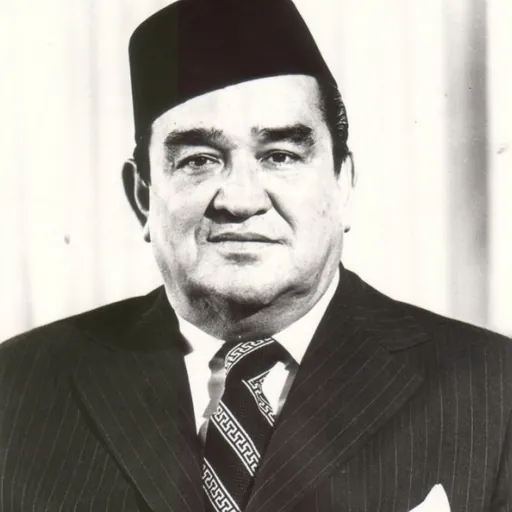
About Fuad Stephens
Lived 1920 – 1976 (aged 55). Fuad Stephens was a Malaysian politician.
Muhammad Fuad Stephens (né Donald Aloysius Marmaduke Stephens, born 14 September 1920 – 6 June 1976) was a Malaysian politician who served as the 1st and 5th Chief Minister of Sabah from September 1963 to December 1964 and again briefly from April 1976 to his death in June 1976, 3rd Yang di-Pertua Negara of Sabah from September 1973 to July 1975, and 6th High Commissioner of Malaysia to Australia from 1968 to 1973. In addition, he also served as the 1st Huguan Siou or Paramount Leader of the Kadazandusun community. He played a role in bringing Sabah into the Federation of Malaysia in 1963. While he was initially against the idea of Sabah joining in the Federation, given British concerns about the stability of the region and their move to relinquish all their colonies in the post WWII era, he was gradually convinced to work towards it. He held the chief minister's post from 16 September 1963 until 31 December 1964 when he was forced to resign; and again in 1976 for 54 days from 15 April.
During his second term as Chief Minister, he died in a controversial accident on 6 June 1976 dubbed the Double Six Crash, in Kota Kinabalu, the state capital of Sabah. He was a passenger in an Australian made Nomad aircraft which crashed and killed everyone on board, including his son Johari. His body was buried at the State Mausoleum near the Sabah State Mosque, Kota Kinabalu.
Early life Stephens was born on 14 September 1920 in Kudat. His father, Jules Stephen Pavitt (later known as Jules Pavitt Stephens, Snr.), was of mixed parentage, half-Kadazan and half-British. Jules was born and brought up in North Borneo in the district of Papar. Jules' father, Ernest Alfred Pavitt was born in Akaroa, New Zealand but had ancestral roots in Colchester, Essex, England, United Kingdom. When Ernest Alfred Pavitt left North Borneo to live in New Zealand, Jules dropped the name Pavitt and made his surname Stephens. Fuad Stephens' mother, Edith Cope, was of mixed Japanese, British and Dusun ancestry from Kinabatangan, Sandakan. Stephens had five siblings; two younger sisters and three younger brothers. Two of them, John and Martin, died in infancy. A third, Leo Benedict was born in 1926 and later became the President of the Dewan Negara from 1985 to 1988 amongst other accomplishments. His sisters were Esther (born in 1928) and Agnes (born in 1930).
Political career alt=A man reading from a large piece of paper in front of an arch saying "MERDEKA MALAYSIA" Donald Stephens founded the political party United National Kadazan Organisation (UNKO) in August 1961. He played a key role in negotiating the independence of Sabah and the formation of Malaysia, together with Tun Mustapha of United Sabah National Organisation (USNO), Lee Kuan Yew of Singapore and Tunku Abdul Rahman, the then Prime Minister of Malaya. The formation of Malaysia was finally achieved on 16 September 1963, which is today known as Malaysia Day. He became Sabah's first Chief Minister as UNKO together with USNO and Sabah Chinese Association (SCA) formed the Sabah Alliance coalition to rule the new Government of Sabah.
In 1964, Donald Stephens stepped down as Chief Minister to become the first Malaysian federal cabinet member from Sabah. He was replaced by Peter Lo Sui Yin of SCA. Stephens became the minister in charge of Sabah affairs under the Prime Minister's department.
Stephens saw Malaysia as the federation of four countries - Malaya, Sabah, Sarawak and Singapore - as equal partners, as opposed to the eleven states making up the Federation of Malaya, which had less autonomy.
Following Singapore's exit from Malaysia, Stephens sought a review of Sabah's participation in the federation, although he was not seeking secession. However, this was rejected by the federal government, which feared that such a move would endanger the federation as a whole.
In 1973, Fuad Stephens was appointed as the governor of Sabah, known as the Yang di-Pertua Negara (the post was later downgraded after 1976 to Yang di-Pertua Negeri). He held this position until 1975. Later that same year, Tun Fuad Stephens together with Harris Salleh formed the new political party Sabah People's United Front (BERJAYA). They won the 1976 state election, defeating Tun Mustapha's USNO and becoming the new government of Sabah. Tun Fuad Stephens became Sabah's fifth Chief Minister. Forty-four days later, he died in a plane crash.
Plane crash
On 6 June 1976 ("Double Six"), Tun Fuad Stephens and several cabinet members boarded a flight from Labuan heading towards Kota Kinabalu. About from Kota Kinabalu International Airport, the plane crashed killing everyone on board.
The site of the plane crash is marked by a memorial called Double Six Monument constructed not long after the accident. The site is located in the Sembulan area near the Grace Garden housing complex in Kota Kinabalu across Jalan Coastal Highway from Sutera Harbour resort.
Personal life Stephens converted to Islam on 7 January 1971, together with his wife and five children at Tun Mustapha's residence. Stephens said that he and Mustapha were "blood brothers" when they pricked their fingers in August 1969. He and his family also had close ties with Mustapha's family. Stephens also considered the religion to be a unifying factor in Sabah and also in Malaysia as a whole to bring prosperity and happiness to the country. Stephens adopted the name 'Muhammad Fuad', the latter meaning "heart" in Arabic. Stephens was also encouraged to abandon his surname at the time of his conversion but declined to do so.
Honours Honours of Malaysia
Awards Tun Fuad Stephens was posthumously granted the soubriquet Bapa Malaysia Dari Sabah (Father of Malaysia From Sabah) and Huguan Siou.
Places named after him
Several places were named after him, including: Tun Fuad Stephens Park, a public park in Kota Kinabalu. SMK Tun Fuad Stephens, a secondary school at Kiulu, Tamparuli, Tuaran. SMK Taman Tun Fuad, a secondary school at Kota Kinabalu. Jalan Tun Fuad Stephens, a major highway in the Kota Kinabalu metropolitan area. Jalan Tun Mohd Fuad, a road at Taman Tun Dr Ismail, Kuala Lumpur. SK Tun Fuad, a primary school at Kunak, Tawau Division. Dewan Tun Fuad Stephens, the main community hall of the Penampang district located in Donggongon, Penampang. Maktab Rendah Sains Mara Tun Muhammad Fuad Stephens, a government-owned elite boarding school in Sandakan. Wisma Tun Fuad Stephens, a state government building complex in Kota Kinabalu. Kolej Kediaman Tun Fuad Stephens, one of the student residential areas in University Malaysia Sabah.
Don’t just read it —
keep it.
Full-length biographies made to live with: read them, listen on the way to work, watch them tonight.
- E-book
- Audio
- Video
Instant download · yours to keep · every purchase keeps this site free
Important facts
Family & relationships
People in Fuad Stephens's life
Named in this biography and alive at the same time





Related people
Same field, nearest in time






Contemporaries
People whose lives overlapped Fuad Stephens's




Frequently asked questions
Who was Fuad Stephens?
Malaysian politician
When was Fuad Stephens born?
Fuad Stephens was born on 14 September 1920 in Kudat.
When did Fuad Stephens die?
Fuad Stephens died on 6 June 1976 in Kota Kinabalu.
What was Fuad Stephens's occupation?
Fuad Stephens was a politician.
What nationality was Fuad Stephens?
Fuad Stephens was Malaysian.
Sources & further reading
Cite this page
APA: Biography.guide. (2026). Fuad Stephens. https://biography.guide/fuad-stephens/
MLA: "Fuad Stephens." Biography.guide, https://biography.guide/fuad-stephens/.
Chicago: "Fuad Stephens." Biography.guide. https://biography.guide/fuad-stephens/.
Data last updated: 2026-09-22 · Spot an error? Report a correction.
Portrait: Wikimedia Commons · author & licence
Page generated 2026-09-27 05:02 UTC