
About Fritz Fabritius
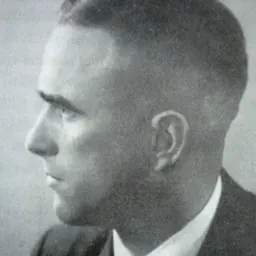
Lived 1883 – 1957 (aged 73–74). Fritz Fabritius was a German politician and farmer.
Fritz Fabritius (27 March 1883 - 20 October 1957) was a Transylvanian-Saxon politician, ethnic group leader, and military officer. He served in numerous ethnic group roles embracing Nazism, including as Chairman of the National-Socialist Party of Romanian Germans (1932-1934), the German Party of Romania (1935-1939), and the Association of German Minorities in Europe.
Fabritius was born in Sibiu, Romania, into a military family. He transferred to active military service in 1903, serving in the Uhlan Regiment No. 7 Galicia until 1907, when he switched to the reserves after achieving the rank of Rittmeister. He joined the military again on the outbreak of World War I. He was later sent on a trip to Germany, returning to Romania "full of enthusiasm" for then-unknown Adolf Hitler. Inspired by this, he founded the building society called Self-Help (Selbsthilfe) in 1922, which advocated for a home nation for Transylvanian Saxons, and which heavily embraced many Nazi Party sentiments. The society closed within a year, and Fabritius re-established it in 1927, where it grew rapidly, under to the influence of youth organisations, became more political. In 1932 it was transformed into the National Socialist Self-help Movement for Germans in Romania (NSDR), which was explicitly pro-Nazi. The organisation was banned multiple times by Ion G. Duca, a fierce opponent of far-right extremism, but still continued.
In 1935, Fabritius was elected Chairman of the German Party of Romania as a moderate, opposing Alfred Bonfert and Waldemar Gust. That year, a split occurred between the radical Nazis, led by Bonfert and Gust, and the moderate Nazis, led by Fabritius and Otto Jickeli. This effectively paralysed the party, as Romanian Germans were heavily divided. The dispute was finally resolved in October 1938 after talks by Edith von Coler, Germany's Special Representative who established Fabritius as chairman and the radical group merged into the party. In December 1938, Fabritius's party joined the Frontul Renașterii Naționale, which was founded by King Carol II. However, Fabritius was cast aside since he had sought autonomy and did not have good relations with the current regime. In February 1939, Fabritius became Chairman of the Association of German Minorities in Europe. Within a few months, he started endorsing a German empire, and Armand Călinescu accused him of forming paramilitary units loyal to him and endorsing the expansion of Germany into Romania. Fabritius was recalled to Germany after nearly being charged with high treason. He returned to Romania a few months later but resigned from his roles. This effectively ended his political career; although he was rehabilitated, he never sought political power again.
Early life Fabritius attended the Theresian Military Academy for secondary school. Fritz Fabritius was born on 27 March 1883 in Sibiu, Transylvania, Austria-Hungary. He was the son of a military sub-intendant and his wife Viktorine , who was part of a patrician family. He was part of the ethnic minority of Transylvanian Saxons in Romania. At the academy, he received the rank of lieutenant on 18 August 1903 and was transferred to the military. He then served in the Uhlan Regiment No. 7 Galicia, and twice in brigade officer schools. After moving to the reserves, he worked at the Hermannstädter Sparkasse, a credit bank, for seven years.
In 1912, Fabritius helped to found the "Transylvanian-Saxon Youth Brigade" in order to revive völkisch life. In August 1914, Fabritius left his job at the credit bank and returned to active duty in a lancers regiment at the start of the First World War, and was transferred to the dragoons, where he was awarded the Militärverdienstmedaille am Bande des Militärverdienstkreuzes two months later.
In 1918, he joined the genealogical association Deutscher Roland, which promoted Völkisch nationalism and anti-semitism. and proposed building a new society.
After his confidant Wolff's death in 1922, Fabritius lost his position at the bank since they only kept him due to his association with Wolff, so he lived off income from a farm until the end of 1922. Returning that year, he founded a building society called Self-Help (Selbsthilfe) in Sibiu. The goal, as explained by distributed leaflets from the society, was to build a home nation that was economically stable, achieve economic freedom and independence for Transylvanian Saxons, and not to become a tributary by providing cheap credit to them. In Autumn 1922, construction of the first housing project began for the society. However, after a few years of absence, Fabritius refounded the self-help society in 1927. The organisation rapidly grew after its refounding, and by 1931 had capital of about 121 million lei. By 1930 the self-help organisation had moved away from a business association for Transylvanian Saxons and became prominently political. This was in part due to the influence of youth organisations that advocated for voluntary labour service and rural service.
Renewal movement (1930-1935) Ion G. Duca, who was a fierce opponent of Nazism, banned the NSDR multiple times. In 1930, he renamed his self-help movement to the renewal movement. "Renewal" to him and many Saxons meant an effort to generate internally the power needed to confront danger from outside sources, and it was a word he commonly repeated to describe his goals.
On 22 May 1932, Fabritius officially founded the National Socialist Self-help Movement for Germans in Romania (Nationalsozialistische Selbsthilfebewegung der Deutschen in Rumänien; NSDR), with a twenty-five-point program oriented towards the Nazi model. Although it experienced a temporary setback of being banned by the government because of its rhetoric on 29 November 1933, the movement continued. Ion G. Duca, the Prime Minister, had previously declared a "revolutionary state" to tackle far-right extremism, citing NSDR's acts of homage to Germany, their influence by Nazis, their marches in uniforms, and vocal disagreement about the German Party's moderate electoral agreements. Just ten days later, however, it was re-formed as the National Movement for Renewal of the Germans in Romania (Nationale Erneuerungsbewegung der Deutschen in Rumänien; NEDR), allowing it to exist until it was banned again in July 1934. Thus, due to his more moderate stances, Fabritius was elected in a general meeting in Bucharest with the support of the deputies of the People's Council of Bukovina, Bessarabia, a majority of the Saxon deputies, and one-third of the Swabian deputies.
Only a few months before Fabritius was elected, the split between the moderates and radicals had gotten worse. Bonfert founded the German People's Party (PPGR) on 10 February 1935, which included most of Fabritius's opponents, leading to disorganisation and a split within the Nazi Romanian Germans. With the quarrel, Romanian German families were divided, children shouted in the streets that either Fabritius or Bonfert should rule, and battles occurred in cities. According to Tudor Georgescu, the "next three years descended into bitter feuding between the movement's moderate and radical wing", paralysing the party. Then on the next day, Coler invited Bonfert, Gust, and Hans Kaufmes, the regional farmer's leader, to the apartment of Artur Konradi, who was regional group leader of the NSDAP's foreign organisation in Romania. Due to this unity, the new organisation met in a massive rally on 6 November 1938 in Timișoara, with an attendance of 10,000, where he announced that the organisation now disavowed autonomy but demanded some concessions from the Romanian government.
Eventually, on 15 December 1938, King of Romania Carol II founded the National Renaissance Front (Frontul Renașterii Naționale; FRN), and Volksgemeinschaft attempted to negotiate entry into the organisation, which was denied by the government, which insisted on individual entry. Fabritius then resisted this, believing it was intended to divide the minority, despite pressure from the government. The group formally joined the FRN on 10 January 1939 alongside receiving state recognition. Fabritius was then recalled to Germany and was replaced by Wolfgang Bruckner and, after a transitional period, Andreas Schmidt, because he did not have good relations with the regime of Carol and the fact that he had sought autonomy as opposed to unity.
Early in July 1939, he gave a speech in Munich calling for a future German empire. This culminated in a report of a meeting on 13 July 1939 with Armand Călinescu, who accused him of forming paramilitary units that took an oath of allegiance to him and endorsing the expansion of Germany into Romania. Perhaps the most incriminating thing that he mentioned was that Fabritius had adopted the unconstitutional title of Landesführer, which was viewed as reminiscent of "head of state". In November 1939, he returned to Romania, where he was criticised for his "spa stay" in Berlin, and then continued to resume his duties. He lived on an estate in Jaszczurowa, which is near Bielsko. After the war, he was sent to the Deggendorf internment camp, but was rehabilitated before a court in Nuremberg. He spent the last few years of his life in the "Transylvanian Home" in Rimsting, where he died.
Personal life While serving in the Uhlan regiment, Fabritius met Hermine Promper in Stockerau. He married Promper in 1907, after he had moved to the reserves.
Don’t just read it —
keep it.
Full-length biographies made to live with: read them, listen on the way to work, watch them tonight.
- E-book
- Audio
- Video
Instant download · yours to keep · every purchase keeps this site free
Important facts
People in Fritz Fabritius's life
Named in this biography and alive at the same time

Related people
Same field, nearest in time




Contemporaries
People whose lives overlapped Fritz Fabritius's



Frequently asked questions
Who was Fritz Fabritius?
German politician (1883-1957)
When was Fritz Fabritius born?
Fritz Fabritius was born on 27 March 1883 in Romania, Sibiu.
When did Fritz Fabritius die?
Fritz Fabritius died in 1957 in Prien am Chiemsee.
What was Fritz Fabritius's occupation?
Fritz Fabritius was a politician and farmer.
What nationality was Fritz Fabritius?
Fritz Fabritius was German.
Sources & further reading
Cite this page
APA: Biography.guide. (2026). Fritz Fabritius. https://biography.guide/fritz-fabritius/
MLA: "Fritz Fabritius." Biography.guide, https://biography.guide/fritz-fabritius/.
Chicago: "Fritz Fabritius." Biography.guide. https://biography.guide/fritz-fabritius/.
Data last updated: 2026-09-20 · Spot an error? Report a correction.
Page generated 2026-09-27 05:03 UTC