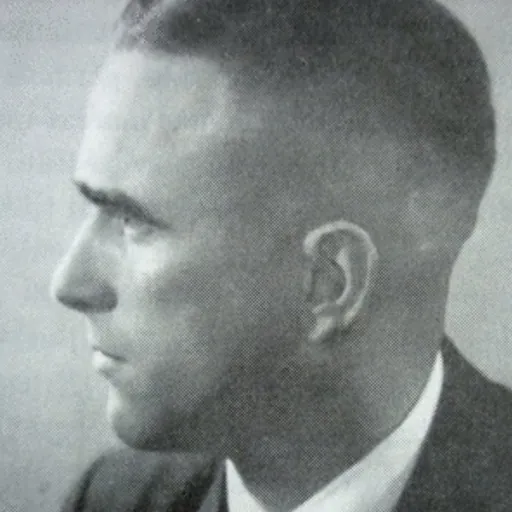
Andreas Schmidt
Transylvanian-Saxon politician, member of the SS and ethnic leader of Germans in Romania
About Andreas Schmidt
Lived 1912 – 1948 (aged 35–36). Andreas Schmidt was a German politician.
Political career Representative of the Volksdeutsche Mittelstelle (VoMI) His father-in-law, Gottlob Berger, for whom he recruited 1,000 German-Romanian SS volunteers. Returning to Romania in 1939, he then became a Representative of the Volksdeutsche Mittelstelle (VoMI), fulfilling various roles.
In this role, he recruited 1,000 Romanian Germans and 500 Hungarian Germans to the SS for his father-in-law, Gottlob Berger. They were encouraged to join in the columns of the Deutsche Zeitung, with the Zeitung publishing war letters from ethnic German SS volunteers that glorified their units. Franz Anton Basch, a Volksgruppenführer, opposed this because he said it would have serious consequences for the Volksbund led by Basch, alongside most of the VoMI even though it was approved by the German government.
In April 1940, he also helped a radical faction that intensely supported Nazi-ideals among the two German ethnic groups in Banat achieve power after a dispute. In August 1940 in accordance with the Second Vienna Award, Transylvania was divided, and Schmidt's territory now fell within the Romanian part.
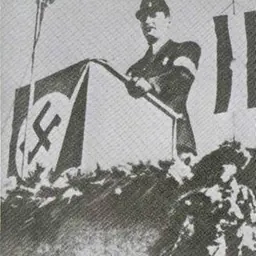
Volksgruppenführer Schmidt saying goodbye alongside Viktor Stürmer to the first 1,300 SS volunteers from Transylvania in 1943.
In September 1940, Schmidt was summoned to Berlin alongside the then ethnic group leader Wolfram Bruckner, where Lorenz stated that due to "wartime circumstances," the German minority needed an "official" person rather than what he deemed was someone who was solely honorary, and indicated that Schmidt would be good for the post. Bruckner immediately opposed this, nominating Nikolaus Hans Hockl to fill his post instead, which Lorenz rejected. Almost immediately after, Schmidt relocated the GEGR's headquarters from Sibiu to Brașov to increase cooperation with Rodde, who had been taken by Joachim von Ribbentrop to monitor GEGR and Schmidt. Among the first actions that Schmidt did was reorganize the leadership structures of the German minority in Romania as part of a Gleichschaltung policy that aligned the minority with the German's models. He also helped reorganize the Jugend to reflect NSDAP youth hierarchies, including the offices of the Landesjugendführer for the national youth program and Landesjungenschaftsführer which used propaganda to appeal to school-age children. The NSDAP of the German Ethnic Group in Romania (GEGR) became the sole representative of ethnic Germans in November, which he was appointed in charge of. Some people he recruited also went to espionage school and returned to Romania as "permissionaries", assigned to intelligence services or at Andr's disposal.
Schmidt soon proved himself as a contact person during the Legionnary Uprising of Iron Guard members, an uprising he called "racially determined" and so he recommended that the influence of the German Reich become stronger in order for there to be tranquility. He also rejected claims that he was hostile towards religious authority amid accusation of Schmidt suppressing religion.
He helped negotiate the 12 May 1943 agreement between the Reich government and the Romanian government where Romanian-Germans were allowed a short-team leave to go volunteer with German troops.
Loss of favor By early 1944 there was a split between Berger and Ernst Kaltenbrunner within the Volksgruppe leadership, which led to Schmidt having to force members of his staff to draw away from Berger because he promoted Berger's interests. This led to dissidents of Berger, Kurt Auner and Matthias Liebhardt launching a smear campaign against Schmidt, and Schmidt threatened to arrest both even though they were protected by Kaltenbrunner. In addition he started to lose favor among Reich leadership because of an internal complaint later that year, as he was described as having excessive ambition by his coworkers, playing off individual Reich authorities against each other, sexual harassment, and making repeated statements against Kaltenbrunner. This led to authorities in the Reich recommending he be terminated from his office, although he was given the chance of rehabilitation during Operation Regulus. In June 1944 when many Swabians returned home from the front, they openly protested against the GEGR, stating they had been misled and lied to us when volunteering and blamed Schmidt.
The Reich government also received conflicting reports on intelligence from GEGR, Abwehr, and SD, as Schmidt tended to downplay unrest within the German minority which led to Schmidt not being seen as a reliable informant. By mid-1944, the RSHA's Militärisches Amt stated that Schmidt lacked control over the German minority and its affairs, and the SD started to sideline him as they doubted his competence. They were all published by Krafft & Drotleff in Sibiu.
Coup d'état and resistance On 23 August 1944 the Romanian coup d'état occurred where Ion Antonescu was overthrown, and on 12 September an armistice was signed with the Soviets.
After the coup, Schmidt played an important role in a mission titled "". This was ordered by the Reich in order to rehabilitate Schmidt, because of his reaction to Kaltenbrunner and for "abandoning" the ethnic group at a critical moment. His adversaries also accused him of deliberately ignoring the possibility of a German defeat, yet making arrangements for the evacuation of the ethnic German population in Transylvania, and because he left Romania on 21 August 1944 for Berlin and Vienna, which led to others to accuse him of fleeing to the Reich in anticipation of the coup. On 10 November 1944 Schmidt left Transylvania together with the legionary commander Stoicănescu and Iron Guard member Codreanu. His plane, however, crashed in southern Hungary but he went by foot 170 km to the Fagaras Mountains, where he stayed into February 1945, although he continued to frequent Brașov, Sibiu, and Bucharest. Due to this, Schmidt advocated for his dismissal, especially after in July 1938 the Nazi-aligned members of the church had gained a majority over the church's superior consistory. Glondys was eventually forced out of the post of bishop in September 1940. As a replacement to Glondys, Schmidt eventually nominated Nazi-aligned pastor Wilhelm Staedel, referring to him as his comrade. Schmidt had orchestrated the installation by overriding church law, due to the fact that Staedel had previously been disqualified on disciplinary action, usurping the church's autonomy. Glondys was eventually replaced with Staedel as bishop on 19 July 1941, with Staedel receiving 60 of the 105 votes.
Staedel soon proved to be controversial in the church for distancing himself from the Old Testament, which eventually led to a debate where it was agreed that the Old Testament to be disregarded, which Schmidt approved. This process was finalized in 1943. Heinrich Himmler was his best man. They were both involved in a serious car crash in 1942, which led to her having serious injuries, but she gave birth a few months later to a son named Heidrun and died on 11 November 1942 from tuberculosis. Kaufmes was born in 1924 as the daughter of a regional farm leader named Hans Kaufmes. A rumor, however, then spread the next day that Schmidt had died of typhus, which was rampant in the camp. Later reports said he was free and living in Moscow around 1951 as an advisor to the Soviets, but this is more than likely legend, and another version said he died in 1952 in a concentration camp in the Donbass from tuberculosis.
Don’t just read it —
keep it.
Full-length biographies made to live with: read them, listen on the way to work, watch them tonight.
- E-book
- Audio
- Video
Instant download · yours to keep · every purchase keeps this site free
Important facts
People in Andreas Schmidt's life
Named in this biography and alive at the same time


Related people
Same field, nearest in time






Contemporaries
People whose lives overlapped Andreas Schmidt's




Frequently asked questions
Who was Andreas Schmidt?
Transylvanian-Saxon politician, member of the SS and ethnic leader of Germans in Romania (1912-1948)
When was Andreas Schmidt born?
Andreas Schmidt was born on 24 May 1912 in Mănărade.
When did Andreas Schmidt die?
Andreas Schmidt died in 1948 in Vorkuta.
What was Andreas Schmidt's occupation?
Andreas Schmidt was a politician.
What nationality was Andreas Schmidt?
Andreas Schmidt was German.
Sources & further reading
· DBpedia: Andreas Schmidt (politician)
Cite this page
APA: Biography.guide. (2026). Andreas Schmidt. https://biography.guide/andreas-schmidt-politician/
MLA: "Andreas Schmidt." Biography.guide, https://biography.guide/andreas-schmidt-politician/.
Chicago: "Andreas Schmidt." Biography.guide. https://biography.guide/andreas-schmidt-politician/.
Data last updated: 2026-09-23 · Spot an error? Report a correction.
Portrait: Wikimedia Commons · author & licence
Page generated 2026-09-27 05:06 UTC