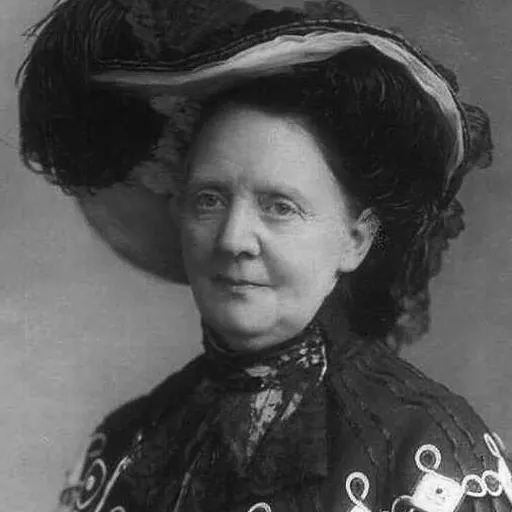
About Fredrikke Marie Qvam
Lived 1843 – 1938 (aged 95). Fredrikke Marie Qvam was a Norwegian politician.
Fredrikke Marie Qvam (née Gram) (31 May 184310 September 1938) was a Norwegian humanitarian leader, feminist, liberal politician and the wife of Prime Minister Ole Anton Qvam. She was the founder of the Norwegian Women's Public Health Association that grew to become Norway's largest women's organisation with 250,000 members, and served as its first President from 1896 to 1933, and as its Honorary President from 1933 until her death. She also served as president of the Norwegian Association for Women's Rights from 1899 to 1903. She was widely regarded as one of the most influential and successful political lobbyists of her time, and was described in the journal Samtiden in 1915 as the "Queen of the corridors." She was addressed as "Madam Cabinet Minister" and later as "Madam Prime Minister" , using her husband's titles.
Early life and marriage
Qvam was born Fredrikke Marie Gram in Trondheim to merchant David Andreas Gram and Louise Augusta Gram (née Bing). In 1849, the family moved to the manor Helge-By-Rein in Steinkjer. The family was socially well connected and culturally involved and among their guests were Bjørnstjerne Bjørnson, Ole Bull, Aasmund Olavsson Vinje and Peter Chr. Asbjørnsen.
Fredrikke Marie Gran met her husband, Ole Anton Qvam, in 1857 when he was tutoring her. He was born in 1831 to a family of farmers in Molde, had taken examen artium and worked as a teacher in private home. They became secretly engaged in 1858 and married in 1865 after Ole Anton Qvam had finished law studies in Kristiania in 1862. In 1873, the couple bought the Gjævran farm and moved there. They had five children, of which two died in childhood and two while they were young. Three of the children died of tuberculosis, in 1878, 1889, and 1893 respectively. She later stated that the sorrow she felt when experiencing her children die of ill health was one of the things that motivated her to found the Norwegian Women's Public Health Association.
In 1896, Qvam was among the founders of the Norwegian Women's Public Health Association and became its leader. The organization's stated purpose at the start was to provide medical supplies for use both in war and accidents during peacetime, to educate women in first aid, to educate nurses, and to fight common diseases like tuberculosis and rheumatism. The background was to a large degree the tense situation between Sweden and Norway as a result of increasing Norwegian demands for independence from Sweden. In addition to focusing on health issues and social policies, the organization also became a meeting point for women concerned about voting rights for women and Norwegian independence from Sweden.
Qvam belonged to the minority in the Women Voting Rights Association that did not want to compromise about full voting rights as a human right. In 1898, they broke away from the mother association and formed the Countrywide Women Rights Association where Qvam became leader. When women obtained a limited right to vote in municipal elections in 1901, the Countrywide Women Rights Association challenged women to get involved in party work and they recruited candidates to political parties, mainly to the Liberal Party.
In 1902–1903, Qvam lived in Stockholm where Ole Anton Qvam had been appointed Norwegian Prime Minister in Stockholm.
The success of gathering female signatures in support of the dissolution of the union earned women respect and was seen by many as a sign that women were politically mature enough to vote. It contributed to a process that led to full voting rights for women in 1913. After this, Qvam and the Countrywide Women Voting Rights Association focused on projects that should stimulate women to use their voting rights and participate in political activities. A motto frequently used by Qvam was "A right to vote is a duty to vote". A statue of her has been erected in Steinkjer. An award in her name, Fredrikkeprisen, is awarded yearly by the Norwegian Women's Public Health Association. Fredrikke Qvams gate, a street in central Oslo, was named after her in 1951.
In connection with the 100th anniversary of universal female suffrage in Norway in 2013, Qvam was voted the second most important woman in Norway in the last hundred years (following Gro Harlem Brundtland).
Awards King's Medal of Merit in gold (1911) Knight, First Class of Order of St. Olav (1915)
Don’t just read it —
keep it.
Full-length biographies made to live with: read them, listen on the way to work, watch them tonight.
- E-book
- Audio
- Video
Instant download · yours to keep · every purchase keeps this site free
Important facts
Family & relationships
People in Fredrikke Marie Qvam's life
Named in this biography and alive at the same time


Related people
Same field, nearest in time





Contemporaries
People whose lives overlapped Fredrikke Marie Qvam's

Frequently asked questions
Who was Fredrikke Marie Qvam?
Norwegian women's rights activist (1843–1938)
When was Fredrikke Marie Qvam born?
Fredrikke Marie Qvam was born on 31 May 1843 in Trondheim.
When did Fredrikke Marie Qvam die?
Fredrikke Marie Qvam died on 10 September 1938 in Steinkjer Municipality.
What was Fredrikke Marie Qvam's occupation?
Fredrikke Marie Qvam was a politician.
What nationality was Fredrikke Marie Qvam?
Fredrikke Marie Qvam was Norwegian.
Sources & further reading
· Wikipedia: Fredrikke Marie Qvam
· DBpedia: Fredrikke Marie Qvam
Cite this page
APA: Biography.guide. (2026). Fredrikke Marie Qvam. https://biography.guide/fredrikke-marie-qvam/
MLA: "Fredrikke Marie Qvam." Biography.guide, https://biography.guide/fredrikke-marie-qvam/.
Chicago: "Fredrikke Marie Qvam." Biography.guide. https://biography.guide/fredrikke-marie-qvam/.
Data last updated: 2026-09-21 · Spot an error? Report a correction.
Portrait: Wikimedia Commons · author & licence
Page generated 2026-09-27 04:59 UTC