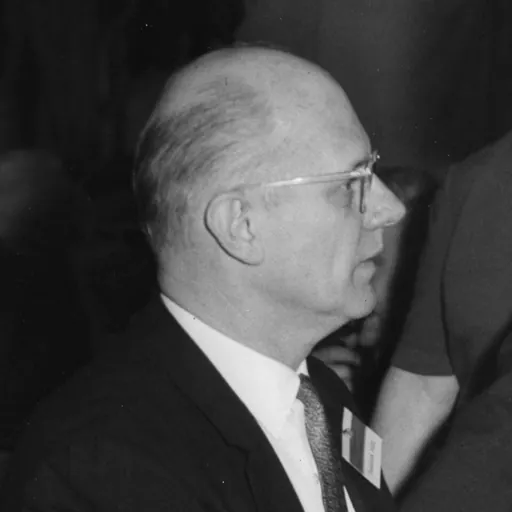
About Frederick Seitz
Lived 1911 – 2008 (aged 96). Frederick Seitz was an American physicist and university teacher.
Frederick Seitz (July 4, 1911 – March 2, 2008) was an American physicist, a pioneer of solid state physics, and climate change denier. Seitz was the 4th president of Rockefeller University from 1968 to 1978, and the 17th president of the National Academy of Sciences from 1962 to 1969. Seitz was the recipient of the National Medal of Science, NASA's Distinguished Public Service Award, and other honors.
He founded the Frederick Seitz Materials Research Laboratory at the University of Illinois at Urbana–Champaign and several other material research laboratories across the United States. Seitz was also the founding chairman of the George C. Marshall Institute.
Background and personal life Seitz was born in San Francisco on July 4, 1911. His mother was also from San Francisco and his father, after whom he was named, was born in Germany. Seitz graduated from Lick-Wilmerding High School in the middle of his senior year, and went on to study physics at Stanford University obtaining his bachelor's degree in three years,
Seitz died March 2, 2008, in New York. He was survived by a son, three grandchildren, and four great-grandchildren. He and Wigner pioneered one of the first quantum theories of crystals, and developed concepts in solid-state physics such as the Wigner–Seitz unit cell As NAS president he initiated the Universities Research Association, which contracted with the Atomic Energy Commission to construct the world's largest particle accelerator at the time, Fermilab. Among other things, he investigated the possible use of non-toxic silicon carbide as a white pigment. Seitz was a director of Texas Instruments (1971–1982) and of Akzona Corporation (1973–1982). until 1988. Seitz later wrote that "The money was all spent on basic science, medical science," and pointed to Reynolds-funded research on mad cow disease and tuberculosis. "played a key role... in helping the tobacco industry produce uncertainty concerning the health impacts of smoking." According to a tobacco industry memo from 1989, Seitz was described by an employee of Philip Morris International as "quite elderly and not sufficiently rational to offer advice."
In 1984 Seitz was the founding chairman of the George C. Marshall Institute, and was its chairman until 2001. The Institute was founded to argue for President Reagan's Strategic Defense Initiative, but "in the 1990s it branched out to become one of the leading think tanks trying to debunk the science of climate change." A 1990 report co-authored with Institute co-founders Robert Jastrow and William Nierenberg "centrally informed the Bush administration's position on human-induced climate change". The Institute also promoted environmental skepticism more generally. In 1994, the Institute published a paper by Seitz titled Global warming and ozone hole controversies: A challenge to scientific judgment. Seitz questioned the view that CFCs "are the greatest threat to the ozone layer". In the same paper, commenting on the dangers of secondary inhalation of tobacco smoke, he concluded "there is no good scientific evidence that passive inhalation is truly dangerous under normal circumstances."
Seitz was a central figure amongst global warming deniers. He was the highest-ranking scientist among a band of doubters who, beginning in the early 1990s, resolutely disputed suggestions that global warming was serious threat. In 2001 Seitz and Jastrow questioned whether global warming is anthropogenic.
Seitz signed the 1995 Leipzig Declaration and, in an open letter inviting scientists to sign the Oregon Institute of Science and Medicine's global warming petition, called for the United States to reject the Kyoto Protocol. even including a date of publication ("October 26") and volume number ("Vol. 13: 149–164 1999"), but was not actually a publication of the National Academy of Science (NAS). In response the United States National Academy of Sciences took what the New York Times called "the extraordinary step of refuting the position of one [of] its former presidents." The NAS also made it clear that "The petition does not reflect the conclusions of expert reports of the Academy." The latter, begun in 1955, with David Turnbull, reached 60 volumes by 2008, with Seitz remaining an active editor until volume 38 in 1984. After his retirement he co-authored a book on global warming, published via the George C. Marshall Institute he chaired. He published his autobiography in 1994. Other works included biographies of American physicist Francis Wheeler Loomis (1991) and Canadian inventor Reginald Fessenden (1999), a history of silicon, and a history of the US National Academy of Sciences (2007).
Criticism
In the early 1970s, Seitz became unpopular for his support of the Vietnam war, a position which most of his colleagues on the President's Science Advisory Committee did not share. In the late 1970s, Seitz also parted company with his scientific colleagues on questions of nuclear preparedness. Seitz was committed to "a muscular military strengthened by the most technologically advanced weaponry", while the scientific community generally supported arms limitations talks and treaties. Seitz was also ardently anti-communist and his support for aggressive weapons programs was a reflection of this.
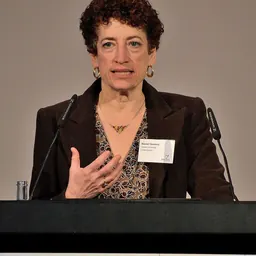
In their book Merchants of Doubt, science historians Naomi Oreskes and Erik M. Conway state that Seitz and a group of other scientists fought the scientific evidence and spread confusion on many of the most important issues of the 20th and 21st centuries like harmfulness of tobacco smoke, acid rain, CFCs, pesticides and global warming. Seitz said that American science had become "rigid", and his colleagues had become closed-minded and dogmatic. According to Oreskes and Conway, Seitz used normal uncertainties of scientific evidence to spread doubt about the harmfulness of tobacco smoke. Journalists subsequently found that the identities of the vast majority of signatories could not be verified, because the petition's organizers had no process for identity authentication. Further, the supposed scientific article that claimed to refute global warming (and which accompanied the petition) was in fact a non-peer reviewed article from the "Journal of the American Association of Physicians and Surgeons", which was published by Arthur Robinson, the petition's co-organizer. This journal advocates scientifically discredited viewpoints such as claiming that there is no connection between the HIV virus and AIDS, and is not indexed in PubMed.
Oreskes and Conway were critical of Seitz's involvement in the tobacco industry. They stated that Seitz stood against the scientific consensus that smoking was dangerous to people's health, and helped to create confusion and doubt on this issue.
Awards and recognition Seitz was elected to the American Philosophical Society in 1946. He was elected to the United States National Academy of Sciences in 1952, serving as its President from 1962 to 1969. He received the Franklin Medal (1965). In 1973 he was awarded the National Medal of Science "for his contributions to the modern quantum theory of the solid state of matter." He was also a member of the Council on Foreign Relations. He was also a board member of the Center for Strategic and International Studies.
Positions held Academic Carnegie Tech, head of the physics department (1946–?) University of Illinois, professor of physics (1949–1964)
Private sector George C. Marshall Institute, co-founder, chairman (1984–2001) chairman (since 1998) Science and Environmental Policy Project, chair (?–?) Advancement of Sound Science Center, member of advisory board
Books Frederick Seitz, A matrix-algebraic development of the crystallographic groups, Princeton University, 1934 Frederick Seitz, The modern theory of solids, McGraw-Hill, 1940 Frederick Seitz, The physics of metals, McGraw-Hill, 1943 Robert Jastrow, William Aaron Nierenberg, Frederick Seitz, Global warming: what does the science tell us?, George C. Marshall Institute, 1990 Robert Jastrow, William Aaron Nierenberg, Frederick Seitz, Scientific perspectives on the greenhouse problem, Marshall Press, 1990 Frederick Seitz, Francis Wheeler Loomis: August 4, 1889 – February 9, 1976, National Academy Press, 1991
Nikolaus Riehl and Frederick Seitz, Stalin's Captive: Nikolaus Riehl and the Soviet Race for the Bomb (American Chemical Society and the Chemical Heritage Foundations, 1996) . This book is a translation of Nikolaus Riehl's book Zehn Jahre im goldenen Käfig (Ten Years in a Golden Cage) (Riederer-Verlag, 1988); but Seitz wrote a lengthy introduction. It contains 58 photographs . Frederick Seitz and Norman G. Einspruch, Electronic genie: the tangled history of silicon, University of Illinois Press, 1998. Frederick Seitz, The science matrix: the journey, travails, triumphs, Springer, 1998. Frederick Seitz, The cosmic inventor Reginald Aubrey Fessenden (1866–1932), American Philosophical Society, 1999 Henry Ehrenreich, Frederick Seitz, David Turnbull, Frans Spaepen, Solid state physics, Academic Press, 2006 Frederick Seitz, A selection of highlights from the history of the National Academy of Sciences, 1863–2005, University Press of America, 2007.
Don’t just read it —
keep it.
Full-length biographies made to live with: read them, listen on the way to work, watch them tonight.
- E-book
- Audio
- Video
Instant download · yours to keep · every purchase keeps this site free
Important facts
People in Frederick Seitz's life
Named in this biography and alive at the same time




Related people
Same field, nearest in time

Contemporaries
People whose lives overlapped Frederick Seitz's





Frequently asked questions
Who was Frederick Seitz?
American physicist (1911–2008)
When was Frederick Seitz born?
Frederick Seitz was born on 4 July 1911 in San Francisco.
When did Frederick Seitz die?
Frederick Seitz died on 2 March 2008 in New York City.
What was Frederick Seitz's occupation?
Frederick Seitz was a physicist and university teacher.
What nationality was Frederick Seitz?
Frederick Seitz was American.
Sources & further reading
Cite this page
APA: Biography.guide. (2026). Frederick Seitz. https://biography.guide/frederick-seitz/
MLA: "Frederick Seitz." Biography.guide, https://biography.guide/frederick-seitz/.
Chicago: "Frederick Seitz." Biography.guide. https://biography.guide/frederick-seitz/.
Data last updated: 2026-09-21 · Spot an error? Report a correction.
Portrait: Wikimedia Commons · author & licence
Page generated 2026-09-27 05:00 UTC