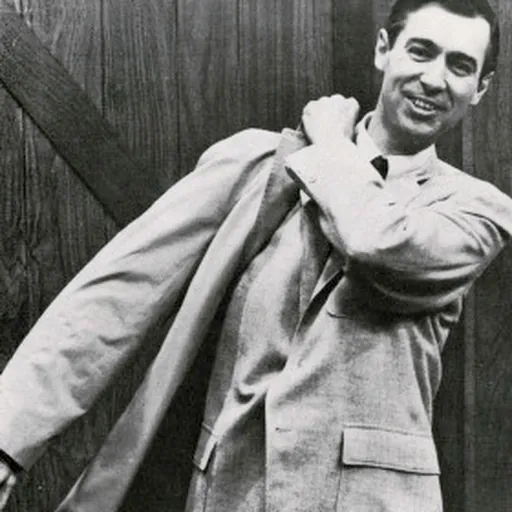
About Fred Rogers
Lived 1928 – 2003 (aged 74). Fred Rogers was an American christian minister, marionetteist, singer, author, composer and educator.
Fred McFeely Rogers (March 20, 1928 – February 27, 2003), known professionally as Mister Rogers, was an American television personality, Presbyterian minister, and author. He was the creator, showrunner, and host of the preschool television series Mister Rogers' Neighborhood, which ran from 1968 to 2001.
Born in Latrobe, Pennsylvania, Rogers earned a bachelor's degree in music from Rollins College in 1951. He began his television career at NBC in New York City, returning to Pittsburgh in 1953 to work for children's programming at NET (later PBS) television station WQED. He graduated from Pittsburgh Theological Seminary with a bachelor's degree in divinity in 1962 and became a Presbyterian minister in 1963. He attended the University of Pittsburgh's Graduate School of Child Development, where he began his thirty-year collaboration with child psychologist Margaret McFarland. He also helped develop the children's shows The Children's Corner (1955) for WQED in Pittsburgh and Misterogers (1963) in Canada for the Canadian Broadcasting Corporation. In 1968, he returned to Pittsburgh and adapted the format of his Canadian series to create Mister Rogers' Neighborhood. It ran for 33 years and was critically acclaimed for focusing on children's emotional and physical concerns, such as death, sibling rivalry, school enrollment, and divorce.
Rogers died of stomach cancer in 2003, aged 74. His work in children's television has been widely lauded, and he received more than forty honorary degrees and several awards, including a Lifetime Achievement Emmy in 1997 and the Presidential Medal of Freedom in 2002. He was inducted into the Television Hall of Fame in 1999. Rogers influenced many writers and producers of children's television shows, and his broadcasts provided comfort during incidents, even after his death.
Early life Fred Rogers was born in 1928, at 705 Main Street in Latrobe, Pennsylvania. His father, James Hillis Rogers, was "a very successful businessman" who was president of the McFeely Brick Company, one of Latrobe's most prominent businesses and founded in 1900. His mother, Nancy (née McFeely), knitted sweaters for American soldiers from western Pennsylvania who were fighting in Europe and regularly volunteered at the Latrobe Hospital. Initially dreaming of becoming a doctor, she settled for a life of hospital volunteer work. Her father, Fred Brooks McFeely, after whom Rogers was named, was an entrepreneur.
Rogers grew up in a large three-story brick house at 737 Weldon Street in Latrobe. He had a sister, Elaine, whom the Rogerses adopted when he was eleven years old.
Rogers had a difficult childhood. Shy, introverted, and overweight, he was frequently homebound after suffering bouts of asthma. According to Morgan Neville, director of the 2018 documentary Won't You Be My Neighbor?, Rogers had a "lonely childhood... I think he made friends with himself as much as he could. He had a ventriloquist dummy, he had [stuffed] animals, and he would create his own worlds in his childhood bedroom". "It was tough for me at the beginning," Rogers told NPR's Terry Gross in 1984, "and then I made a couple friends who found out that the core of me was okay. And one of them was... the head of the football team". Rogers became president of the student council, a member of the National Honor Society, and editor-in-chief of the school yearbook. however, his status was changed to unqualified for military service following an Armed Forces physical on October 12, 1950.
He then attended Pittsburgh Theological Seminary, from which he graduated magna cum laude in 1962 with a Bachelor of Divinity, and was ordained a Presbyterian minister by the Pittsburgh Presbytery of the United Presbyterian Church in 1963. His work as an ordained minister, rather than pastoring a church, was ministering to children and their families through television. He regularly appeared before church officials to maintain his ordination.
Career Early work Rogers wanted to enter seminary after college, but instead chose to go into the nascent medium of television after experiencing TV at his parents' home in 1951, during his senior year at Rollins College. In a CNN interview, he said, "I went into television because I hated it so, and I thought there's some way of using this fabulous instrument to nurture those who would watch and listen". After graduating in 1951, he worked at NBC in New York City as floor director of Your Hit Parade, The Kate Smith Hour, and Gabby Hayes's children's show, and as an assistant producer of The Voice of Firestone.
Josie Carey and Rogers filming an Attic scene in The Children's Corner. Over Carey's shoulder is Daniel S. (Striped) Tiger, and to the right of Rogers is King Friday XIII. In 1953, Rogers returned to Pittsburgh to work as a program developer at public television station WQED. Josie Carey worked with him to develop the children's show The Children's Corner, which Carey hosted. Rogers worked off-camera to develop puppets, characters, and music for the show. He used many puppet characters developed during this time, such as Daniel the Striped Tiger (named after WQED's station manager, Dorothy Daniel, who gave Rogers a tiger puppet before the show's premiere), King Friday XIII, Queen Sara Saturday (named after Rogers' wife), X the Owl, Henrietta, and Lady Elaine, in his later work. Children's television entertainer Ernie Coombs was an assistant puppeteer. While working on the show, Rogers attended Pittsburgh Theological Seminary and was ordained a Presbyterian minister in 1963. He also attended the University of Pittsburgh's Graduate School of Child Development, where he began working with child psychologist Margaret McFarland—who, according to Rogers' biographer Maxwell King, became his "key advisor and collaborator" and "child-education guru". Much of Rogers' "thinking about and appreciation for children was shaped and informed" by McFarland. It was the first time Rogers appeared on camera. CBC's children's programming head Fred Rainsberry insisted on it, telling Rogers, "Fred, I've seen you talk with kids. Let's put you yourself on the air". Coombs joined Rogers in Toronto as an assistant puppeteer. On Rogers' recommendation, Coombs remained in Toronto and became Rogers' Canadian equivalent of an iconic television personality, creating the children's program Mr. Dressup, which ran from 1967 to 1996. Rogers' work for CBC "helped shape and develop the concept and style of his later program for the Public Broadcasting Service (PBS) in the U.S."
Mister Rogers' Neighborhood
Mister Rogers' Neighborhood (also called the Neighborhood), a half-hour educational children's program starring Rogers, began airing nationally in 1968 and ran for 895 episodes. It was videotaped at WQED in Pittsburgh and broadcast by National Educational Television (NET), which later became the Public Broadcasting Service (PBS). Its first season had 180 black-and-white episodes. Each subsequent season, filmed in color and funded by PBS, the Sears-Roebuck Foundation, and other charities, consisted of 65 episodes. By the time it ended production in December 2000, its average rating was about 0.7% of television households or 680,000 homes, and it aired on 384 PBS stations. At its peak in 1985–1986, its ratings were 2.1%, or 1.8 million homes. The last original episode aired in 2001, but PBS continued to air reruns, and by 2016 it was the third-longest-running program in PBS history.
Many of the sets and props in Mister Rogers' Neighborhood, like the trolley, the sneakers, and the castle, were created for Rogers' show in Toronto by CBC designers and producers. The program also "incorporated most of the highly imaginative elements that later became famous", such as its slow pace and its host's quiet manner. The format of Mister Rogers' Neighborhood "remained virtually unchanged" for the entire run of the program. Every episode begins with a camera's-eye view of a model of a neighborhood, then panning in closer to a representation of a house while a piano instrumental of the theme song, "Won't You be My Neighbor?", performed by music director Johnny Costa and inspired by a Beethoven sonata, is played. The camera zooms in to a model representing Mr. Rogers' house, then cuts to the house's interior and pans across the room to the front door, which Rogers opens as he sings the theme song to greet his visitors while changing his suit jacket to a cardigan (knitted by his mother, Nancy) and his dress shoes to sneakers, "complete with a shoe tossed from one hand to another". The episode's theme is introduced, and Mr. Rogers leaves his home to visit another location, the camera panning back to the neighborhood model and zooming in to the new location as he enters it. Once this segment ends, Mr. Rogers leaves and returns to his home, indicating that it is time to visit the Neighborhood of Make-Believe. Mr. Rogers proceeds to the window seat by the trolley track and sets up the action there as the Trolley comes out. The camera follows it down a tunnel in the back wall of the house as it enters the Neighborhood of Make-Believe. The stories and lessons take place over a week's worth of episodes and involve puppets and human characters. The end of the visit occurs when the Trolley returns to the same tunnel from which it emerged, reappearing in Mr. Rogers' home. He then talks to the viewers before concluding the episode. He often feeds his fish, cleans up any props he has used, and returns to the front room, where he sings the closing song while changing back into his dress shoes and jacket. He exits the front door as he ends the song, and the camera zooms out of his home and pans across the neighborhood model as the episode ends.
Mister Rogers' Neighborhood emphasized young children's social and emotional needs, and unlike another PBS show, Sesame Street, which premiered in 1969, did not focus on cognitive learning. Writer Kathy Merlock Jackson said, "While both shows target the same preschool audience and prepare children for kindergarten, Sesame Street concentrates on school-readiness skills while Mister Rogers Neighborhood focuses on the child's developing psyche and feelings and sense of moral and ethical reasoning". The Neighborhood also spent fewer resources on research than Sesame Street, but Rogers used early childhood education concepts taught by his mentor Margaret McFarland, Benjamin Spock, Erik Erikson, and T. Berry Brazelton in his lessons. As The Washington Post noted, Rogers taught young children about civility, tolerance, sharing, and self-worth "in a reassuring tone and leisurely cadence". He tackled difficult topics such as the death of a family pet, sibling rivalry, the addition of a newborn into a family, moving and enrolling in a new school, and divorce.
According to King, the process of putting each episode of Mister Rogers' Neighborhood together was "painstaking" and Rogers' contribution to the program was "astounding". Rogers wrote and edited all the episodes, played the piano and sang for most of the songs, wrote 200 songs and 13 operas, created all the characters (both puppet and human), played most of the significant puppet roles, hosted every episode, and produced and approved every detail of the program. The puppets created for the Neighborhood of Make-Believe "included an extraordinary variety of personalities". They were simple puppets but "complex, complicated, and utterly honest beings". In 1971, Rogers formed Family Communications, Inc. (FCI, now Fred Rogers Productions), to produce the Neighborhood, other programs, and non-broadcast materials.
In 1975, Rogers stopped producing Mr. Rogers' Neighborhood to focus on adult programming. Reruns of the Neighborhood continued to air on PBS. King reports that the decision caught many of his coworkers and supporters "off guard". Rogers continued to confer with McFarland about child development and early childhood education, however. In 1979, after an almost five-year hiatus, Rogers returned to producing the Neighborhood; King calls the new version "stronger and more sophisticated than ever". King writes that by the program's second run in the 1980s, it was "such a cultural touchstone that it had inspired numerous parodies",
Other work and appearances
Rogers testified before the Senate Subcommittee on Communications, chaired by John Pastore, on May 1, 1969. As part of his testimony, he recites the lyrics to "What Do You Do with the Mad that You Feel?" In 1969, Rogers testified before the U.S. Senate Subcommittee on Communications, which was chaired by Democratic Senator John Pastore of Rhode Island. U.S. President Lyndon Johnson had proposed a $20 million bill for the creation of PBS before he left office, but his successor, Richard Nixon, wanted to cut the funding to $10 million. Even though Rogers was not yet nationally known, he was chosen to testify because of his ability to make persuasive arguments and to connect emotionally with his audience. The clip of Rogers' testimony, which was televised and has since been viewed by millions of people on the internet, helped to secure funding for PBS for many years afterward. According to King, Rogers' testimony was "considered one of the most powerful pieces of testimony ever offered before Congress, and one of the most powerful pieces of video presentation ever filmed". It brought Pastore to tears and, according to King, has been studied by public relations experts and academics.
In 1978, while on hiatus from Mister Rogers' Neighborhood, Rogers wrote, produced, and hosted a 30-minute interview program for adults on PBS called Old Friends... New Friends. It lasted 20 episodes. Rogers' guests included Hoagy Carmichael, Helen Hayes, Milton Berle, Lorin Hollander, poet Robert Frost's daughter Lesley, and Willie Stargell.
In September 1987, Rogers visited Moscow to appear as the first guest on the long-running Soviet children's TV show Good Night, Little Ones! with host Tatyana Vedeneyeva. The appearance was broadcast in the Soviet Union on December 7, coinciding with the Washington Summit meeting between Soviet leader Mikhail Gorbachev and U.S. President Ronald Reagan in Washington, D.C. Vedeneyeva visited the set of Mister Rogers' Neighborhood in November, the occasion taped and later aired in March 1988 as part of Rogers' program. In 1994, Rogers wrote, produced, and hosted a special for PBS called Fred Rogers' Heroes, which featured interviews and portraits of four people from across the country who were having a positive impact on children and education. The first time Rogers appeared on television as an actor, and not as himself, was in a 1996 episode of Dr. Quinn, Medicine Woman, playing a preacher. Though reluctant to appear on television talk shows, he would usually "charm the host with his quick wit and ability to ad-lib on a moment's notice". Rogers was "one of the country's most sought-after commencement speakers", and King reported that Rogers was at his least guarded during his speeches, which were about children, television, education, his view of the world, how to make the world a better place, and his quest for self-knowledge. His tone was quiet and informal but "commanded attention".
Personal life
Rogers met Sara Joanne Byrd (called "Joanne") from Jacksonville, Florida, while attending Rollins College. They were married from 1952 until he died in 2003. They had two sons, James and John. Joanne was an accomplished pianist, who, like Fred, earned a Bachelor of Music from Rollins, and went on to earn a Master of Music from Florida State University. She performed publicly with her college classmate Jeannine Morrison from 1976 to 2008. According to biographer Maxwell King, Rogers' close associates said he was "absolutely faithful to his marriage vows".
Rogers was red-green color-blind. He became a pescetarian in 1970, after the death of his father, and a vegetarian in the early 1980s, saying he "couldn't eat anything that had a mother". He became a co-owner of Vegetarian Times in the mid-1980s, He told Vegetarian Times that he became a vegetarian for both ethical and health reasons.
Rogers was a Presbyterian, and many of the messages he expressed in Mister Rogers' Neighborhood were inspired by the core tenets of Christianity. Rogers rarely spoke about his faith on air; he believed that teaching through example was as powerful as preaching. He said, "You don't need to speak overtly about religion in order to get a message across". According to writer Shea Tuttle, Rogers considered his faith a fundamental part of his personality and "called the space between the viewer and the television set 'holy ground'". He also studied Catholic mysticism, Judaism, Buddhism, and other faiths and cultures. King called him "that unique television star with a real spiritual life", King reported that Rogers' relationship with his young audience was important to him. For example, since hosting Misterogers in Canada, he answered every letter sent to him by hand. After Mister Rogers' Neighborhood began airing in the United States, the letters increased in volume, and he hired staff member and producer Hedda Sharapan to answer them, but he read, edited, and signed each one. King wrote that Rogers saw responding to his viewers' letters as "a pastoral duty of sorts".
The New York Times called Rogers "a dedicated lap-swimmer", and Tom Junod, author of "Can You Say... Hero?", the 1998 Esquire profile of Rogers, said, "Nearly every morning of his life, Mister Rogers has gone swimming". Rogers began swimming when he was a child at his family's vacation home outside Latrobe, where they owned a pool, and during their winter trips to Florida. King wrote that swimming and playing the piano were "lifelong passions" and that "both gave him a chance to feel capable and in charge of his destiny", and that swimming became "an important part of the strong sense of self-discipline he cultivated". Rogers swam daily at the Pittsburgh Athletic Association, after waking every morning between 4:30 and 5:30 A.M. to pray and to "read the Bible and prepare himself for the day". He did not smoke or drink.
Sexuality According to biographer Michael Long in a 2014 HuffPost essay, Rogers' sexuality had long been a topic of curiosity due to his lack of traditional machismo. The 2018 documentary Won't You Be My Neighbor? featured an interview with François Clemmons, the gay actor who played Officer Clemmons on Mister Rogers' Neighborhood, in which he denied that Rogers was gay or that he had ever gotten a "gay vibe" from him. This excerpt resurfaced in 2019 and led many social media users to celebrate him as bisexual, though there is no record of him identifying as such during his lifetime. By the summer of 2002, his chronic stomach pain became severe enough for him to see a doctor about it, and in October 2002, he was diagnosed with stomach cancer. He delayed treatment until after he served as Grand Marshal of the 2003 Rose Parade, with Art Linkletter and Bill Cosby, in January. On January 6, Rogers underwent stomach surgery. He died less than two months later at his Pittsburgh home on February 27, 2003, at the age of 74, with his wife of 50 years, Joanne, at his side. While comatose shortly before his death, he received the last rites of the Catholic Church from Archabbot Nowicki.
The following day, the Pittsburgh Post-Gazette covered Rogers' death on the front page and dedicated an entire section to his death and impact. Rogers' death was widely lamented. Most American metropolitan newspapers ran his obituary on their front page and some dedicated entire sections to coverage of his death. On March 4, the U.S. House of Representatives unanimously passed a resolution honoring Rogers sponsored by Representative Mike Doyle from Pennsylvania.
On March 1, 2003, a private funeral was held for Rogers in Unity Chapel, which was restored by Rogers' father, at Unity Cemetery in his hometown of Latrobe. About 80 relatives, co-workers, and close friends attended the service, which "was planned in great secrecy so that those closest to him could grieve in private". Reverend John McCall, pastor of the Rogers family's church, Sixth Presbyterian Church in Squirrel Hill, gave the homily; Reverend William Barker, a retired Presbyterian minister who was a "close friend of Mr. Rogers and the voice of Mr. Platypus on his show", Jeff Erlanger, who at age 10 appeared on Mister Rogers' Neighborhood in 1981 to explain his electric wheelchair, also spoke. The memorial was broadcast several times on Pittsburgh television stations and websites throughout the day. Legacy
Marc Brown, creator of another PBS children's show, Arthur, and also a Western Pennsylvania native, considered Rogers both a friend and "a terrific role model for how to use television and the media to be helpful to kids and families". Josh Selig, creator of Wonder Pets, credits Rogers with influencing his use of structure and predictability, and his use of music, opera, and originality.
Rogers inspired Angela Santomero, co-creator of the children's television show Blue's Clues, to earn a degree in developmental psychology and go into educational television. In 2006, three years after Rogers' death and the end of production of Blue's Clues, the Fred Rogers Company contacted Santomero to create a show that would promote Rogers' legacy. In 2012, Daniel Tiger's Neighborhood, with characters from and based upon Mister Rogers' Neighborhood, premiered on PBS.
Rogers' style and approach to children's television and early childhood education also "begged to be parodied". Comedian Eddie Murphy parodied Mister Rogers' Neighborhood on Saturday Night Live during the 1980s.
Video of Rogers' 1969 testimony in defense of public programming has experienced a resurgence since 2012, going viral at least twice. It first resurfaced after then presidential candidate Mitt Romney suggested cutting funding for PBS. In 2017, video of the testimony again went viral after U.S. President Donald Trump proposed defunding several arts-related government programs including PBS and the National Endowment for the Arts.
A roadside Pennsylvania Historical Marker dedicated to Rogers to be installed in Latrobe was approved by the Pennsylvania Historical and Museum Commission on March 4, 2014. It was installed on June 11, 2016, with the title "Fred McFeely Rogers (1928–2003)".
Won't You Be My Neighbor? director Morgan Neville's 2018 documentary about Rogers' life, grossed over $22 million and became the top-grossing biographical documentary ever produced, the highest-grossing documentary in five years, and the twelfth-largest-grossing documentary ever made. The 2019 drama film A Beautiful Day in the Neighborhood tells the story of Rogers and his television series, with Rogers' distant relative Tom Hanks portraying him.
According to Caitlin Gibson of The Washington Post, Rogers became a source for parenting advice; she called him "a timeless oracle against a backdrop of ever-shifting parenting philosophies and cultural trends". Robert Thompson of Syracuse University noted that Rogers "took American childhood—and I think Americans in general—through some very turbulent and trying times", Burns has said Rogers' words of comfort "began circulating on social media" 1975 Ralph Lowell Award Given by the Corporation for Public Broadcasting in recognition of "outstanding contributions and achievements to public television". 1977 Myrtle Wreath Award Awarded for "outstanding contributions to the community" 1977 Other's Award Given at the 13th Annual Civic Luncheon of the Salvation Army Association of Greater Pittsburgh. Awarded for humanitarianism. 1978 Distinguished Alumnus Award Given by Pittsburgh Theological Seminary. 1978 1977-78 Lay Leader Award Given by the Three Rivers Chapter, University of Pittsburgh, Phi Delta Kappa fraternity 1978 Gabriel awardee Given by the Catholic Broadcasting Association 1981 Distinguished Communications Recognition Award Awarded at the 12th national Abe Lincoln Awards banquet for his work in children's television. 1982 Media Arts Award Given as part of the third annual Governor's Day Awards in the Arts. 1986 CINE Golden Eagle Award Awarded for Rogers' educational special for children "Let's Talk About Going to the Doctor." 1987 CINE Golden Eagle Award Awarded for Rogers' educational special for children "Mister Rogers Talks With Children About Saying Goodbye to Friends." 1988 Immaculata Medal Given by Immaculata College. It is the college's highest honor. 1989 1989 Man of the Year Named by the Vectors/Pittsburgh. 1990 Gold Medal for Distinguished Achievement Given by The Pennsylvania Society, which recognizes Pennsylvanians who made significant contributions to the Commonwealth. The Society donated $25,000 to the McFarland Fund of the Pittsburgh Foundation (named after Margaret McFarland) in Rogers' honor. 1991 Pittsburgh Penguins Celebrity Captain Part of the National Hockey League (NHL)'s 75th anniversary. Rogers was one of 12 celebrity captains to be selected for the 1992 Pro Set Platinum collection. 1991 Rollins College Walk of Fame Honored by Rollins College. 1992 Peabody Award Awarded "in recognition of 25 years of beautiful days in the neighborhood". 1994 President's Distinguished Service Medal Given by Colgate Rochester Divinity School. Rogers spoke at the commencement of the school's Bexley–Hall–Crozer Theological Seminary on the date of receipt. The award is the school's equivalent of an honorary degree. 1995 National Patron, Delta Omicron Awarded by the international professional music fraternity to musicians who have attained "a national reputation in his or her field". 1995 Joseph F. Mulach Jr. Award Presented by the Vocational Rehabilitation Center board of directors in Pittsburgh. The award is given to a person who made major improvements to the quality of life of the disabled. 1997 Lifetime Achievement Emmy Awarded "for giving generation upon generation of children confidence in themselves, for being their friend, for telling them again and again and again that they are special and that they have worth." 1998 Hollywood Walk of Fame star Located at 6600 Hollywood Boulevard 1999 Television Hall of Fame inductee Jeff Erlanger appeared as a surprise guest during the ceremony. 1999 Pennsylvania Founder's Award The award was created in 1997 to recognize a Pennsylvanian who has made major contributions to their state. Governor Tom Ridge presented the award. 2000 Presidential Medal of Honor Presented by St. Vincent College. Rogers was a guest speaker for the college's 154th commencement on the date of receipt. 2001 Fred Rogers Award Presented by the Corporation for Public Broadcasting. Rogers was the first recipient of this award. 2002 Elsie Award Awarded for community service. 2002 Presidential Medal of Freedom The highest American civilian honor; awarded by President George W. Bush. 2002 Common Wealth Award Given by PNC Financial Services, "celebrating the best of human achievement". 2003 International Astronomical Union asteroid designation Asteroid 26858 Misterrogers named in Rogers' honor, discovered by Eleanor Helin in 1993. 2006 Television Hall of Fame inductee Awarded by the Online Film & Television Association. In 2010, Mister Rogers' Neighborhood was inducted into the Hall of Fame. 2008 "Sweater Day" Tribute to Rogers on what would have been his 80th birthday (March 20) by FCI. People worldwide were encouraged to wear a sweater honoring Rogers' legacy and the final event in a six-day celebration in Pittsburgh. 2015 "Sweater drive" Rogers honored by the Altoona Curve, a Double-A affiliate of the Pittsburgh Pirates. The team wore commemorative jerseys that featured a printed facsimile of Rogers' cardigan and tie ensemble, which were then auctioned off, with the proceeds going to the local PBS station, WPSU-TV. 2018, 2026 First-class/Forever postage stamp issued by the U.S. Postal Service Dedicated on March 23, 2018 at WQED. Was re-released in 2026 as part of the Post Office Stamp Encore contest 2018 Google Doodle In honor of the 51st anniversary of the premiere of Mister Rogers' Neighborhood (September 21). Created in collaboration with Fred Rogers Productions, The Fred Rogers Center, and BixPix Entertainment. 2019 Unforgettable Nonfiction Subject of 2018 Awarded by Cinema Eye Honors for being a "notable and significant nonfiction film subject" in Won't You Be My Neighbor? 2021 Grammy Award Awarded posthumously by The Recording Academy for Best Historical Album for It's Such a Good Feeling: The Best of Mister Rogers. Fred Rogers and Michael Graves, mastering engineers; Lee Lodyga and Cheryl Pawelski, compilation producers. Rogers being presented the Presidential Medal of Freedom by President George W. Bush in the East Room of the White House on July 9, 2002 Museum exhibits Hand-made sweater worn by Rogers, on display in the Smithsonian Institution's Museum of American History. Fred Rogers' mother, Nancy Rogers, knitted all the sweaters he wore on the program. Smithsonian Institution permanent collection. In 1984, Rogers donated one of his sweaters to the Smithsonian. Children's Museum of Pittsburgh. Exhibit created by Rogers and FCI in 1998. It attracted hundreds of thousands of visitors over ten years. It included, from Mister Rogers' Neighborhood, one of his sweaters, a pair of his sneakers, original puppets from the program, and photographs of Rogers. The exhibit traveled to children's museums throughout the country for eight years until it was given to the Louisiana Children's Museum in New Orleans as a permanent exhibit to help them recover from Hurricane Katrina in 2005. In 2007, the Children's Museum of Pittsburgh created a traveling exhibit based on the factory tours featured in episodes of Mister Rogers' Neighborhood. Heinz History Center permanent collection (2018). In honor of the 50th anniversary of Mister Rogers' Neighborhood and what would have been Rogers' 90th birthday. Exhibits include the iconic King Friday's blue castle, the Owl's tree and a tricycle ridden by courier Mr. McFeely. Louisiana Children's Museum. The museum contains an exhibit of Mister Rogers' Neighborhood, which debuted in 2007. The Children's Museum of Pittsburgh donated the exhibit.
Art pieces Several pieces of art are dedicated to Rogers throughout Pittsburgh, including an tall, bronze statue of him in the North Shore neighborhood. In the Oakland neighborhood, his portrait is included in the Martin Luther King Jr. and "Interpretations of Oakland" murals. A dinosaur statue titled "Fredasaurus Rex Friday XIII" originally stood in front of the WQED building and, as of 2014, stood in front of the building containing the Fred Rogers Company offices. There is a "Mister Rogers' Neighborhood of Make-Believe" in Idlewild Park and a kiosk of Mister Rogers' Neighborhood artifacts at Pittsburgh International Airport. The Carnegie Science Center's Miniature Railroad and Village debuted a miniature recreation of Rogers' house from Mister Rogers' Neighborhood in 2005. In Rogers' hometown of Latrobe, a statue of Rogers on a bench is situated in James H. Rogers Park, named for Rogers' father. In 2021, A Beautiful Day in the Neighborhood—a tall, bronze statue by Paul Day—was dedicated at Rollins College. The memorial depicts Rogers and Daniel S. Tiger speaking with a group of children and features lyrics from Mister Rogers' Neighborhood's theme on the base.
Honorary degrees
Rogers has received honorary degrees from over 43 colleges and universities. After 1973, two commemorative quilts, created by two of Rogers' friends and archived at the Fred Rogers Center at St. Vincent College in Latrobe, were made out of the academic hoods he received during various graduation ceremonies.
Note: Much of the below list is taken from "Honorary Degrees Awarded to Fred Rogers", Carnegie Mellon University, 1976 Lafayette College, 1977 Waynesburg College, 1978 Linfield College, 1982 Slippery Rock State College, 1982 Duquesne University, 1982 Washington & Jefferson College, 1984 University of South Carolina, 1985 Hobart and William Smith Colleges, 1985 Drury College, 1986 MacMurray College, 1986 Bowling Green State University, 1987 Westminster College (Pennsylvania), 1987 University of Indianapolis, 1988 University of Connecticut, 1991 Boston University, 1992 Indiana University of Pennsylvania, 1992 Moravian College, 1992 Goucher College, 1993 University of Pittsburgh, 1993 West Virginia University, 1995 North Carolina State University, 1996 Edinboro University of Pennsylvania, 1998 Marist College, 1999 Westminster Choir College, 1999 Old Dominion University, 2000 Marquette University, 2001 Middlebury College, 2001 Dartmouth College, 2002 Union College, 2003 (posthumous) Roanoke College, 2003 (posthumous) 1963–1966 Misterogers 1978–1980 Old Friends... New Friends|- 1981 Sesame Street 1988 Good Night, Little Ones! 1991 Where in the World Is Carmen Sandiego?|- 1994 Mr. Dressup's 25th Anniversary 1994 Fred Rogers' Heroes 1996 Dr. Quinn, Medicine Woman 1997 Arthur 1998 Wheel of Fortune 2003 114th Annual Tournament of Roses Parade
Published works Children's books Our Small World (with Josie Carey, illustrated by Norb Nathanson), 1954, Reed and Witting, The Elves, the Shoemaker, & the Shoemaker's Wife (illustrated by Richard Hefter), 1973, Small World Enterprises, The Matter of the Mittens, 1973, Small World Enterprises, Speedy Delivery (illustrated by Richard Hefter), 1973, Hubbard, Henrietta Meets Someone New (illustrated by Jason Art Studios), 1974, Golden Press, Mister Rogers Talks About, 1974, Platt & Munk, Time to Be Friends, 1974, Hallmark Cards, Everyone is Special (illustrated by Jason Art Studios), 1975, Western Publishing, Tell Me, Mister Rogers, 1975, Platt & Munk, The Costume Party (illustrated by Jason Art Studios), 1976, Golden Press, Planet Purple (illustrated by Dennis Hockerman), 1986, Texas Instruments, If We Were All the Same (illustrated by Pat Sustendal), 1987, Random House, A Trolley Visit to Make-Believe (illustrated by Pat Sustendal), 1987, Random House, Wishes Don't Make Things Come True (illustrated Pat Sustendal), 1987, Random House, No One Can Ever Take Your Place (illustrated by Pat Sustendal), 1988, Random House, When Monsters Seem Real (illustrated by Pat Sustendal), 1988, Random House, You Can Never Go Down the Drain (illustrated by Pat Sustendal), 1988, Random House, The Giving Box (illustrated by Jennifer Herbert), 2000, Running Press, Good Weather or Not (with Hedda Bluestone Sharapan, illustrated by James Mellet), 2005, Family Communications, Josephine the Short Neck-Giraffe, 2006, Family Communications, A Beautiful Day in the Neighborhood: The Poetry of Mister Rogers Neighborhood (illustrated by Luke Flowers), 2009, Quirk Books, First Experiences series illustrated by Jim Judkis Going to Day Care, 1985, Putnam, The New Baby, 1985, Putnam, Going to the Potty, 1986, Putnam, Going to the Doctor, 1986, Putnam, Making Friends, 1987, Putnam, Moving, 1987, Putnam, Going to the Hospital, 1988, Putnam, When a Pet Dies, 1988, Putnam, Going on an Airplane, 1989, Putnam, Going to the Dentist, 1989, Putnam, Let's Talk About It series Going to the Hospital , 1977, Family Communications, Having an Operation , 1977, Family Communications, So Many Things To See! , 1977, Family Communications, Wearing a Cast , 1977, Family Communications, Adoption, 1993, Putnam, Divorce, 1994, Putnam, Extraordinary Friends, 2000, Putnam, Stepfamilies, 2001, Putnam,
Songbooks Tomorrow on the Children's Corner (with Josie Carey, illustrated by Mal Wittman), 1960, Vernon Music Corporation, Mister Rogers' Songbook (with Johnny Costa, illustrated by Steven Kellogg), 1970, Random House,
Books for adults Mister Rogers Talks to Parents , 1983, Family Communications, Mister Rogers' Playbook (with Barry Head, illustrated by Jamie Adams), 1986, Berkley Books, Mister Rogers Talks with Families About Divorce (with Clare O'Brien), 1987, Berkley Books, Mister Rogers' How Families Grow (with Barry Head and Jim Prokell), 1988, Berkley Books, You Are Special: Words of Wisdom from America's Most Beloved Neighbor, 1994, Penguin Books, Dear Mister Rogers, 1996, Penguin Books, Mister Rogers' Playtime, 2001, Running Press, The Mister Rogers Parenting Book, 2002, Running Press, You are special: Neighborly Wisdom from Mister Rogers, 2002, Running Press, The World According to Mister Rogers, 2003, Hyperion Books, Life's Journeys According to Mister Rogers, 2005, Hyperion Books, The Mister Rogers Parenting Resource Book, 2005, Courage Books, Many Ways to Say I Love You: Wisdom For Parents And Children, 2019, Hachette Books,
Discography Around the Children's Corner (with Josey Carey), 1958, Vernon Music Corporation, Tomorrow on the Children's Corner (with Josie Carey), 1959 King Friday XIII Celebrates, 1964 Won't You Be My Neighbor?, 1967 Let's Be Together Today, 1968 Growing, 1992 It's Such a Good Feeling: The Best of Mister Rogers, 2019, Omnivore Recordings, posthumous release
Don’t just read it —
keep it.
Full-length biographies made to live with: read them, listen on the way to work, watch them tonight.
- E-book
- Audio
- Video
Instant download · yours to keep · every purchase keeps this site free
Important facts
People in Fred Rogers's life
Named in this biography and alive at the same time




Related people
Same field, nearest in time



Contemporaries
People whose lives overlapped Fred Rogers's


Frequently asked questions
Who was Fred Rogers?
American television personality (1928–2003)
When was Fred Rogers born?
Fred Rogers was born on 20 March 1928 in Latrobe.
When did Fred Rogers die?
Fred Rogers died on 27 February 2003 in Pittsburgh.
What was Fred Rogers's occupation?
Fred Rogers was a christian minister, marionetteist, singer, author, composer and educator.
What nationality was Fred Rogers?
Fred Rogers was American.
Sources & further reading
Cite this page
APA: Biography.guide. (2026). Fred Rogers. https://biography.guide/fred-rogers-christian-minister/
MLA: "Fred Rogers." Biography.guide, https://biography.guide/fred-rogers-christian-minister/.
Chicago: "Fred Rogers." Biography.guide. https://biography.guide/fred-rogers-christian-minister/.
Data last updated: 2026-09-22 · Spot an error? Report a correction.
Portrait: Wikimedia Commons · author & licence
Page generated 2026-09-27 05:01 UTC