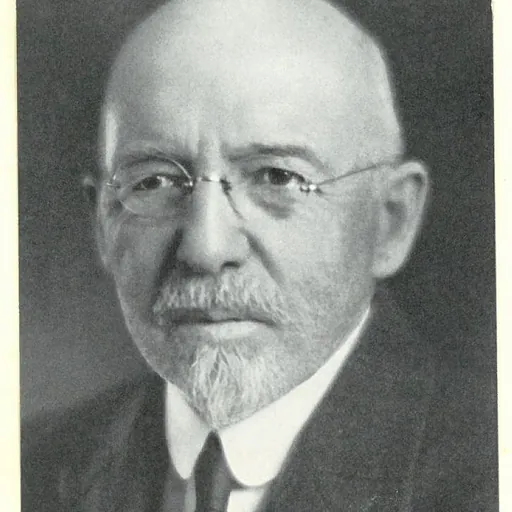
About Fred Newton Scott
Lived 1860 – 1931 (aged 70). Fred Newton Scott was a writer.
Fred Newton Scott (1860–1931) was an American writer, educator and rhetorician. Scott received his A.B., A.M, and Ph.D from the University of Michigan. In the preface to The New Composition Rhetoric, Newton Scott states “that composition is…a social act, and the student [should] therefore constantly [be] led to think of himself as writing or speaking for a specified audience. Thus not mere expression but communication as well is made the business of composition.” Fred Newton Scott saw rhetoric as an intellectually challenging subject. He looked to English departments to balance work in rhetoric and linguistics in addition to literary study.
Questions facing 19th-century rhetoricians Rhetoric in the 1890s was full of vigorous experimentation in rhetorical theory and practice. The Harvard Reports of 1892, 1895, and 1897 generated much public interest and concern about the teaching of writing. At this time, composition was shifting away from an emphasis on oratory skills. The 19th-century American University was experiencing a major transformation in its educational purposes. Education was opening up to everyone, including women. Classical rhetoric was being displaced as schools responded to more practical needs, like preparing their students to be excellent employees.
1. How relevant is psychology to composition?
2. How can the change in practical teaching skills caused by a changing social climate best be dealt with?
3. Is teaching grammar really beneficial to the composing process?
4. What is the relationship between rhetoric and literary studies?
5. Should the focus of writing instruction be parts-to-whole or whole-to parts?
John Dewey’s influence
Fred Newton Scott promoted a drive for social efficiency by promoting a democratic rhetoric that responded to the progressive agenda of John Dewey. John Dewey was a highly influential figure in Scott’s life. Dewey believed in a progressive style of education that was a holistic experience. Both men attended the same college and they spent much time discussing and debating the current theory of rhetoric. Scott based most of his work on social rhetoric on the progressive ideals John Dewey advocated. Their close ties are demonstrated by the flattering and highly complimentary biographical pieces each wrote on the other.
Classical Rhetoric
Fred Newton Scott encouraged a Platonic concept of writing. He stressed that writing is a social act that may be used as a method of seeking the truth. Scott also felt it was important that Americans unite under a common ideology.
“The most prominent characteristic of this ideology was engagement with a set of political and civil ideals stemming from the legacy of republicanism: commitment to the public good and the health of the nation; a belief in liberty so that all could be free to participate in public affairs; the creation of community, so that all would share an equal existence among others sharing and participating in the same commitments.” Scott viewed the educational experience as self-development within a democratic environment, and was a method of training young minds to be active participants in a democratic society. In essence, Scott viewed writing as a social act performed through a complex interaction of writer, audience, subject, and language. Due to his concern for social reform and harmony, and for the preparation for economic integration, education should be utilized for the good of all; it should be utilized to prepare citizens for democracy.
Writing should be taught within a complete rhetorical situation, a situation that was thoroughly social without denying the importance of the individual. Scott, in his work “A Substitute,” describes writing as: “essential for building character…moral courage, self-reliance, respect for the truth in every aspect…sympathy for our fellow human beings, and an active desire to help them and co-operate with them, a love of justice and fair play, belief in democratic institutions, [and] loyalty to our republic.”
Scott saw an intrinsic connection between the essay and the survival of the nation, and he argued that mastering the conventions associated with this form would bring with it assimilation of the values that he believed would ensure that survival. In Two Ideals of Composition Instruction, Scott argued that mastering the right sort of English was crucial for the survival of the nation. “Language s the mode by which culture is imparted…and with mastery of the mother tongue [came] the obligation to use this great instrument for the training and instruction of the souls of the citizens.” Scott saw a number of factors threatening this. In his essay English Composition as a Mode of Behavior, Scott probed the causes of the errors occurring in the transmission of values reflected in the language that was necessary for the perpetuation of the culture. Scott determined that there were two main causes for the student errors that came out of the breakup of community during this period: the influence of spoken foreign languages and the breaking up of the family tradition. The three evidences he cites as the breakup of family tradition are: the Sunday newspaper, the telephone, and the automobile. In other words, Scott felt that media that was used for communication broke up the family unit.
Scott also contrasted two different styles of speech and illustrated the distinctions between them. The first he called degraded speech and he compares it to a foreign language or media language. The second is acceptable speech, which represents the family language and is more acceptable in school because it has fewer errors than degraded speech. Scott recommended two solutions to encourage the nation to form common goals and bonds. The first is to give the people and education because with this information they will feel part owner in the system and actively participate. The second is that it will encourage individual achievement and satisfaction and they will continue to focus on their own development.
Works Scott, Fred Newton, and Gertrude Buck. A Brief English Grammar. Chicago: Scott, Foresman, 1905. Scott, Fred Newton, and Joseph Villiers Denney. Composition-Literature. Boston:Allyn and Bacon, 1902. Scott, Fred Newton, and Joseph Villiers Denney. Composition-Rhetoric, Designed For Use in Secondary Schools. Boston: Allyn and Bacon, 1897. Scott, Fred Newton, and Joseph Villiers Denney. “Elementary English Composition”. New ed. Boston: Allyn and Bacon, 1900, 1908. Scott, Fred Newton. "English at the University of Michigan." Dial 17 (1894): 82-84. Scott, Fred Newton. "English Composition as a Mode of Behavior." English Journal 11 (1922): 463-473. Scott, Fred Newton, and Joseph Villiers Denney. “The New Composition-Rhetoric”. Boston: Allyn and Bacon, 1911. Scott, Fred Newton. "Our Problems." English Journal 2 (1913): 1-10. Scott, Fred Newton, and Joseph Villiers Denney. Paragraph-Writing: A Rhetoric for Colleges. New ed. Boston : Allyn and Bacon, 1909. Scott, Fred Newton, ed. and intro. The Philosophy of Style. By Herbert Spencer. 2nd ed. Boston: Allyn and Bacon, 1892. Scott, Fred Newton. The Principles of Style. Ann Arbor, MI: Register Publishing, 1890. Scott, Fred Newton, ed. and intro. The Principles of Success in Literature. By George Henry Lewes. Boston: Allyn and Bacon, 1891. Scott, Fred Newton. References on the Teaching of Rhetoric and Composition. N.P., n.d. Scott, Fred Newton. "The Report on College-Entrance Requirements in English." Educational Review 20 (1900): 289-294. Scott, Fred Newton. "Rhetoric Rediviva." 1909. Rpt. College Composition and Communication 31 (1980): 413-19. Scott, Fred Newton. "The Standard of American Speech." The English Journal 6(January 1917): 1-15. Rpt. A Various Language: Perspectives on American Dialects. Ed. Juanita V. Williamson and Virginia M. Burke. New York: Holt, Rinehart & Winston, 1971. 3-12. Scott, Fred Newton. The Standard of American Speech and Other Papers. Boston: Allyn and Bacon, 1926. Scott, Fred Newton. The Teaching of English in the Elementary and the Secondary School. By George Rice Carpenter. New York: Longmans, Green, 1903. Scott, Fred Newton. "What the West Wants in Preparatory English." School Review 17 (1909): 19. Scott, Fred Newton, and Gertrude Buck. A Brief English Grammar. Chicago: Scott, Foresman, 1905.
Don’t just read it —
keep it.
Full-length biographies made to live with: read them, listen on the way to work, watch them tonight.
- E-book
- Audio
- Video
Instant download · yours to keep · every purchase keeps this site free
Important facts
People in Fred Newton Scott's life
Named in this biography and alive at the same time




Related people
Same field, nearest in time



Contemporaries
People whose lives overlapped Fred Newton Scott's


Frequently asked questions
Who was Fred Newton Scott?
American writer
When was Fred Newton Scott born?
Fred Newton Scott was born on 20 August 1860 in Terre Haute.
When did Fred Newton Scott die?
Fred Newton Scott died on 29 May 1931 in San Diego.
What was Fred Newton Scott's occupation?
Fred Newton Scott was a writer.
Sources & further reading
· Wikipedia: Fred Newton Scott
Cite this page
APA: Biography.guide. (2026). Fred Newton Scott. https://biography.guide/fred-newton-scott/
MLA: "Fred Newton Scott." Biography.guide, https://biography.guide/fred-newton-scott/.
Chicago: "Fred Newton Scott." Biography.guide. https://biography.guide/fred-newton-scott/.
Data last updated: 2026-09-23 · Spot an error? Report a correction.
Portrait: Wikimedia Commons · author & licence
Page generated 2026-09-27 05:08 UTC