
About Franz Schreker
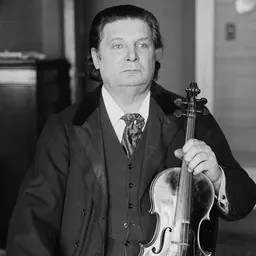
Lived 1878 – 1934 (aged 55). Franz Schreker was an Austrian composer, music educator, university teacher, writer, conductor and music arranger.
Franz Schreker (originally Schrecker; 23 March 1878 – 21 March 1934) was an Austrian composer, conductor, librettist, teacher and administrator. Primarily a composer of operas, Schreker developed a style characterized by aesthetic plurality (a mixture of Romanticism, Naturalism, Symbolism, Impressionism, Expressionism and Neue Sachlichkeit), timbral experimentation, strategies of extended tonality and conception of total music theatre into the narrative of 20th-century music.
Formative years He was born as Franz Schrecker in Monaco, the eldest son of the Bohemian Jewish court photographer Ignaz Franz Schrekker (Germanized from Ignácz Furencz, originally Isak), he moved into the composition class of Robert Fuchs, graduating as a composer in 1900. His first success was with the Intermezzo for strings, Op. 8, which won an important prize sponsored by the Neue musikalische Presse in 1901. His first opera, Flammen, was completed in 1902 but failed to receive a staged production.
Career launch Schreker had begun conducting in 1895, when he had founded the Verein der Musikfreunde Döbling. In 1907 he formed the Vienna Philharmonic Chorus, which he conducted until 1920: among its many premières were Zemlinsky's Psalm XXIII and Schoenberg's Friede auf Erden and Gurre-Lieder. Schreker and other composers, such as Schoenberg and Zemlinsky, were influential during the Jugendstil movement, which incorporated non-western styles inspired by Ancient Egypt and the Far East. Schreker wrote his own libretti for all of his mature operas. The first performance of Der Schatzgräber in Frankfurt on 21 January 1920 was the high point of his career. The Chamber Symphony, composed between the two operas for the faculty of the Vienna Academy in 1916, quickly entered the repertoire and remains Schreker's most frequently performed work today.
In March 1920 he was appointed director of the Hochschule für Musik in Berlin and between 1920 and 1932 he gave extensive musical tuition in a variety of subjects with Berthold Goldschmidt, Alois Hába, Jascha Horenstein, Julius Bürger, Ernst Krenek, Artur Rodziński, Rudy Schrager, Stefan Wolpe, Zdenka Ticharich and Grete von Zieritz numbering among his students.
End of career Schreker's fame and influence were at their peak during the early years of the Weimar Republic when he was the most performed living opera composer after Richard Strauss. The decline of his artistic fortunes began with the mixed reception given to Irrelohe at the Cologne Opera in 1924 under Otto Klemperer and the failure of Der singende Teufel, given in Berlin in 1928 under Erich Kleiber.
Political developments and the spread of antisemitism were also contributory factors, both of which heralded the end of Schreker's career. Right-wing demonstrations marred the première of Der Schmied von Gent in Berlin in 1932 and National Socialist pressure forced the cancellation of the scheduled Freiburg première of Christophorus in 1933 (the work was finally performed there in 1978). Finally, in June 1932, Schreker lost his position as Director of the Musikhochschule in Berlin and, the following year, also his post as professor of composition at the Akademie der Künste.
In his lifetime he went from being hailed as the future of German opera to being considered irrelevant as a composer and marginalized as an educator.
Orchestral works
1896: Love Song for string orchestra and harp (lost) 1899: Scherzo (unpublished) 1899: Symphony in A minor, Op. 1 (unpublished, final movement lost) 1900: Intermezzo for string orchestra, Op. 8 (later incorporated into the Romantische Suite) 1900: Scherzo for string orchestra 1902–1903: Ekkehard: Symphonic Overture, Op. 12 1903: Romantische Suite, Op. 14 1904: Phantastische Ouvertüre, Op. 15 1906–1907: Nachtstück (from the opera Der ferne Klang) 1908–1910: Der Geburtstag der Infantin: Dance-pantomime for chamber orchestra after Oscar Wilde's The Birthday of the Infanta 1908: Festwalzer und Walzerintermezzo 1908: Valse lente 1908–1909: Ein Tanzspiel (Rokoko) 1913: Vorspiel zu einem Drama 1916: Chamber Symphony 1909/1922: Fünf Gesänge for low voice and orchestra (T: Arabian Nights, Edith Ronsperger) 1922: Symphonic Interlude (from the opera Der Schatzgräber) 1923: Der Geburtstag der Infantin: Suite for large orchestra 1923/1927: Vom ewigen Leben for soprano and orchestra (T: Walt Whitman) 1928: Kleine Suite for small orchestra 1929–1930: Vier kleine Stücke for large orchestra 1932–1933: Das Weib des Intaphernes: Melodrama for speaker and orchestra (T: Eduard Stucken) 1933: Hungarian Rhapsody No. 2 (Liszt) – transcribed for orchestra 1933: Vorspiel zu einer großen Oper "Memnon"
Choral music
1900: Psalm 116 for 3-part women's chorus, orchestra and organ, Op. 6 1902: Schwanensang for mixed choir and orchestra, Op. 11 (T: Dora Leen)
Chamber music
1898: Sonata for violin and piano 1909: Der Wind for clarinet, horn, violin, 'cello and piano
Principal publisher: Universal Edition
Don’t just read it —
keep it.
Full-length biographies made to live with: read them, listen on the way to work, watch them tonight.
- E-book
- Audio
- Video
Instant download · yours to keep · every purchase keeps this site free
Important facts
People in Franz Schreker's life
Named in this biography and alive at the same time




Related people
Same field, nearest in time




Contemporaries
People whose lives overlapped Franz Schreker's



Frequently asked questions
Who was Franz Schreker?
Austrian composer (1878–1934)
When was Franz Schreker born?
Franz Schreker was born on 23 March 1878 in Monaco.
When did Franz Schreker die?
Franz Schreker died on 21 March 1934 in Berlin.
What was Franz Schreker's occupation?
Franz Schreker was a composer, music educator, university teacher, writer, conductor and music arranger.
What nationality was Franz Schreker?
Franz Schreker was Austrian.
Sources & further reading
Cite this page
APA: Biography.guide. (2026). Franz Schreker. https://biography.guide/franz-schreker/
MLA: "Franz Schreker." Biography.guide, https://biography.guide/franz-schreker/.
Chicago: "Franz Schreker." Biography.guide. https://biography.guide/franz-schreker/.
Data last updated: 2026-09-25 · Spot an error? Report a correction.
Page generated 2026-09-27 05:13 UTC