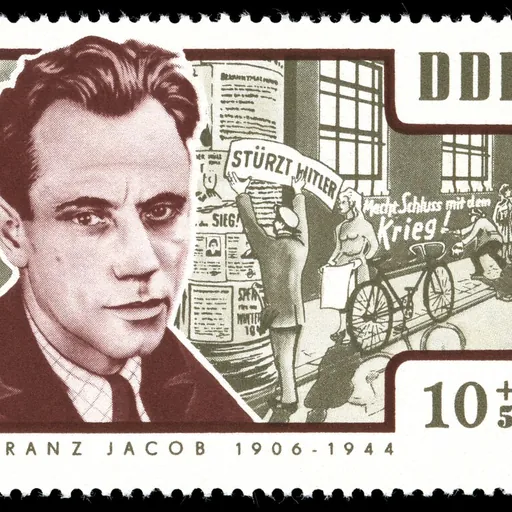
Franz Jacob
German Communist politician and Resistance fighter against Nazism
About Franz Jacob
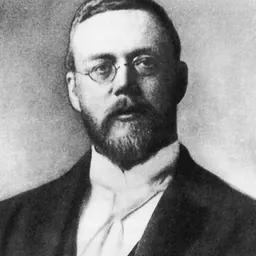
Lived 1906 – 1944 (aged 38). Franz Jacob was a politician, resistance fighter, metalworker and communist.
Franz Jacob (9 August 1906 – 18 September 1944) was an activist and a Communist politician who participated in the German Resistance against the Nazis.
Jacob grew up in a Social Democratic Party family but aged 19 he joined the Communist Party. He worked as a longshoreman during numerous periods of his life, often organising his fellow workers. In 1932 at the age of 26, Jacob became a member of the Hamburg Parliament. In 1933, the Nazis came to power and the Reichstag was burned down, an event that was blamed on the Communists. Hitler pushed through the Reichstag Fire Decree, which withdrew civil liberties and enabled the Nazis to arrest anyone they deemed to be an enemy, and in effect, outlawed all other political parties in Germany. By the end of April 1933, the Nazis had arrested 18,000 Communists and Jacob was forced underground.
Jacob only attended one year of secondary school. He then learned the trade of machine fitting on Hamburg wharfs and joined the metalworkers' union, where he was elected representative of the apprentices.
Career The First World War and the economic situation in Germany prompted Jacob to join the youth branch of the Social Democratic Party of Germany in 1920, at the age of 14. A year later, he joined the SPD.
He also joined the Rote Hilfe and the Rote Frontkämpferbund (RFB). His activity in the Communist Youth group, led to him being elected the organization leader of the waterfront district. In 1928, he joined the KPD itself and was allowed to be a delegate to the 5th International Congress of Communist Youth and the 6th World Congress of the Communist International, both in Moscow. As a result, Jacob lost his job at the Hamburg Telegraph Office. His next job was at Reiherstieg-Werft, but he was fired without notice after calling for a short strike.
Arrest The March 1933 elections saw great gains by the National Socialists to seats of power, both on the state and national level. On 27 February 1933, six days before the election, the Reichstag was burned, an event that was blamed on the Communists. With Nazis in key positions in government, Adolf Hitler was able to push through the Reichstag Fire Decree, which was then signed into law by President Paul von Hindenburg. The decree withdrew civil liberties and enabled the Nazis to arrest anyone they deemed to be an enemy. This became first and foremost a confrontation with the KPD, but in effect, outlawed all political parties in Germany, other than the Nazi Party. The Enabling Act of 27 March 1933 consolidated their power and authority. By the end of April 1933, the Nazis had arrested 18,000 Communists, 12,000 SPD members and others, filling concentration camps. By June 1933, more than half of the KPD's district leaders were in detention and hundreds of Nazi opponents had been killed. Many people went underground, including Jacob.
After a wave of arrests began in Hamburg in October 1942, which included Bästlein and Abshagen, Jacob fled and went to Berlin, where he was again underground. In 1943, he formed another resistance group, this time with Anton Saefkow. Bästlein was able to escape prison during a bombing raid in 1944 and ran into Jacob by chance, after which he joined them in forming the Saefkow-Jacob-Bästlein Organization, They focused on disseminating information that they were able to glean from foreign newspapers and from radio broadcasts from Moscow.
They also organized the Bewegung Freies Deutschland (Free Germany Movement) to work with people in factories, military units, opposition parties and others, growing to several hundred people. In his publication, Am Beginn der letzten Phase des Krieges ("At the beginning of the last phase of the war"), Jacob wrote that to end the war and overthrow the fascist dictator, Communists should concentrate all their strength "on developing a broad, national front composed of all groups that stand opposed to fascism.
Jacob lived underground in Berlin almost two years, moving frequently, some 30 times in 18 months, in the apartment of Dr Rudolf Schmid. Then Jacob and Leber, who had been together at Sachsenhausen and had formed a good trust with one another, met again, separately. According to historian Peter Steinbach, they knew this military resistance was an effort without a broad foundation of support and that the leaders of the SPD and KPD, as well as trade unions, had the contacts to turn it into an act of resistance with support.
An additional meeting was planned for 4 July 1944 to discuss concrete measures. They were denounced by an informer, however, and when Jacob, Saefkow and Reichwein arrived at the appointed place, the Gestapo snared them all. Leber was arrested a few days later. Jacob was sentenced to death by the Volksgerichtshof on 5 September 1944 and was executed on 18 September 1944, at Brandenburg-Görden Prison, along with Saefkow and Bästlein.
Legacy The Lichtenberg suburb of Berlin named a street named after Franz Jacob in 1975. There is also a street in Rostock named for Jacob. There is a commemorative plaque for Franz Jacob at Jarrestraße 21, in Hamburg, where he lived with his wife and family.
Don’t just read it —
keep it.
Full-length biographies made to live with: read them, listen on the way to work, watch them tonight.
- E-book
- Audio
- Video
Instant download · yours to keep · every purchase keeps this site free
Important facts
People in Franz Jacob's life
Named in this biography and alive at the same time



Related people
Same field, nearest in time




Contemporaries
People whose lives overlapped Franz Jacob's


Frequently asked questions
Who was Franz Jacob?
German Communist politician and Resistance fighter against Nazism (1906-1944)
When was Franz Jacob born?
Franz Jacob was born on 9 August 1906 in Hamburg.
When did Franz Jacob die?
Franz Jacob died on 18 September 1944 in Brandenburg.
What was Franz Jacob's occupation?
Franz Jacob was a politician, resistance fighter, metalworker and communist.
What nationality was Franz Jacob?
Franz Jacob's recorded nationality: German Reich.
Sources & further reading
· DBpedia: Franz Jacob (resistance fighter)
Cite this page
APA: Biography.guide. (2026). Franz Jacob. https://biography.guide/franz-jacob/
MLA: "Franz Jacob." Biography.guide, https://biography.guide/franz-jacob/.
Chicago: "Franz Jacob." Biography.guide. https://biography.guide/franz-jacob/.
Data last updated: 2026-09-20 · Spot an error? Report a correction.
Portrait: Wikimedia Commons · author & licence
Page generated 2026-09-27 04:57 UTC