
About Franklin S. Harris
Lived 1884 – 1960 (aged 75). Franklin S. Harris was an American academic and missionary.
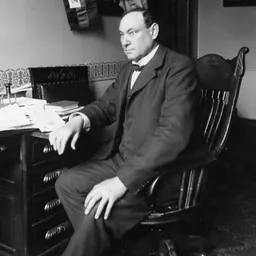
Franklin Stewart Harris (August 29, 1884 – April 18, 1960) was president of Brigham Young University (BYU) from 1921 to 1945, and president of Utah State Agricultural College (USAG) from 1945 to 1950. His administration was the longest in BYU history and saw the granting of the first master's degrees. Under his administration the school became an accredited university. He set up several colleges, such as the College of Fine and Performing Arts, with Gerrit De Jong as the founding dean. Harris was an agricultural scientist, holding a doctorate in agronomy from Cornell University. He had served as the agriculture department head and head of the experiment station at USAC and left BYU to become president of that institution. Harris also traveled to Russia and to Iran and other parts of the Middle East in order to provide expert advice on agriculture issues. The Harris Fine Arts Center on BYU's campus was named after him.
Early life Harris was born in Benjamin, Utah Territory, United States. In the 1890s, his family moved to the Mormon colonies in the Mexican state of Chihuahua. Harris did his early studies at BYU, taking a year to teach at USAC, before going on to receive his doctorate from Cornell.
After Cornell, Harris traveled back to Logan to become a professor of agronomy and an agronomist at USAC. In 1920, Harris was working as director of the USAC Experiment Station and was also head of its department of zoology and Entomology. Although he held these administrative positions at USAC and was already the president of the American Society of Agronomy, Harris accepted the offer of the Board of Trustees of the Church of Jesus Christ of Latter-day Saints (LDS Church) to become BYU's president on April 22, 1921. Harris recognized that the combination of high school students and university students was hurting the scholarship of the college and organized the high school and college into separate buildings. His second year as president, Harris attempted to get BYU accredited with the Northwest Association of Secondary and Higher Schools; BYU became recognized as a four-year college but was not given the status of university. Harris then requested accreditation with the Association of American Universities, "but BYU failed to meet the criteria in student entrance requirements, coursework, faculty credentials, or research funds". In 1928, BYU was finally accepted as a member of the Association of American Universities. The first building constructed on the BYU campus during the administration of Harris was the Heber J. Grant building. Its first purpose was as the university's library. In 1929, Harris traveled to the Soviet Union as chairman of a commission appraising the territory. In July 1929 the commission began searching in Birobidzhan to see if it could agriculturally sustain a large population. Harris spent two months "evaluating the territory for agricultural development." After his twenty-four years as president of BYU, Harris also became known as "Mr. BYU." During BYU's 1998 Homecoming week on Founders Day, October 6, Harris was honored as the "right man." Effects of variations of moisture content on certain properties of soil and on the growth of wheat, 1914 The Principles of Agronomy, 1915 The Young Man and His Vocation, 1916 The Sugar Beet in America, 1918 Soil Alkali, 1920 Scientific Research and Human Welfare, 1924 Heroes of science, 1926 A Book of Mormon bibliography, 1936 A critical study of the apparatus used by Beniams in his study of the emission of positive ions from heated filaments coated with metallic salts, 1936 College values in retrospect, 1953 The farmers of Iran, 1954. Others kept records on metal plates too, 1957
He also wrote articles for scientific journals and contributed bulletins to the Agricultural Experiment Station.
Don’t just read it —
keep it.
Full-length biographies made to live with: read them, listen on the way to work, watch them tonight.
- E-book
- Audio
- Video
Instant download · yours to keep · every purchase keeps this site free
Important facts
Related people
Same field, nearest in time


Contemporaries
People whose lives overlapped Franklin S. Harris's


Frequently asked questions
Who was Franklin S. Harris?
American educator (1884-1960)
When was Franklin S. Harris born?
Franklin S. Harris was born on 29 August 1884 in Benjamin.
When did Franklin S. Harris die?
Franklin S. Harris died on 18 April 1960 in Salt Lake City.
What was Franklin S. Harris's occupation?
Franklin S. Harris was an academic and missionary.
What nationality was Franklin S. Harris?
Franklin S. Harris was American.
Sources & further reading
· Wikipedia: Franklin S. Harris
Cite this page
APA: Biography.guide. (2026). Franklin S. Harris. https://biography.guide/franklin-s-harris/
MLA: "Franklin S. Harris." Biography.guide, https://biography.guide/franklin-s-harris/.
Chicago: "Franklin S. Harris." Biography.guide. https://biography.guide/franklin-s-harris/.
Data last updated: 2026-09-20 · Spot an error? Report a correction.
Page generated 2026-09-27 05:17 UTC