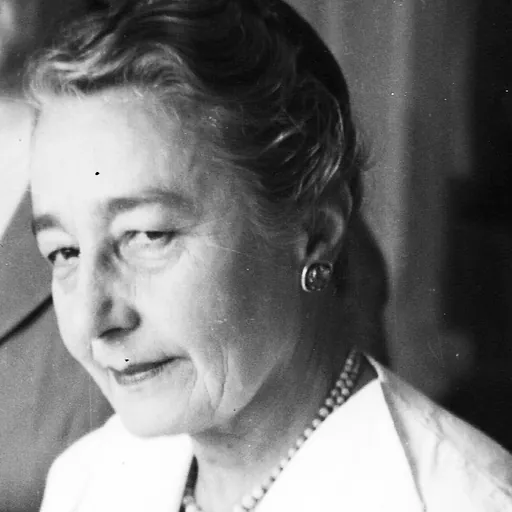
About Hélène Sparrow
Lived 1891 – 1970 (aged 79). Hélène Sparrow was a French, Russian and Polish academic, physician, head of laboratory, microbiologist and university teacher.
Hélène Sparrow (5 June 1891 – 13 November 1970), was a Polish medical doctor and bacteriologist. She helped to control epidemics including: typhoid fever, cholera, dysentery, and smallpox. Throughout the 1920s, Sparrow worked with the Polish Armed Forces at the State Institute of Hygiene in Warsaw. While at the State Institute of Hygiene, she produced the first vaccine against typhus and ran vaccination campaigns to control the spread of diphtheria and scarlet fever along the eastern frontiers of Poland. She was educated at a secondary school in Kiev, gaining a gold medal
Academic career In 1915 she became involved in the control of epidemic disease within the Russian army during the First World War. Once fighting ended, she began working in clinics in Dorpat (now Tartu, Estonia), supervised by Professor Bylina, soon moving to the Institute of Bacteriology in Kiev as an assistant to Wolodymyr Lindeman. She began to work on epidemic typhus with Oleksii Krontovski and L. Polev. In 1920 she went to Warsaw to work with Dr Ludwik Rajchman, the Director of the State Institute of Hygiene. She studied tuberculosis with Albert Calmette and Camille Guérin in Lille, then worked with Jules Bordet in Brussels and also with Amédée Borrel at the Institute of Health in Strasbourg. In 1924 she was again sent to France for training in microbiology at the Pasteur Institute and in the laboratory of Alexandre Besredka. There she met Charles Nicolle during his annual conference on typhus, changing the course of her life.
Sparrow and Nicolle began working together, with their main studies being focused on typhus, specifically the ways in which it spread and how to create a vaccine to limit the contagion. At the beginning of the 20th century, little was known about epidemic typhus. The only known facts about typhus was that it was a dangerous and deadly disease that spread rapidly amongst dense populations, with its principal factors for transmission being dirty clothing and overcrowding. In September 1909, Nicolle made the discovery that lice were the primary vectors for typhus.
In 1931, she was sent by the government, along with Charles Nicolle, to study epidemic typhus in Mexico and Guatemala, where they administered their typhus serum to the public. Rudolf Weigl had developed a technique for a typhus vaccine that involved producing numerous infected lice and then grinding them to create a vaccine paste.
Her transfer of expertise in the laboratory culture of lice was important for progress against typhus at the Pasteur Institute in Tunis. This included development of a vaccine, trials of insecticides and isolation of bacteria that were the causal agents of typhus and typhus-like fevers. Sparrow became a French national in 1933. Gide also recounts how Sparrow narrowly escaped death during bombing raids. On 1 January 1943, while she was in the building, a bomb fell on the ground-floor apartment where Sparrow lodged with the Boutelleau family, but it did not explode. Five days later, on 6 January, bombs destroyed two adjacent houses.
Selected publications She was author or co-author of at least 103 scientific publications. Some of the most significant are: Sparrow H. "Sur une souche de Rickettsia quintana isolee en Tunisie" Pathologia et Microbiologia, Vol. 24 (1961) pp. 140 - Heisch RB., Sparrow H., Harvey AE. "The behavior of Spirochaeta recurrentis Lebert in lice." Bulletin de la Société de pathologie exotique et de ses filiales, Vol 53 (1960) pp. 140 – 143 Sparrow, H. "Etude du foyer ethiopien de fievre recurrente (Study of the Ethiopian source of recurrent fever)" Bulletin of the World Health Organization Vol. 19, No. 2 (1958) pp. 673 – 710 Sparrow H. "Emploi des ratons noveaunes pour entrien de Borrelia recurrentis.(Use of newborn rats for maintenance of Borrelia recurrentis)" Bulletin de la Société de pathologie exotique et de ses filiales, Vol. 49 No. 4 (1956) pp. 630 - Durand P., Sparrow H., "Pulmonary inoculation in typhic and spotty viruses" Comptes Rendus Hebdomadaires des Seances de L'Acadamie des Sciences, Vol. 210 (1940) pp. 420 – 422 Nicolle C., Sparrow H., "Experiments on the river virus of Japan (Tsutsugamushi)." Comptes Rendus Hebdomadaires des Seances de L'Acadamie des Sciences, Vol. 199 pp. (1934) 1349 - 1351 Nicolle C., Sparrow H., Conseil E. "Preventative vaccination of man against exanthematic typhus by use of small repeated virulent doses (the brain of guinea pig)." Comptes Rendus Hebdomadaires des Seances de L'Acadamie des Sciences, Vol. 184 (1927) pp. 859 – 861 Sparrow H. "Immunization against scarlet fever with the aid of the scarlet fever toxoid" Comptes Rendus des Seances de la Societe de Biologie et de ses filiales, Vol. 97 (1927) pp. 957 – 959
Don’t just read it —
keep it.
Full-length biographies made to live with: read them, listen on the way to work, watch them tonight.
- E-book
- Audio
- Video
Instant download · yours to keep · every purchase keeps this site free
Important facts
People in Hélène Sparrow's life
Named in this biography and alive at the same time


Related people
Same field, nearest in time


Contemporaries
People whose lives overlapped Hélène Sparrow's


Frequently asked questions
Who was Hélène Sparrow?
Polish microbiologist and public health pioneer (1891-1970)
When was Hélène Sparrow born?
Hélène Sparrow was born on 5 June 1891 in Bohuslav.
When did Hélène Sparrow die?
Hélène Sparrow died on 13 November 1970 in Corsica.
What was Hélène Sparrow's occupation?
Hélène Sparrow was an academic, physician, head of laboratory, microbiologist and university teacher.
What nationality was Hélène Sparrow?
Hélène Sparrow was French, Russian and Polish.
Sources & further reading
Cite this page
APA: Biography.guide. (2026). Hélène Sparrow. https://biography.guide/helene-sparrow/
MLA: "Hélène Sparrow." Biography.guide, https://biography.guide/helene-sparrow/.
Chicago: "Hélène Sparrow." Biography.guide. https://biography.guide/helene-sparrow/.
Data last updated: 2026-09-22 · Spot an error? Report a correction.
Portrait: Wikimedia Commons · author & licence
Page generated 2026-09-27 05:02 UTC