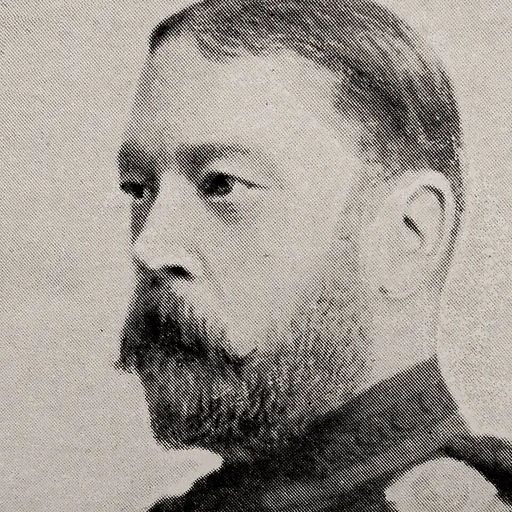
About Frank Barlow Osborn
Lived 1840 – 1907 (aged 66–67). Frank Barlow Osborn was an architect.
Frank Barlow Osborn FRIBA (June 1840 - 6 April 1907) was an English architect practising in Birmingham.
Personal life Osborn's father was Councillor Thomas Osborn. They had three children, and lived at 205 or 222 Hagley Road, Birmingham. On 2 September 1880 at the Holy Trinity Church, Lickey, near Bromsgrove, Osborn married his second wife, Marion Georgina, the youngest daughter of solicitor Nathaniel Taynton of Lincoln's Inn.
Osborn died suddenly at the Union Club, Birmingham, on 6 April 1907. He left £21,911 . His funeral and burial service were held at St Peter's Church, Harborne, on 9 April 1907.
Career 106-110 Edmund Street, Birmingham of 1895 for W.M. Smythe Solicitors' offices After leaving school, Osborn was articled to Charles Edge before transferring to Samuel Sanders Teulon in London. At that time, his practice was located at 13 Bennett's Hill, Birmingham.
One of Osborn's pupils was Thomas Walter Francis Newton, who later entered practice with Alfred Edward Cheatle and designed numerous Arts and Crafts-style buildings in Birmingham.
Institution and awards Osborn was appointed a Fellow of the Royal Institute of British Architects in 1872. He served as president of the Birmingham Institute of Architects. He was involved with the archaeological section of the Midland Institute, being one of its first secretaries. Osborn was a long-serving member of the management board at Birmingham General Hospital, and when he died, its members attended his funeral. Buildings for the Smithfield Market, Jamaica Row to Moat Lane 1883 Conservative Club, Temple Row, Birmingham 1886 Edgbaston Vestry Hall and Rate Office, Islington Row, Birmingham 1886 Methodist Central Hall, Corporation Street, Birmingham 1887 (replaced in 1900) St James' Parish Church, Norton Canes 1887-88 (rebuilding after a fire) All Saints' Church, Kirkby Mallory 1888 (restoration) Office building, Sheepcote Street, Birmingham 1890 Christ Church, Quinton, Birmingham 1890 restoration St Thomas Mission Hall, Ellis Street 1891 St. Thomas' Church, Birmingham 1893 restoration London and Midland Bank, High Street/Little Park Street, Coventry 1894, "in the Elizabethan style of architecture". W.M. Smythe Solicitors' offices, 29 Newhall Street/106-110 Edmund Street, Birmingham 1895 Extension to the Royal Institution for Deaf and Dumb Children, Church Road, Edgbaston 1899 Extension to the Birmingham Smithfield Vegetable Market 1903 St Peter's Church, Spring Hill 1902 St Peter's Church, Dudley Road (undated). Scottish Provident Buildings, Birmingham (undated). Private hospital, Newhall Street, Birmingham (undated).
Don’t just read it —
keep it.
Full-length biographies made to live with: read them, listen on the way to work, watch them tonight.
- E-book
- Audio
- Video
Instant download · yours to keep · every purchase keeps this site free
Important facts
People in Frank Barlow Osborn's life
Named in this biography and alive at the same time






Related people
Same field, nearest in time

Contemporaries
People whose lives overlapped Frank Barlow Osborn's
Frequently asked questions
Who was Frank Barlow Osborn?
English architect (1840-1907)
When was Frank Barlow Osborn born?
Frank Barlow Osborn was born in 1840 in Edgbaston.
When did Frank Barlow Osborn die?
Frank Barlow Osborn died on 6 April 1907 in Birmingham.
What was Frank Barlow Osborn's occupation?
Frank Barlow Osborn was an architect.
Sources & further reading
· Wikipedia: Frank Barlow Osborn
· DBpedia: Frank Barlow Osborn
Cite this page
APA: Biography.guide. (2026). Frank Barlow Osborn. https://biography.guide/frank-barlow-osborn/
MLA: "Frank Barlow Osborn." Biography.guide, https://biography.guide/frank-barlow-osborn/.
Chicago: "Frank Barlow Osborn." Biography.guide. https://biography.guide/frank-barlow-osborn/.
Data last updated: 2026-09-23 · Spot an error? Report a correction.
Portrait: Wikimedia Commons · author & licence
Page generated 2026-09-27 05:07 UTC