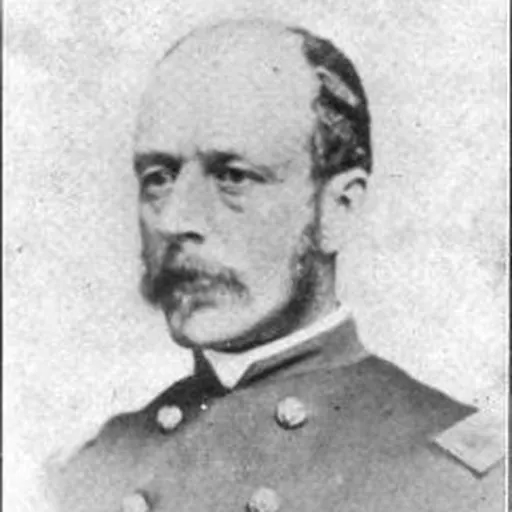
About Frank A. Haskell
Lived 1828 – 1864 (aged 35). Frank A. Haskell was an American writer, soldier, author and lawyer.
Franklin Aretas Haskell (July 13, 1828 – June 3, 1864) was an American lawyer and Union Army officer during the American Civil War. He spent much of the war as a top aide to General John Gibbon, as Gibbon ascended the ranks from brigade to division to corps command. On the third day of the Battle of Gettysburg, their corps bore the brunt of the pivotal Confederate assault; Haskell personally rallied the troops of Gibbon's division after Gibbon was wounded. Gibbon later commented that "I have always thought that to him, more than to any one man, are we indebted for the repulse of Lee's assault."
In 1864, Haskell was promoted to colonel and given his own command, but he died just a few months later at the Battle of Cold Harbor. Before his death, Haskell wrote a famous account of the Battle of Gettysburg that was published posthumously.
Early life Haskell was born at Tunbridge, Vermont, to Aretas and Anna E. Folsom Haskell. He moved to Wisconsin to study law in the office of his brother Harrison. He graduated from Dartmouth College in 1854 and returned to Madison, Wisconsin, to practice law. During this period, Haskell became the drill master of a militia company.
Civil War When the Civil War began, Haskell enlisted in Col. Lysander Cutler's 6th Wisconsin Infantry of Brig. Gen. Rufus King's Brigade. This brigade would eventually be known as the Iron Brigade. He served as adjutant for the regiment with the rank of first lieutenant until April 1862, when he was made aide-de-camp for Brig. Gen. John Gibbon, the new Commander of the Iron Brigade.
Gettysburg Gibbon's Division headed north toward Pennsylvania during the Gettysburg campaign and was in Taneytown, Maryland, when the Battle of Gettysburg began. Gibbon was given temporary command of II Corps after I Corps Commander Maj. Gen. John F. Reynolds was killed and Maj. Gen. George G. Meade ordered II Corps Commander Maj. Gen. Winfield S. Hancock to Gettysburg to assume command. Haskell and II Corps did not arrive on the battlefield until July 2, 1863. There they took part in the defense of Cemetery Ridge, the area around the Nicholas Codori Farm, and supported III Corps, commanded by Daniel E. Sickles, in their defense of the Peach Orchard. In his recollections of the Battle, Haskell was highly critical of Sickles as a soldier and a person as well as his move forward that led to his III Corps being attacked by the Confederates.
That night, Gibbon took part in a council of war called by Meade which Haskell recorded in his recollections of the Battle. On July 3, Gibbon was back in command of his division and Haskell was by his side. Late that morning, Gibbon hosted a meal for much of the Union high command which Haskell also recorded for posterity. Shortly after the luncheon broke up Confederate artillery began to shell the area where Gibbon's men were positioned. Gibbon's position bore the brunt of the Confederate attack known as Pickett's Charge. Haskell rallied Gibbon's men after the Confederates had breached the stone wall and Gibbon had been wounded. Hancock, Gibbon, Brig. Gen.William Harrow, Col. Norman J. Hall, and Col. A.F. Devereux (19th Mass.) commended Haskell for his performance, with Gibbon later writing that "I have always thought that to him, more than to any one man, are we indebted for the repulse of Lee's assault."
A few weeks after the Battle, Haskell wrote the account of what he had experienced at Gettysburg to his brother Harrison in Portage, Wisconsin.
Gibbon and Haskell returned to Gettysburg in November 1863 to attend the dedication of the Soldiers' National Cemetery and witnessed President Abraham Lincoln's Gettysburg Address after recreating their role in the battle for some tourists on Cemetery Ridge.
Death On February 9, 1864, Haskell was appointed colonel of the 36th Wisconsin Infantry Regiment. On June 3, he assumed command of the 1st Brigade, 2nd Division, II Corps, when its commander Col. Henry Boyd McKeen was killed during the Battle of Cold Harbor. Shortly after taking command he was shot through the temple and killed while leading a charge. A distraught Gibbon cried out: "My God! I have lost my best friend, and one of the best soldiers in the Army of the Potomac has fallen!" Gibbon wrote to his wife that he had planned to promote "poor Haskell" to field command after the battle.
Haskell's Battle of Gettysburg in popular culture Haskell's writings were instrumental in influencing the direction of Peter Rothermel's 1870 painting of Pickett's Charge.
Haskell's account is reprinted in volume 43, "American Historical Documents", of The Harvard Classics.
In The Killer Angels, the novel by Michael Shaara, part 4 ("Friday, July 3, 1863"), chapter 3 ("Chamberlain"), Col. Joshua Lawrence Chamberlain goes to see Gen. Sykes, his corps commander, where there is a lunch for the senior commanders, and is finally taken some chicken by Lt. Haskell himself. That lunch is from Haskell's account.
In The Civil War, the documentary by Ken Burns, the subtitle of Episode 5, "The Universe of Battle", comes from Haskell's account, where, shortly after the lunch, he and Gen. Gibbon are sitting, watching the great cannonade of the third day. During "Gettysburg: The Third Day", Garrison Keillor reads a relevant excerpt.
Don’t just read it —
keep it.
Full-length biographies made to live with: read them, listen on the way to work, watch them tonight.
- E-book
- Audio
- Video
Instant download · yours to keep · every purchase keeps this site free
Important facts
People in Frank A. Haskell's life
Named in this biography and alive at the same time




Related people
Same field, nearest in time

Contemporaries
People whose lives overlapped Frank A. Haskell's




Frequently asked questions
Who was Frank A. Haskell?
Union Army officer (1828-1864)
When was Frank A. Haskell born?
Frank A. Haskell was born on 13 July 1828 in Tunbridge.
When did Frank A. Haskell die?
Frank A. Haskell died on 3 June 1864 in Hanover County.
What was Frank A. Haskell's occupation?
Frank A. Haskell was a writer, soldier, author and lawyer.
What nationality was Frank A. Haskell?
Frank A. Haskell was American.
Sources & further reading
Cite this page
APA: Biography.guide. (2026). Frank A. Haskell. https://biography.guide/frank-a-haskell/
MLA: "Frank A. Haskell." Biography.guide, https://biography.guide/frank-a-haskell/.
Chicago: "Frank A. Haskell." Biography.guide. https://biography.guide/frank-a-haskell/.
Data last updated: 2026-09-23 · Spot an error? Report a correction.
Portrait: Wikimedia Commons · author & licence
Page generated 2026-09-27 05:05 UTC