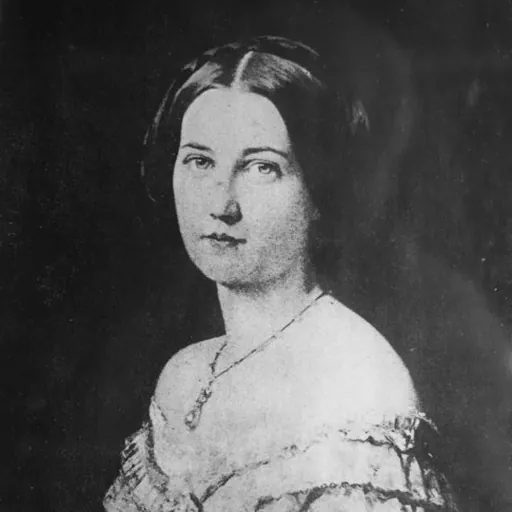
About Francoise, Duchess de Praslin
Lived 1807 – 1847 (aged 40). Francoise, Duchess de Praslin was a French aristocrat.
Françoise, Duchess de Choiseul-Praslin (April 14, 1807 – August 17, 1847) was a French duchess and heiress who was found murdered. Her husband, Charles de Choiseul, Duke of Praslin was believed guilty for her death and committed suicide while awaiting trial days later on August 24, 1847. These events in 1847 contributed to the French Revolution of 1848.
Biography Her birth name was Françoise Altarice Rosalba Sébastiani. Her nickname was "Fanny". She was the daughter of Jeanne-Françoise-Antoinette "Fanny" Sébastiani (née Franquetot de Coigny) (1778–1807) and Horace Sébastiani (1771–1851), a French politician and army general. She was born in Constantinople where her father was stationed. Her mother died while giving birth to her. Her family was very wealthy and her father was a peer in Corsica.
She married the duke at age 17 in 1824 and had as many as 9 children with him, with many miscarriages. After going through several governesses for their children, they hired a woman named Henriette Deluzy. Deluzy spent six years with the family, and it was a public scandal when it was widely reported the duke and Deluzy were lovers, which infuriated the duchess.
The duchess fired Deluzy in June 1847, which sent their household into a tailspin. The Duchess felt she was being estranged from her children and her husband had lost interest in her. She was no longer thin and beautiful like she was when they first married when she was 17. She was now nearing 40 years old and was over-weight from her many childbirths. She threatened to divorce the duke after he refused to fire Deluzy himself, which would mean that her family's money would go with her, leaving him much less wealthy.
It is generally believed that, during a visit to Paris, the duc murdered her while she was sleeping. After Deluzy was fired, she had moved into the lodging house of one Mme Renaud. The governess had been desperate for a letter of recommendation from the duchesse which, declaring herself innocent of the charge of having an affair with the duc and believing herself to have dedicated the past six years of her life to caring for the Praslin children, she was entitled to and without which she would find it impossible to get another post. The duchesse possibly seeing a chance to gain her revenge on the governess she sorely detested is believed to have refused to write the recommendation.
The duchesse had her throat slashed and was hit with blunt objects, leaving cuts and marks all over her body. This caused further scandal because her husband, being a duc, was protected from being sentenced and jailed until other peers met and came to an agreement on the proceedings. While the duke awaited what was likely to be a long prison sentence, he poisoned himself with arsenic. He died within six days of first appearing sick on August 24, 1847. He never confessed to his wife's murder.
French society was still reverberating from the aristocratic Teste–Cubières political corruption scandal which was revealed in May 1847. The controversy created by the death of the duc and duchesse further contributed to the start of the French Revolution of 1848. The couple were considered members of the royal court of the King Louis Philippe I and their scandals added to the public feeling that the King and his court were not trustworthy or honorable. King Louis was forced to abdicate the throne and he fled to England where he lived the rest of his life.
During this time period, the family owned Vaux-le-Vicomte and had a residence in Paris.
In popular culture Writer Rachel Field, who claimed Henriette Deluzy was her great-aunt, wrote a novel about the events titled All This, and Heaven Too, which was released in 1938. In 1940, a film was made of the same name All This, and Heaven Too, in which the duchess was portrayed by actress Barbara O'Neil, the duke by Charles Boyer and Bette Davis portraying Henriette Deluzy. O'Neil was nominated for the Academy Award for Best Supporting Actress for her performance as the duchess, and the film was nominated for Best Picture of the Year.
Don’t just read it —
keep it.
Full-length biographies made to live with: read them, listen on the way to work, watch them tonight.
- E-book
- Audio
- Video
Instant download · yours to keep · every purchase keeps this site free
Important facts
Related people
Same field, nearest in time

Contemporaries
People whose lives overlapped Francoise, Duchess de Praslin's





Frequently asked questions
Who was Francoise, Duchess de Praslin?
(1807-1847)
When was Francoise, Duchess de Praslin born?
Francoise, Duchess de Praslin was born on 14 April 1807 in Constantinople.
When did Francoise, Duchess de Praslin die?
Francoise, Duchess de Praslin died on 17 August 1847 in Paris.
What was Francoise, Duchess de Praslin's occupation?
Francoise, Duchess de Praslin was an aristocrat.
What nationality was Francoise, Duchess de Praslin?
Francoise, Duchess de Praslin was French.
Sources & further reading
· Wikipedia: Francoise, Duchess de Praslin
· DBpedia: Françoise, Duchesse de Praslin
Cite this page
APA: Biography.guide. (2026). Francoise, Duchess de Praslin. https://biography.guide/francoise-duchess-de-praslin/
MLA: "Francoise, Duchess de Praslin." Biography.guide, https://biography.guide/francoise-duchess-de-praslin/.
Chicago: "Francoise, Duchess de Praslin." Biography.guide. https://biography.guide/francoise-duchess-de-praslin/.
Data last updated: 2026-09-22 · Spot an error? Report a correction.
Portrait: Wikimedia Commons · author & licence
Page generated 2026-09-27 05:01 UTC