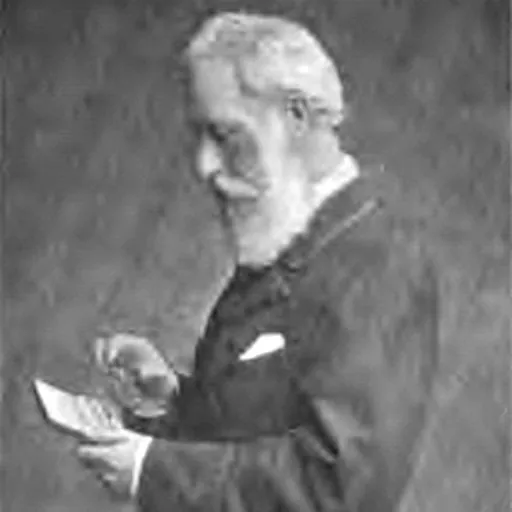
James Carnegie, 9th Earl of Southesk
Scottish nobleman
About James Carnegie, 9th Earl of Southesk
Lived 1827 – 1905 (aged 77). James Carnegie, 9th Earl of Southesk was a British aristocrat, art collector, politician and writer.
James Carnegie, 9th Earl of Southesk, (16 November 1827 – 21 February 1905) was a Scottish nobleman, explorer and poet.
Early life Born in Edinburgh, on 16 November 1827, Southesk was the son of Sir James Carnegie, 5th Baronet and Charlotte Lysons, daughter of the Reverend Daniel Lysons.
1859 North American expedition
In 1859, after the death of his first wife, the Earl was advised that to improve his health he should travel to a place where he could live an open-air life and hunt. In 1859, at the age of 32, he embarked on a trip to the Hudson's Bay Company (HBC) trading area, which later became western Canada. At the fort he bought horses, hired a Métis, Antoine Blandoine, to be his guide, and built enough pack saddles to haul his outfit.
The party went into the mountains west of the future site of Cadomin to pursue bighorn sheep. The expedition went up the Athabasca River to the McLeod River and the Medicine Tent River (in present-day Jasper National Park). In September he noted that he was now in country that, "no European had ever seen, where bears and wild sheep were certain to be abundant."
On September 6, he wrote in his journal, "I am the first European who has visited this valley [at the head of the Medicine Tent and North Saskatchewan rivers], and if I might have the geographic honour of giving my name to some spot of earth, I should choose the mountain near which the two rivers rise."
Worried that that mountain (Mount Southesk) had already been named and therefore could not carry his name, he climbed a mountain located 6 km north of Mount Southesk and erected a cairn on top that can still be seen today. This mountain is named Southesk Cairn in his honour. As well, Southesk Pass, Southesk River and Southesk Lake, all nearby, bear his name.
The expedition then crossed over Southesk Pass, also known as Cairn Pass, and pressed on to the Kootenay Plains of the North Saskatchewan River valley. The expedition followed the Siffleur River, crossed over the Pipestone Pass, and followed the Pipestone River to the Bow River. The Earl nearly crossed paths with another explorer, James Hector, at a time when there were very few Europeans in the Rockies. The two passed through the same route going in opposite directions about a month apart in time. Southesk made his way east, arriving at Fort Garry (Winnipeg) on January 8, 1860. He travelled on to New York and made the voyage home to England on the Cunard liner Etna, arriving in February 1860.
For the expedition he employed several Métis guides and helpers: James McKay, John McKay, George Klyne, John "Piscan" Munroe, Baptiste La Grace, James "Little Dog" Short, Antoine Blandion, Pierre Desnomme, Thomas Arinwakena, and Duncan Robertson. These men were experienced buffalo hunters. During this trip which took him west to Fort Edmonton and into the Rocky Mountains he commissioned and collected several Métis and aboriginal artifacts.
He wrote an account of his trip, Saskatchewan and the Rocky Mountains (published in 1874). His research on the Cree language was published that same year, under the title The Cree syllabic characters, terminations, &c.
An exhibit dedicated to the Earl's prairie and mountain trip, including a life-sized statue of a large plains grizzly bear he killed while on a bison hunt on the nearby prairie, is at Ancient Echoes Interpretive Centre in Herschel, Saskatchewan.
The Southesk Collection at the Royal Alberta Museum
Throughout the 1859 Canadian expedition, Southesk collected objects made by First Nations and Métis people whom he met in the course of his travels. The artifacts returned home with Southesk to Kinnaird Castle, the family estate in Scotland where they remained for the next 146 years, until 2006, when the earl's descendants put them up for auction at Sotheby's in New York.
The Royal Alberta Museum purchased many of the items put up for sale. for $1.1 million.
Publications Novels
Herminius: a romance. (1862) Suomiria: a fantasy (1899)
Short fiction
Some Sort of Madness [excerpt] (1982) [only as by Earl of Southesk]
Non-Fiction
Saskatchewan and the Rocky Mountains: a diary and narrative of travel, sport, and adventure, during a journey through the Hudson's Bay Company's territories, in 1859 and 1860. (1875) Origins of Pictish symbolism; with notes on the sun boar and a new reading of the Newton inscriptions. (1893) The Ogham Inscriptions of Scotland. (1885) Britain's art paradise; or, Notes on some pictures in the Royal Academy, (1871)
Poetry (His poetry is said to tend to the occult.)
Lurida lumina. (1876) The Burial of Isis, and other poems. (1884) Jonas Fisher, a poem in brown and white. (1875) Greenwood's farewell and other poems. (1876) The Meda Maiden, and other poems. (1877)
Catalogues
Catalogue of the collection of antique gems formed by James, ninth earl of Southesk, K.T.; edited by his daughter Lady Helena Carnegie. (1908) The letter archive of James Carnegie, 9th Earl of Southesk, and the Pictish symbol stones of Aberdeenshire; Lynda McGuigan. (2020)
Personal life On 19 June 1849, Sir James married Lady Catherine Hamilton Noel (1829–1855) at Exton Park, Rutland, England. Lady Catherine was the second daughter of Charles Noel, 1st Earl of Gainsborough and, his third wife, Annabella Hamlyn-Williams (second daughter of Sir James Hamlyn-Williams, 2nd Baronet of Clovelly Court). Before Catherine's death in 1855, at the age of twenty-six, they had one son and three daughters:
In 1860, Lord Southesk married Lady Susan Catherine Mary Murray (1837–1915), eldest daughter of Alexander, Earl of Dunmore. They had three sons and four daughters, including:
Legacy and honours Fellow of the Royal Geographical Society (1860) Knight of the Order of the Thistle. (1869) on Prime Minister Gladstone's recommendation. Honorary LL.D. from St. Andrews. (1872) Honorary LL.D. from Aberdeen University. (1875)
Don’t just read it —
keep it.
Full-length biographies made to live with: read them, listen on the way to work, watch them tonight.
- E-book
- Audio
- Video
Instant download · yours to keep · every purchase keeps this site free
Important facts
Family & relationships
People in James Carnegie, 9th Earl of Southesk's life
Named in this biography and alive at the same time




Related people
Same field, nearest in time


Contemporaries
People whose lives overlapped James Carnegie, 9th Earl of Southesk's





Frequently asked questions
Who was James Carnegie, 9th Earl of Southesk?
Scottish nobleman (1827-1905)
When was James Carnegie, 9th Earl of Southesk born?
James Carnegie, 9th Earl of Southesk was born on 16 November 1827 in Edinburgh.
When did James Carnegie, 9th Earl of Southesk die?
James Carnegie, 9th Earl of Southesk died on 21 February 1905 in Angus, Scotland.
What was James Carnegie, 9th Earl of Southesk's occupation?
James Carnegie, 9th Earl of Southesk was an aristocrat, art collector, politician and writer.
What nationality was James Carnegie, 9th Earl of Southesk?
James Carnegie, 9th Earl of Southesk was British.
Sources & further reading
· Wikipedia: James Carnegie, 9th Earl of Southesk
· DBpedia: James Carnegie, 9th Earl of Southesk
Cite this page
APA: Biography.guide. (2026). James Carnegie, 9th Earl of Southesk. https://biography.guide/james-carnegie-9th-earl-of-southesk/
MLA: "James Carnegie, 9th Earl of Southesk." Biography.guide, https://biography.guide/james-carnegie-9th-earl-of-southesk/.
Chicago: "James Carnegie, 9th Earl of Southesk." Biography.guide. https://biography.guide/james-carnegie-9th-earl-of-southesk/.
Data last updated: 2026-09-20 · Spot an error? Report a correction.
Portrait: Wikimedia Commons · author & licence
Page generated 2026-09-27 04:58 UTC