
About Francis Pearson
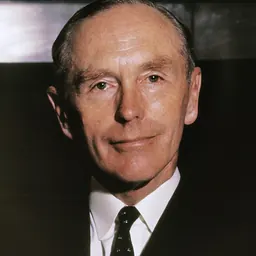
Lived 1911 – 1991 (aged 79). Francis Pearson was a British politician.
Sir Francis Fenwick Pearson, 1st Baronet, (13 June 1911 – 17 February 1991) was a British colonial administrator, farmer and politician.
Colonial service Pearson attended Uppingham School in Rutland, and then Trinity Hall, Cambridge. He was commissioned a Second Lieutenant onto the Unattached List for the Indian Army from being a Second Lieutenant, T.A. (University Candidate) in September 1932, with seniority from 29 January 1931. After a year attached to a British regiment in India, he was appointed to the Indian Army and posted to the 1st King George's Own Gurkha Rifles on 3 November 1933. He served as Aide-de-camp to the Viceroy of India from June 1935 to April 1936.
Indian Political Service Pearson transferred to the Indian Political Service in October 1935. In June 1945 he was appointed a Member of the Order of the British Empire as captain, Indian Political Service.
He served as the President of the Manipur State Durbar (later designated as the Chief Minister) in the princely state of Manipur from 1945 to 1947. The ruler of Manipur at that time was Maharaja Bodhachandra Singh. Pearson headed the committee that formulated the Manipur State Constitution Act, passed in May 1947. He handed over power to Maharajkumar Priyobrata Singh, the Maharaja's nominee for chief minister, on 14 August 1947.
The village of Pearson in Churachandpur district was named in his honour.
Parliamentary career Pearson returned to Britain after Indian independence and settled in Lancashire where he became a farmer, and also involved himself in local government. He was a Justice of the Peace for Lancashire from 1952.
At the 1959 general election, Pearson replaced Richard Fort (who had died earlier in the year) as Conservative Party Member of Parliament for Clitheroe, a rural constituency in the Lancashire foothills of the Pennines. He was swiftly named as an Assistant Government Whip (1960) and became a Lord Commissioner of the Treasury (Government Whip) in March 1962.
Parliamentary Private Secretary Sir Alec Douglas-Home, who became Prime Minister in October 1963, choose Pearson to be his Parliamentary Private Secretary, an unpaid but pivotal role where Pearson had to maintain relations between the Prime Minister and his own backbenchers. When Douglas-Home lost the 1964 general election and resigned as Prime Minister, he gave Pearson a Baronetcy in his resignation honours list.
Lancashire contribution Pearson retired from Parliament at the 1970 general election, but not from politics. He was Chairman of the Central Lancashire New Town Development Corporation from 1971 (the new town covered Preston, Chorley, Leyland and several other areas).
Don’t just read it —
keep it.
Full-length biographies made to live with: read them, listen on the way to work, watch them tonight.
- E-book
- Audio
- Video
Instant download · yours to keep · every purchase keeps this site free
Important facts
People in Francis Pearson's life
Named in this biography and alive at the same time


Related people
Same field, nearest in time






Contemporaries
People whose lives overlapped Francis Pearson's





Frequently asked questions
Who was Francis Pearson?
British politician
When was Francis Pearson born?
Francis Pearson was born on 13 June 1911.
When did Francis Pearson die?
Francis Pearson died on 17 February 1991.
What was Francis Pearson's occupation?
Francis Pearson was a politician.
What nationality was Francis Pearson?
Francis Pearson was British.
Sources & further reading
Cite this page
APA: Biography.guide. (2026). Francis Pearson. https://biography.guide/francis-pearson/
MLA: "Francis Pearson." Biography.guide, https://biography.guide/francis-pearson/.
Chicago: "Francis Pearson." Biography.guide. https://biography.guide/francis-pearson/.
Data last updated: 2026-09-20 · Spot an error? Report a correction.
Page generated 2026-09-27 05:11 UTC