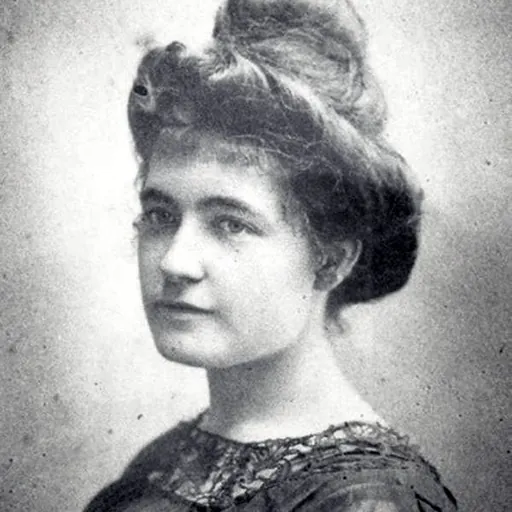
About Frances Darlington
Lived 1880 – 1940 (aged 60). Frances Darlington was a British sculptor.
Frances Darlington (born Fanny Taplin Darlington; 3 February 1880 – 5 September 1940) was an English artist of the New Sculpture movement. In the early 20th century she created decorative panels, busts, garden statuary, medallions, group sculptures, and statuettes, in various materials including copper, bronze and painted plaster. She also designed a railway poster, featuring Ilkley.
She is known in Harrogate for her painted plaster relief panels, including her large frieze around the walls of the vestibule of Harrogate Theatre, and her Stations of the Cross in St Wilfrid's Church, Harrogate. A retrospective exhibition of her works, called Heavenly Creatures, was held in Harrogate's Mercer Art Gallery in 2003 and 2004.
Personal life
Darlington's paternal grandfather was solicitor and justice of the peace John Darlington, who managed the Leeds and West Riding Bank in Bradford, and later lived at Shipley Hall, Shipley. who was the Belgian Consul for Bradford, daughter of Hugh Brown Taplin of Shaw House, Headingley, Leeds manager for the Royal Insurance Company. Emma Taplin was a painter, although untrained. Her parents married on 14 or 15 August 1877, at St Chad's Church, Far Headingley, the service being conducted by Bishop Ryan. Darlington had an elder brother, variety artist Hugh Latimer M. Darlington, who had shell shock from the First World War, and a younger sister, Dorothy Marriott Darlington. She spent her younger years in Ilkley, and then – when not training in London – for most of the time between 1900 and 1910 she was living and working at her family home at Burland House, Harrogate, She had "strong religious beliefs", and was a member of the congregation of St Wilfrid's Church, Harrogate. Darlington was shy of marriage, having observed its negative effect on the careers of women. She died of heart failure at Oxted on 5 September 1940,
Career In spite of being shy of self-promotion, Her career spanned more than four decades until the late 1930s,
Darlington trained as a sculptor and medallist, where she studied under George Frampton. In 1901 she passed the Royal College of Art's entrance examination, having won the South Kensington Modelling Sketch Club Prize, and the second prize in the Gilbert Competition for modelling. After that, she studied at the Central School of Art and Design, South Kensington, Her first commission was a bust, which was titled Emily Bottomley, and executed in 1898. The painting shows a statue of Darlington's niece Marjory, and a plaster cast of her bust of Robert Collyer.
Works Early works
In 1896, before her formal training began, Darlington contributed Mr L. Darlington and Dorothy Marriott Darlington, a pair of clay busts for an exhibition at Bradford Museum. for Morley Town Hall. The bust was unveiled on 8 December 1902, by mayoress Mrs Scarth, in commemoration of Queen Victoria's Diamond Jubilee. The cost was met by the remainder of the council's Diamond Jubilee fund. Darlington was present at the unveiling. Her next recorded work is The Little Sea Maiden (1905), which is now in the collection of Leeds Art Gallery. Her panel, Madonna della Rosa (1905), was illustrated in the Catholic Home Journal, which described it as "an excellent piece of work".
Sir Perceval's Vision of the Holy Grail (1907) for Harrogate Ladies College
Early in 1907, the Leeds Mercury reported that Darlington's plaster bas relief of Sir Perceval's Vision of the Holy Grail, a decoration for a mantelpiece in the reading room of Harrogate Ladies' College, had been accepted for the Royal Academy Summer Exhibition. The wide panel featured twelve figures. The Sheffield Daily Telegraph said: it was "carefully composed and vigorously modelled". The Yorkshire Post commented, "There is some very good modelling in Sir Perceval and the Vision of the Holy Grail, though the difficulties of the composition are not entirely overcome, and there are some awkward lines". In 1907 the panel was at Harrogate Ladies' College, in the Hewlett Reading Room. It was later in St James' Church, Wetherby; the work was reported to be there in 1949. From the 1980s, the work has been displayed over the vestry door in St Mary the Virgin Church, Ingleton, North Yorkshire.
Rev. Dr Collyer and Andrew Carnegie (1907) for Ilkley Library
One of Darlington's works which drew public attention was the pair of life-sized bronze busts which were commissioned in 1906, and which Darlington completed in 1907, at a cost of 90 guineas for the Ilkley Public Library. One of the busts was a portrait of Reverend Dr Robert Collyer of New York, who had been a blacksmith in Ilkley when young. He had since been a benefactor to Ilkley and had donated 300 books to the new library. The other was of Andrew Carnegie, who donated £3,000 for the construction of the library in 1907. When the maquettes for the busts were offered for viewing, the Brighouse News said, "The representations are exceedingly life-like and natural, and should do much to increase Miss Darlington's reputation".
The library was opened, and the busts were unveiled, in the empty library in front of a large audience on 2 October 1907. The library was not to be furnished with shelves and books until the following spring, but the unveiling was put forward when Collyer visited England. At the opening, Collyer was presented with a gold key, and an illuminated address. On seeing his bust, Collyer responded: "I am proud of my likeness. It is well done, and it will stay well done. Time will only ripen the features". The Wharfedale & Airedale Observer commented: "[Darlington] has shown conspicuous ability in this particular line, and we are told that the sculptures do her infinite credit".
Isis (1909)
In 1909 Darlington completed and exhibited a bust of Isis. The Queen commented that, "Darlington ... is coming to the front as a sculptress of talent. Isis ... is a work of considerable dignity and poetic feeling, while the modelling of the face is noteworthy". The Gentlewoman described it as a "striking and imaginative work of a high order". The Yorkshire Post commented:
Joseph Priestley (1912), Birstall
Of all her works it was the Installation of Darlington's statue of Joseph Priestley at Birstall, on 12 October 1912, because Priestley was born in the town, was known there for his invention of soda water, and the town had not yet recognised him in a formal manner. The 1912 plaster maquette for this bronze work, also titled Joseph Priestley, is in the collection of the Bagshaw Museum, Batley.
Nativity and Stations of the Cross (1913–1917) for St Wilfrid's Church, Harrogate This work by Darlington of fifteen sculptural plaster reliefs of the Nativity and Stations of the Cross was commissioned in 1913 by St Wilfrid's Church, Harrogate, where she worshipped.
Though commonly and technically designated Stations of the Cross, the vicar submitted that they were not actually Stations of the Cross, and should more rightly be described representations of Scenes from the Passion, because they represented only the ten pictures of which there were Scriptural references, and not the four legendary scenes. He gave assurances to the Bishop, and these to be repeated in the Court, that the panel would not be used as devotions. The Chancellor said the Stations of the Cross and the Way of the Cross meant standing places for devotions, and these were not to be used for devotions. He was very reluctant to grant the faculty, but the pictures could be amended so as to include the salient points in the life of Our Lord, and yet not be in any sense Stations of the Cross. Ripon Museums describes the work as follows: Darlington's twin nieces, born in 1900, were possibly models for some of the figures in this piece.
Plaque commemorating the birth of Elizabeth II (1926) for the Royal Family This heart-shaped plaque, featuring Elizabeth II as a baby, with her parents George VI and Queen Elizabeth The Queen Mother, was commissioned from Darlington in 1926. and by 1925 she had created the War Shrine in St Mary's Church, Oxted, Surrey. Undated works for the Oxted area are: The Christ Child, in Oxted, Madonna and Child in a niche above the porch of St Mary's, Oxted, works at the Church of St Mary the Virgin at Holmbury St Mary, and works at St Alban's Church, Wrotham. Walker Art Gallery, Liverpool. Confidences (1901) copper medallion. and in 1905 when she showed The Little Sea Maiden, The Unforeseen and Lucretia Borgia. The sculpture featured two children looking at a crab. The 1907 exhibit was Sir Perceval's Vision of the Holy Grail. In 1909 she showed a bust of Isis. Dorothy (1903) plaster portrait bust; Hugh Darlington, Imperial Yeoman (1904) plaster portrait statuette, described as, "a well-modelled figure, firmly planted on its legs"; Magic Crystal (1904) design for electric light; Wrestlers (1904) design for relief medal; The Unforeseen (1904) plaster statuette; Love's Last Gift (1904) design for relief panel; The Little Sea Maiden (1906) plaster figure, displayed on a pedestal in the centre of the black-and-white room; Lucrezia Borgia (1906) plaster bust; Sir Percival and the Vision of the Holy Grail (1908) plaster panel; Andrew Carnegie Esq. (1908) plaster bust; Cupid and Coquette (1910) plaster statuette. In 2001 The Little Sea Maiden was restored by Leeds Art Gallery, and in January 2002 the statue was exhibited in the library of the Henry Moore Institute next door to the gallery. Society of Women Artists (1900 and 1928), London. Arsinoë (1904), bust. St Louis Exhibition: Confidences (1904), copper medallion. Prison and Police Museum, Ripon, Noble Bloods Exhibition (2014). Works by Louise Marchal in relation to her research on the subject of Frances Darlington, and in relation to the Large memorial plaque for St George's House Police Orphanage, Harrogate. Longside Gallery, Yorkshire Sculpture Park (16 July – 16 October 2016), a "Night in the Museum" touring exhibition featuring the Arts Council Collection, and including The Little Sea Maiden.
Undated exhibitions Paris Salon.
Cultural response According to the Surrey Mirror, "Some of [Darlington's] plaques were made into Christmas cards".
Don’t just read it —
keep it.
Full-length biographies made to live with: read them, listen on the way to work, watch them tonight.
- E-book
- Audio
- Video
Instant download · yours to keep · every purchase keeps this site free
Important facts
People in Frances Darlington's life
Named in this biography and alive at the same time




Related people
Same field, nearest in time



Contemporaries
People whose lives overlapped Frances Darlington's


Frequently asked questions
Who was Frances Darlington?
British sculptor
When was Frances Darlington born?
Frances Darlington was born on 3 February 1880 in Headingley.
When did Frances Darlington die?
Frances Darlington died on 5 September 1940 in Oxted.
What was Frances Darlington's occupation?
Frances Darlington was a sculptor.
What nationality was Frances Darlington?
Frances Darlington was British.
Sources & further reading
· Wikipedia: Frances Darlington
Cite this page
APA: Biography.guide. (2026). Frances Darlington. https://biography.guide/frances-darlington/
MLA: "Frances Darlington." Biography.guide, https://biography.guide/frances-darlington/.
Chicago: "Frances Darlington." Biography.guide. https://biography.guide/frances-darlington/.
Data last updated: 2026-09-21 · Spot an error? Report a correction.
Portrait: Wikimedia Commons · author & licence
Page generated 2026-09-27 05:00 UTC