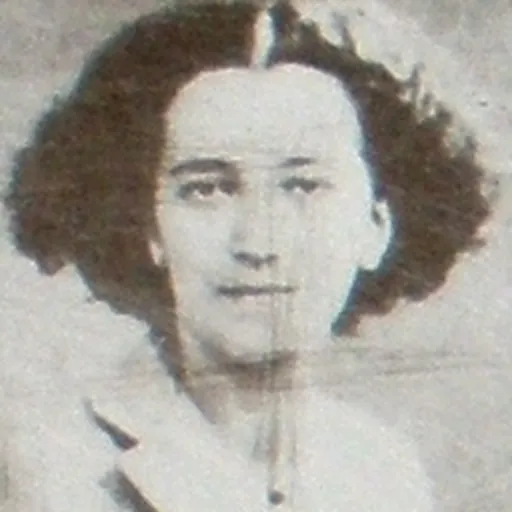
About France Bloch-Sérazin
Lived 1913 – 1943 (aged 29). France Bloch-Sérazin was a French politician, chemist and resistance fighter.
France Bloch-Sérazin (; 1913–1943) was a French chemist and militant communist who fought in the French resistance against German occupation during World War II.
Biography Commemorative plaque on the back of the Holstenglacis remand center in Hamburg. Plaque memorializing European resistance executions located at the back of the prison in Hamburg, Germany.
France Bloch-Sérazin was born Françoise Bloch on 21 February 1913 in Paris to a French Jewish family.
Bloch was arrested by the French police on 16 May 1942. After four months of interrogation and torture, she was condemned to death by a German military tribunal, along with 18 co-conspirators (who were all immediately executed). Meanwhile, Bloch herself was deported to Germany and imprisoned in a fortress at Lübeck. She was subjected to further torture there, and was decapitated by guillotine in Hamburg on 12 February 1943.
In her last letter to her husband before her execution, Bloch-Sérazin wrote: "I die for what we fought for, I fought; you know like me that I could not have acted other than I acted: we cannot change".
Personal life In May 1939, Bloch married , a French metalworker, trade unionist, communist and French resistance fighter. Together they had one child, Roland Sérazin (1940–2020).
Bloch family Bloch's husband, Frédo Sérazin was arrested in February 1940, under the Daladier government, imprisoned first at the Sisteron fortress in March 1940, then at Châteaubriant, and finally at the Voves camp. He was assassinated by the German militia or the Gestapo in 1944 in Saint-Etienne, France.
Plaque affixed on the facade of the building where France Bloch-Sérazin had installed her secret laboratory located 1 avenue Debidour in Paris 19th arrondissement (at the corner with the boulevard Sérurier).
Although Bloch's parents survived the Holocaust, her paternal grandmother, Louise Laure Marie Lévy Bloch (born Carling, near the France-German border on 15 June 1858), was almost 86 when she was arrested on 12 May 1944 by the Gestapo in a roundup in Néris-les-Bains. Louise Bloch was interned in Vichy. She was transferred on 26 May 1944 to the camp near Drancy and received registration number 23255. Despite her advanced age, she was reportedly a model of energy, confidence and strength. On 30 May 1944, she was deported to Auschwitz in convoy number 75. She died there 5 days later, on 4 June 1944. A plaque listing the deportees can be found at the Monument to the Dead in Néris-les-Bains, France; it bears her name.
Honors Posthumously, France Bloch-Sérazin was awarded the Legion of Honor, the Resistance Medal, and the War Cross.
Don’t just read it —
keep it.
Full-length biographies made to live with: read them, listen on the way to work, watch them tonight.
- E-book
- Audio
- Video
Instant download · yours to keep · every purchase keeps this site free
Important facts
Related people
Same field, nearest in time






Contemporaries
People whose lives overlapped France Bloch-Sérazin's



Frequently asked questions
Who was France Bloch-Sérazin?
French resistance fighter (1913-1943)
When was France Bloch-Sérazin born?
France Bloch-Sérazin was born on 21 February 1913 in Paris.
When did France Bloch-Sérazin die?
France Bloch-Sérazin died on 12 February 1943 in Hamburg.
What was France Bloch-Sérazin's occupation?
France Bloch-Sérazin was a politician, chemist and resistance fighter.
What nationality was France Bloch-Sérazin?
France Bloch-Sérazin was French.
Sources & further reading
· Wikipedia: France Bloch-Sérazin
· DBpedia: France Bloch-Sérazin
Cite this page
APA: Biography.guide. (2026). France Bloch-Sérazin. https://biography.guide/france-bloch-serazin/
MLA: "France Bloch-Sérazin." Biography.guide, https://biography.guide/france-bloch-serazin/.
Chicago: "France Bloch-Sérazin." Biography.guide. https://biography.guide/france-bloch-serazin/.
Data last updated: 2026-09-22 · Spot an error? Report a correction.
Portrait: Wikimedia Commons · author & licence
Page generated 2026-09-27 05:04 UTC