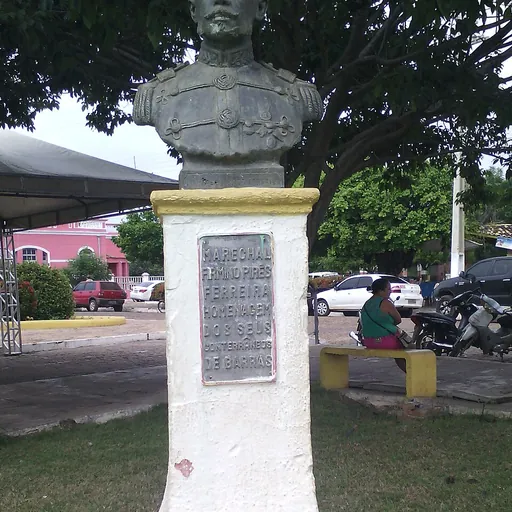
Firmino Pires Ferreira
Brazilian farmer, military and politician,
About Firmino Pires Ferreira
Lived 1848 – 1930 (aged 81–82). Firmino Pires Ferreira was a Brazilian military personnel and politician.
Firmino Pires Ferreira (25 September 1848 – 21 July 1930) was a Brazilian military officer and politician from the Pires Ferreira family.
Born in Barras, he enlisted and fought in the Paraguayan War when he was 17. He was part of important battles and reached the rank of 1st Lieutenant. Back in Brazil, he moved to Rio de Janeiro and graduated at the Court Military School. During the Empire of Brazil, he served in several roles and reached the rank of Lieutenant Colonel.
Firmino helped Deodoro da Fonseca with the military coup against Dom Pedro II during the Proclamation of the Republic on 15 November 1889. He fought in the Revolta da Armada and the Federalist Revolution during Floriano Peixoto's government. He gained military prestige and reached the rank of Marshal in 1906.
Firmino had a huge influence in politics both in Piauí and Rio de Janeiro. While in Rio he was known to be gentle, he used his influence in Piauí "with an iron fist". In Rio, he served as federal deputy from 1891 to 1893 and as senator from 1894 to 1920 and 1927 to 1930. In Piauí, he fought with the local families for power and exercised great power for most of the state history through the Old Republic, with its apex from 1896 to 1908, the so-called "piferismo" political movement.
He just got his power back after the pachequismo movement, but he died on 1930, leaving a gap of power fulfilled by Getúlio Vargas allies. His family was then politically persecuted by the Estado Novo.
First years
Firmino was born in Barras, on 25 September 1848, the son of José Pires Ferreira and Maria Joaquina de Jesus Castello Branco Carvalho de Almeida. He had 10 siblings, and was the 5th youngest. He also had 12 half-siblings.
Empire of Brazil
Paraguayan War
Firmino enlisted in the Brazilian Army on 11 January 1865 as a private. He volunteered to fight in the Paraguayan War and served the Engineering Battalion. On 18 January 1868, he was promoted to lieutenant and was given the responsibility for transporting construction material through the Chaco pathway. His performance was cheered by the Captain Manoel Peixoto Cursino de Amarante.
On 19 February 1868, Firmino was part of the Passage of Humaitá, where he served the charcana garrison. On 8 May, he commanded 24 sappers and destroyed the defense structures from the Paraguayan troops that were obstructing the Chaco passageway. In the same year, he was onboard of the monitor Rio Grande during a mission to protect the withdrawal of the Brazilian infantry. His performance was cheered by the Marquis of Caxias. He also helped taking over the fortifications that covered the passage of Jebiquari. On 12 August 1869, he was part of the Battle of Piribebuy. He was part of the vanguard troops that took over Piribebuy and was wounded. He was cheered by the Captain Deodoro da Fonseca and promoted to 1st Lieutenant. During the war, he became personal friends with Deodoro, Floriano Peixoto and Hermes da Fonseca.
In September 1893, he commanded the 6th Brigade to defend Floriano Peixoto's government during the Revolta da Armada.
In 1894, he was elected as Senator. He was reelected 9 times, serving up until 1920, and was part of the Commissions of the Navy, War and Constitution and Justice. In 1895, he was promoted to Brigadier general.
Firmino was also a First Class Instructor in the Military School of Realengo from Rio de Janeiro and Rio Grande do Sul and Inspector of the Military Schools of Rio de Janeiro and Rio Grande do Sul. In 1892, Coriolano de Carvalho e Silva, Governor of Piauí, fought with Baron of Castelo Branco, as the later denied an alliance to exclude Simplício Coelho de Resende from politics. The situation worsened when Resende was arrested in 1895 in the Gabino Besouro Government for publishing a note in his journal, O Democrata, for the hiring of a sentenced criminal as cooker for the Government Palace.
In 1896, Firmino and other powerful politicians that felt excluded formed a colligation against Raimundo Arthur de Vasconcelos, Governor of Piauí and political inheritor from Coriolano de Carvalho. The colligation was supported by the president Prudente de Morais and used O Democrata to attack the Governor. Raimundo, then, closed himself in an inner circle for the elections of 1896 and tried to renovate his allies as senators and congressmen. One of the candidates for the Senate in the Raimundo colligation was Joaquim de Lima Pires Ferreira, brother of Raimundo. Firmino group allied with the Federal Republican Party (PRF) and the Republican Legalist Party (PRL), but the elections were deemed fraudulent by both sides.
Pachequismo lasted for two governments, from João Luís Ferreira and Matias Olímpio de Melo. Melo's government was marked by a raise in violence in the state, as he had to fight cangaceiros and the Coluna Prestes. In 1927, the federal judge Lucrécio Dantas Avelino was murdered in his own house, and the opposition accused Melo to be the responsible, and Melo accused Eurípedes of the crime. Fernando used the instability of pachequismo and the support of the president Washington Luís, as his grandchild, Firmino Pires de Mello, was married to the presidents daughter, to be elected as a Senator. Félix won the election, but Fernando contested on STF and was elected instead, with Félix becoming ineligible.
There is a street in Teresina calles Firmino Pires.
A monument was built in homage of Firmino Pires Ferreira at Praça da Matriz, Barras. A school at Praça da Bonelle, Pedro II, was named Marechal Pires Ferreira.
Distinctions
Order of Avis Order of the Southern Cross Golden Medal (Brazil) Golden Medal (Argentina) Golden Medal (Uruguay)
Don’t just read it —
keep it.
Full-length biographies made to live with: read them, listen on the way to work, watch them tonight.
- E-book
- Audio
- Video
Instant download · yours to keep · every purchase keeps this site free
Important facts
People in Firmino Pires Ferreira's life
Named in this biography and alive at the same time

Related people
Same field, nearest in time


Contemporaries
People whose lives overlapped Firmino Pires Ferreira's




Frequently asked questions
Who was Firmino Pires Ferreira?
Brazilian farmer, military and politician,
When was Firmino Pires Ferreira born?
Firmino Pires Ferreira was born in 1848.
When did Firmino Pires Ferreira die?
Firmino Pires Ferreira died on 21 July 1930.
What was Firmino Pires Ferreira's occupation?
Firmino Pires Ferreira was a military personnel and politician.
What nationality was Firmino Pires Ferreira?
Firmino Pires Ferreira was Brazilian.
Sources & further reading
· Wikipedia: Firmino Pires Ferreira
· DBpedia: Firmino Pires Ferreira
Cite this page
APA: Biography.guide. (2026). Firmino Pires Ferreira. https://biography.guide/firmino-pires-ferreira/
MLA: "Firmino Pires Ferreira." Biography.guide, https://biography.guide/firmino-pires-ferreira/.
Chicago: "Firmino Pires Ferreira." Biography.guide. https://biography.guide/firmino-pires-ferreira/.
Data last updated: 2026-09-21 · Spot an error? Report a correction.
Portrait: Wikimedia Commons · author & licence
Page generated 2026-09-27 04:59 UTC