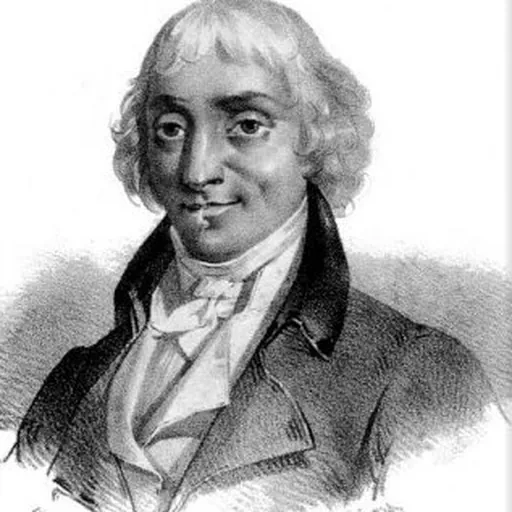
About Évariste de Parny
Lived 1753 – 1814 (aged 61). Évariste de Parny was a French poet, writer and translator.
Évariste Desiré de Forges, vicomte de Parny (6 February 17535 December 1814) was a French Rococo poet.
Biography
De Parny was born in Saint-Paul on the Isle of Bourbon (now Réunion); he came from an aristocratic family from the region of Berry, which had settled on the island in 1698. He left the island at the age of ten years to return to France with his two brothers, Jean-Baptiste and Chériseuil. He studied with the Oratoriens at their college in Rennes and decided to enter their religious order. He studied theology for six months at the collège Saint-Firmin in Paris, but decided finally instead on a military career, explaining that he was not religious enough to become a monk, and that he was attracted to Christianity mainly by the poetic imagery of the Bible. His brother Jean-Baptiste, an equerry of the Count of Artois, introduced him at the French Court at Versailles, where he met two other soldiers, who, like him, were from the French colonies, and would make their names in poetry; Antoine de Bertin, also from the Isle of Bourbon, and Nicolas-Germain Léonard, from Guadeloupe.
In 1773, he visited his father and family on the Isle of Bourbon. During his visit, he fell in love with Esther Lelièvre, but her father forbad them to marry. Missing Paris, he returned to France in 1775. Soon after he left, he learned that the Esther Lelièvre had married a doctor on the island. His unhappy romance inspired his first published poems, Les Poésies érotiques, which appeared in 1778, where Esther appeared under the name of Éléanore. The collection of poems brought great success and celebrity to its author.
On November 6, 1779, Parny was named a captain in the Queen's Regiment of Dragoons. In 1783, he returned to the Isle of Bourgon to settle the estate of his father, who had died, and also visited the Isle de France. In 1785, he left the Isle of Bourbon for Pondicherry in India, where he became an aide de camp to the Governor-General of the French colonies in India.
He was not at all happy in India, but he gathered a part of the material for his Chansons Madécasses (Eng: Songs of Madagascar), one of the first prose poems written in the French language. He soon moved back to France, where he left the army and moved to a house he owned in the valley of Feuillancourt, between Saint-Germain-en-Laye and Marly-le-Roi. The house was named La Caserne (Eng: The barracks), and with Bertin and Léonard, they formed a literary club called "The Society of the Barracks" which met regularly at the house.
When the French Revolution broke out, Parny, who did not receive any pension from the King and was not particularly interested in politics, played no part. He did, however, have to settle the debts left by his brother Jean-Baptiste, and, in 1795, these debts nearly ruined him. He was forced to take a position in the offices of the Ministry of the Interior for thirteen months, and then worked in the Administration of the Theater and the Arts. In 1804, the Count of Nantes found him another government position.
In 1802, Parny married Marie-Françoise Vally, and, the following year was received into the Académie française, where he occupied the 36th armchair. In 1813, Emperor Napoleon I granted him a pension of three thousand francs a year, but this was stopped under the Restoration of the monarchy in 1814. He died on December 5, 1814, in Paris.
Literary reputation and influence
Parny became known for his Poésies érotiques (1778) a collection of love poems which brought a breath of fresh air to the formal academic poetry of the 18th century. He is also known for his Chansons madécasses (1787), which he called translations of songs of the island of Madagascar, which are considered the first prose poems in French. They were illustrated by artist J-E Laboureur (1920) and some of them were set to music by Maurice Ravel (Chansons madécasses, 1925).
Parny's early love poems and elegies are characterised by the combination of tenderness, fancy and wit. One famous piece, the Elegy on a Young Girl, is an example.
Don’t just read it —
keep it.
Full-length biographies made to live with: read them, listen on the way to work, watch them tonight.
- E-book
- Audio
- Video
Instant download · yours to keep · every purchase keeps this site free
Important facts
People in Évariste de Parny's life
Named in this biography and alive at the same time

Related people
Same field, nearest in time

Contemporaries
People whose lives overlapped Évariste de Parny's






Frequently asked questions
Who was Évariste de Parny?
French poet (1753-1814)
When was Évariste de Parny born?
Évariste de Parny was born on 6 February 1753 in Saint-Paul.
When did Évariste de Parny die?
Évariste de Parny died on 5 December 1814 in Paris.
What was Évariste de Parny's occupation?
Évariste de Parny was a poet, writer and translator.
What nationality was Évariste de Parny?
Évariste de Parny was French.
Sources & further reading
· Wikipedia: Évariste de Parny
Cite this page
APA: Biography.guide. (2026). Évariste de Parny. https://biography.guide/evariste-de-parny/
MLA: "Évariste de Parny." Biography.guide, https://biography.guide/evariste-de-parny/.
Chicago: "Évariste de Parny." Biography.guide. https://biography.guide/evariste-de-parny/.
Data last updated: 2026-09-20 · Spot an error? Report a correction.
Page generated 2026-09-27 05:10 UTC