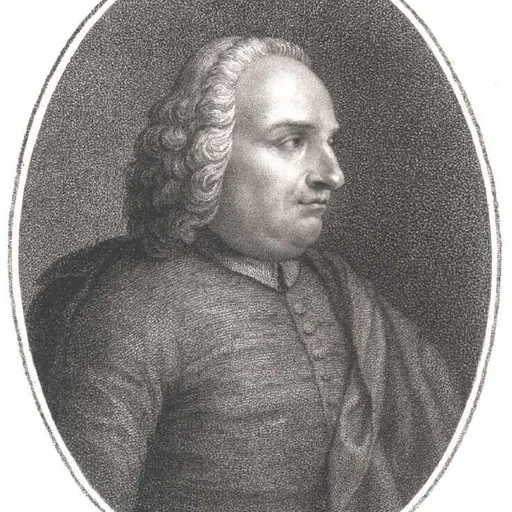
Eustachio Manfredi
Italian mathematician, astronomer and poet
About Eustachio Manfredi
Lived 1674 – 1739 (aged 64). Eustachio Manfredi was a mathematician, astronomer and poet.
Eustachio Manfredi (20 September 1674 – 15 February 1739) was an Italian mathematician, astronomer and poet. Manfredi discovered, ten years earlier than James Bradley, the phenomenon of aberration.
Biography
Eustachio Manfredi was born in Bologna on 20 September 1674. He attended Jesuit school, then studied at the University of Bologna, graduating with a degree in law in 1691. At the same time, he devoted himself to scientific studies in mathematics and astronomy, and to literature.
Manfredi founded the Accademia degli Inquieti (Academy of Restless) in Bologna around 1690 as a place where scientific topics could be discussed. At first, the Academy held its meetings in Manfredi's house. After four years, it moved to Jacopo Sandri's house, which had more space, and in 1705 moved again to the palazzo of Conte Luigi Ferdinando Marsigli. The Accademia delle Scienze dell'Istituto di Bologna was formally inaugurated in 1714, and the Accademia degli Inquieti merged into it.
In 1698, Manfredi obtained the chair of mathematics at the University of Bologna. In 1704, he was named "Superintendent of the waters of Bologna", and was also made head of the college of Montalto, which educated young men destined for a clerical career. In 1711, he became director of the Astronomical Observatory of Bologna, a position he held until his death. He was a member of the French Academy of Sciences in Paris from 1726 and of the Royal Society of London from 1729. He died in Bologna on 15 February 1739.
Scientific work Manfredi's scientific work was impressive. On 29 November 1707 Manfredi and Vittorio Francesco Stancari discovered the comet C/1707 W1. Among his scientific works are Ephemerides motuum coelestium (1715–1725), which he completed with the help of his sisters Maddalena and Teresa; De transitu Mercurii per solem anno 1723 (1724), De gnomone meridiano bononiensi (1736) and Instituzioni astronomiche (1749), a posthumous work.
The asteroid 13225 Manfredi was named in honour of Eustachio Manfredi and his two brothers Gabriele Manfredi and Eraclito Manfredi. In 1719 Manfredi discovered, ten years earlier than James Bradley, the phenomenon of aberration. "The phenomenon is still known as the annual aberration of fixed stars, the name Manfredi gave it in the title of De annuis inerrantium stellarum aberrationibus (1729)."
The discovery provided "the first demonstration, though unsought, of the revolution of the Earth around the Sun, and thus the reality of a heliocentric system". As a result of this discovery, the Church admitted the scientific nature of the Copernican system and removed from the index many works of Galileo Galilei.
Literary work
Manfredi was also a well-known poet in his day. He was a member of the Academy of Arcadia with the name of "Aci Delpusiano". The Rime of Manfredi was issued in 1713 and then published in the final edition posthumously in 1748 by his friend Giampietro Zanotti. It is generally about events of the period (births, marriages, deaths, etc.), according to the peculiar character of the Arcadian poetry, and is often weighed down by emphasis and intellectualism. His poetic vein shows itself in a group of poems called "for a nun," inspired by the closure of the convent of Giulia Caterina Vandi, a girl of Bologna with whom Manfredi had fallen in love. This group includes the song "Woman, they are your eyes", considered his masterpiece, and numerous sonnets in the style of Petrarch.
Works
Notes and references
Don’t just read it —
keep it.
Full-length biographies made to live with: read them, listen on the way to work, watch them tonight.
- E-book
- Audio
- Video
Instant download · yours to keep · every purchase keeps this site free
Important facts
People in Eustachio Manfredi's life
Named in this biography and alive at the same time



Related people
Same field, nearest in time


Contemporaries
People whose lives overlapped Eustachio Manfredi's




Frequently asked questions
Who was Eustachio Manfredi?
Italian mathematician, astronomer and poet (1674–1739)
When was Eustachio Manfredi born?
Eustachio Manfredi was born on 20 September 1674 in Bologna.
When did Eustachio Manfredi die?
Eustachio Manfredi died on 15 February 1739 in Bologna.
What was Eustachio Manfredi's occupation?
Eustachio Manfredi was a mathematician, astronomer and poet.
Sources & further reading
· Wikipedia: Eustachio Manfredi
Cite this page
APA: Biography.guide. (2026). Eustachio Manfredi. https://biography.guide/eustachio-manfredi/
MLA: "Eustachio Manfredi." Biography.guide, https://biography.guide/eustachio-manfredi/.
Chicago: "Eustachio Manfredi." Biography.guide. https://biography.guide/eustachio-manfredi/.
Data last updated: 2026-09-22 · Spot an error? Report a correction.
Portrait: Wikimedia Commons · author & licence
Page generated 2026-09-27 05:04 UTC