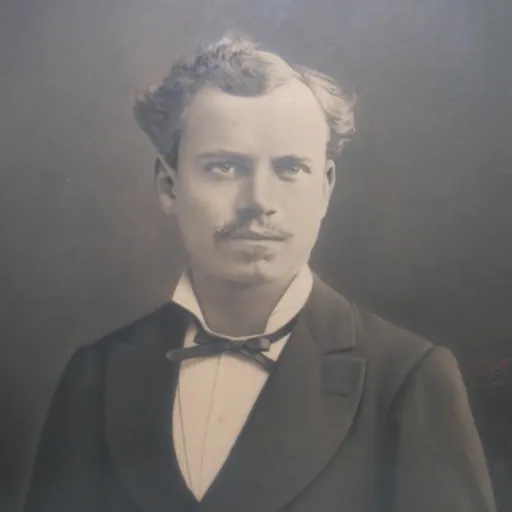
About Eugène Farcot
Lived 1830 – 1896 (aged 66). Eugène Farcot was a French inventor, clockmaker and watchmaker.
Henri-Eugène-Adrien Farcot (20 February 1830 in Sainville – 14 March 1896 in Saint-Maur-des-Fossés) was a French clockmaker, industrialist, inventor, mechanical engineer, aeronaut, writer, and one of the most celebrated makers of conical pendulum clocks.
Career In 1853, he established the Manufacture d'horlogerie E. Farcot with headquarters, from 1855 (previously in , 75, Paris), on , 39, Paris, wherein he worked until his retirement in the late 1880s, succeeded by his son-in-law the Belgian Henri-Charles Wandenberg, or Vandenberg, until December 1903 and Paul Grenon (Wandenberg's nephew) until 1914. Between October 1855 and March 1856 the company's name changed to Farcot et Cie, and in 1887 it was renamed Farcot et Wandenberg, although the partnership was officially constituted in April 1890.
Throughout his career, Farcot earned an honorable mention and four medals at the following expositions: Besançon 1860 (bronze), London 1862 (honorable mention), Paris (1863 bronze, 1867 bronze & 1878 silver), as well as did Henri Wandenberg, both with a silver medal in Paris 1889 and a gold medal in Paris 1900.
In addition to clockmaking, Farcot was a member of the Société aérostatique et météorologique de France and the defunct Chambre syndicale d'horlogerie de Paris. The Musée Farcot in Sainville showcases his life, travels, and work.
Patents Of the nineteen patents registered to his name between 1855 and 1886, sixteen are linked to horology. In chronological order, they are:
22637, 03/03/1855 – Mouvement de pendule 37159, 23/06/1858 – Perfectionnements apportés à l'horlogerie 41812, 11/08/1859 – Perfectionnements apportés à l'horlogerie 44007, 23/02/1860 – Perfectionnements apportés à l'horlogerie 50962, 24/08/1861 – Réveille-matin avertisseur 53502, 25/03/1862 – Perfectionnements apportés à l'horlogerie 65992, 26/01/1865 – Perfectionnements aux réveille-matin 84057, 20/01/1869 – Timbre d'appel, avertisseur mobile de porte, et sonnerie télégraphique simplifiée 89384, 31/03/1870 – Réveil horizontal à marche rotative et silencieuse 89455, 26/03/1870 – Perfectionnements apportés et appliqués spécialement dans la fabrication des réveille-matin 92460, 14/08/1871 – Pendule de nuit
101995, 29/01/1874 – Perfectionnement et transformation dans la fermeture des porte-monnaie à cadre, pouvant s'appliquer à tous objets de fantaisie, tels que porte-cigares, cigarettes, carnets, bonbonnières, etc. 102593, 14/03/1874 – Perfectionnements apportés aux pendules de nuit lumineuses 107030, 01/03/1875 – Système de pendule-écusson applique, à remontoir auxiliaire et à tirage rentrant 166518, 10/08/1875 – Device for winding clocks (US patent of 107030) 167502, 07/03/1885 – Système de pendule à indications diurnes et nocturnes 176982, 24/06/1886 – Pendule courtoise 177703, 31/07/1886 – Réveil courtois 252398, 12/12/1895 – Application du phonographe aux pièces d'horlogerie (registered to the name of the Société Farcot et Wandenberg)
Files for each patent, including a description and drawings, can be consulted in the archives of the Institut national de la propriété industrielle (INPI).
Monumental conical pendulum clock series Clock stand of the Société des Marbres Onyx d'Algérie during the 1867 Paris world fair. This reputed, multi-awarded French firm provided the pedestal for the timepieces. Both the clock making company and the stone carver-supplier marketed the product. Drawing by D. Lancelot. In the section devoted to the French horology at the 1867 Paris world fair is seen another version of the statue by Carrier-Belleuse. Drawing by Lamy.
A class of its own among the conical pendulum clocks are the monumental timepieces commercialized between 1862 and 1878. When this model debuted at the London International Exhibition of 1862, it was presented as the first application of the conical pendulum to statuary. In addition to the British capital, this clock was also displayed at the Paris Exposition des beaux-arts appliqués à l'industrie (1863), as well as in the major world's fairs held in Paris (1867 and 1878) and Philadelphia (1876).
In his own words, Eugène Farcot explained the origins of his idea during the 1867 Paris universal exposition (translated from the French):
Each mystery clock of this series was individually handcrafted. They were produced by artisans and scientists from multiple disciplines, utilizing techniques of Second Empire decorative arts.
Besides a remarkable precision in timekeeping, one of their most distinctive characteristics is the slow continual circular motion at a constant speed (instead of the conventional side to side swinging motion) of the noiseless pendulum, tracing a conical trajectory in space, hence its name.
List of clocks The total number of clocks crafted is unknown; so far 13 have been found. It is unclear if the company used a separate serial number for its large-scale conical pendulum clocks, although probably no more than twenty were ever made. Those known are:
No. 0 – Lambert Castle, New Jersey, USA. Purchased in 1869 for $10,000 No. 8 – The Roosevelt New Orleans Hotel, New Orleans, USA No. 9 – Private collection, USA No. 16 – Drexel University, Pennsylvania, USA. Acquired in 1867 for $6,000 No. 19 – National Watch and Clock Museum (NWCM), Pennsylvania, USA No. 23 – Private collection, USA
No. 25 – Cliffe Castle Museum, Yorkshire, UK No. 28 – Cooper Hewitt, Smithsonian Design Museum, New York, USA No. 30 – Private collection, USA No. 44195 – Private collection, USA No serial number, Museo Cerralbo, Spain No serial number, The Dolder Grand Hotel, Switzerland The one depicted in the drawing by Lamy with two dials in the pedestal front, whereabouts unknown
Gallery
The largest conical pendulum clock The piece at the Galerie d'Iéna, one of the main exhibition pavilions in the Palais du Champ-de-Mars at the Paris world fair of 1878. The artefact epitomizes the alliance between art and industry promoted back then and also the golden age of the conical pendulum clock (second half of the 19th century). Drawing depicting the grand vestibule of the Galerie d'Iéna, both the clock and ceiling height have been magnified.
In 1878, the largest conical pendulum clock ever built was erected in the since-demolished Palais du Champ-de-Mars on the occasion of the Paris Exposition universelle internationale. It was Farcot's ultimate contribution to the conical pendulum clock, a type of timepiece not invented by the French, but that he brought to a new level of sophistication and engineering. Not to mention that he also helped to popularize it by offering affordable mantel models, some with a patent of invention.
The mechanical marvel was reviewed in several publications, next are included three of them:
During the Siege of Paris
Nadar shakes Farcot's hand, before taking off at 9:00 am from the Place Saint-Pierre in Montmartre. The Louis Blanc was the 10th balloon mail of 66 sent during the siege. Farcot and Traclet suffered a turbulent, risky landing in Belgium.
This, however, did not impede him, during the Siege of Paris (1870–71), from leaving the city on 12 October 1870, piloting the ballon monté (balloon mail) Louis Blanc, overflying the siege and the Prussians shooting at it, in order to transport the mail, government dispatches, and eight carrier pigeons. He, and Auguste Traclet from the Association Colombophile de Paris, arrived in Béclers (Belgium) three hours later, becoming the first French aeronauts in Belgium.
Despite the balloon bearing his name, the politician Louis Blanc, who was present at the departure, refused to fly in the balloon when Wilfrid de Fonvielle asked him.
Funereal discourse Discourse pronounced before the tomb of the horologist by Paul Garnier, vice-president of the Chambre syndicale d'horlogerie de Paris [translated from the French]:
Publications La navigation atmosphérique, 1859. Un voyage aérien dans cinquante ans (unpublished), 1864. Invention et contrefaçon. A mes juges et à mes confrères, 1865. De Paris à Tournay en 3 heures. Histoire du ballon le Louis Blanc, 1873. Voyage du ballon le Louis-Blanc, 1874.
Don’t just read it —
keep it.
Full-length biographies made to live with: read them, listen on the way to work, watch them tonight.
- E-book
- Audio
- Video
Instant download · yours to keep · every purchase keeps this site free
Important facts
People in Eugène Farcot's life
Named in this biography and alive at the same time


Related people
Same field, nearest in time



Contemporaries
People whose lives overlapped Eugène Farcot's




Frequently asked questions
Who was Eugène Farcot?
French clockmaker (1830-1896)
When was Eugène Farcot born?
Eugène Farcot was born on 20 February 1830 in Sainville.
When did Eugène Farcot die?
Eugène Farcot died on 14 March 1896 in Saint-Maur-des-Fossés.
What was Eugène Farcot's occupation?
Eugène Farcot was an inventor, clockmaker and watchmaker.
What nationality was Eugène Farcot?
Eugène Farcot was French.
Sources & further reading
Cite this page
APA: Biography.guide. (2026). Eugène Farcot. https://biography.guide/eugene-farcot/
MLA: "Eugène Farcot." Biography.guide, https://biography.guide/eugene-farcot/.
Chicago: "Eugène Farcot." Biography.guide. https://biography.guide/eugene-farcot/.
Data last updated: 2026-09-22 · Spot an error? Report a correction.
Portrait: Wikimedia Commons · author & licence
Page generated 2026-09-27 05:02 UTC