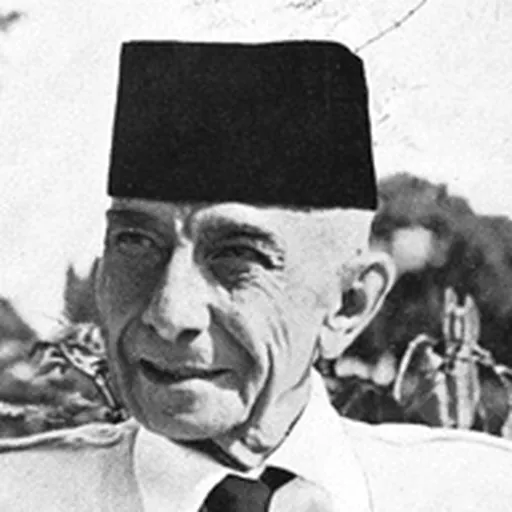
About Ernest Douwes Dekker
Lived 1879 – 1950 (aged 70). Ernest Douwes Dekker was a Dutch and Indonesian writer, teacher, politician and journalist.
Ernest François Eugène Douwes Dekker (8 October 1879 – 28 August 1950), also known as Danudirja Setiabudi after Indonesian independence, was an Indonesian-Dutch nationalist and politician of Indo descent. He was related to the famous Dutch anti-colonialism writer Eduard Douwes Dekker. In his youth, he fought in the Second Boer War in South Africa on the Boer side. His thoughts were highly influential in the early years of the Indonesian freedom movement.
Early years Douwes Dekker was born in Pasuruan, in the north east of Java, south of Surabaya. His father was Auguste Henri Edouard Douwes Dekker, a broker and bank agent, of a Dutch family living in the then-Dutch East Indies. His Indo (Eurasian) mother was Louisa Margaretha Neumann, of half-German and half-Javanese descent. Douwes Dekker's great-uncle was the famous writer Eduard Douwes Dekker, author of Max Havelaar.
After studying in Lower School in Pasuruan, he moved to Surabaya, and later to Batavia. In 1897, he gained his diploma and worked on a coffee plantation in Malang, East Java. Later he moved to a sugar plantation in Kraksaan, East Java. During his years in these plantations, he came in contact with ordinary Javanese and saw the realities of their hard work. He established contact with Indian anti-colonial radicals like Shyamji Krishna Varma and Har Dayal, whose work was published in Dekker's publication Het Tijdschrift. He sympathised with syndicalism and Dekker was widely considered to be an anarchist himself during this time and was the first Indonesian to be known as such.
In 1913, close associates of Douwes Dekker, including physicians Tjipto Mangunkusumo and Suwardi Surjaningrat, established the Native Committee in Bandung, which later became the Indische Partij. The Colonial government quickly became worried, and the party was forbidden. This led to the exile to the Netherlands of Douwes Dekker and his two Javanese associates.
In exile, they worked with liberal Dutchmen and compatriot students. It is believed that the term Indonesia was first used in the name of an organization, the Indonesian Alliance of Students, with which they were associated during the early 1920s.
In 1918 he was allowed to return to the East Indies and was responsible for reforming the 'Insulinde' into the new 'National Indische Party' (NIP). Together with his new associate P.F. Dahler and old companion Tjipto Mangoenkoesoemo, he became a prominent leader of the NIP. After the NIP was involved in the Surakarta farmers' strike, he was imprisoned again by the colonial authorities in 1921.
Later, however, his activities were branded illegal, and in 1936 he was condemned to three months in prison. He was still actively advocating independence and sharing his thoughts with other intellectuals, among them Sukarno, who considered Douwes Dekker as his teacher. Later, however, his influence was overshadowed by the politics of his student Sukarno's Indonesian National Party (PNI), Islamist Sarekat Islam, and Communist Party of Indonesia.
During World War II, Dutch authorities, who considered him a dangerous activist, exiled him, along with many Indo-European of German descent, to Suriname. He would spend years in a forest prison camp called Jodensavanne internment camp. Dekker returned to Indonesia on 2 January 1947.
Later years After he returned to Indonesia, he was appointed a member of the provisional parliament, or Komite Nasional Indonesia Pusat (Indonesian National Central Committee). In February 1947, he changed his name to Danudirja Setiabudi which means 'powerful substance, faithful spirit.' In 1947 he divorced his second wife and married the Indo European author Nelly Alberta Kruymel, who had changed her name to Harumi Wanasita, in an Islamic ceremony.
In December 1948 he was lifted from his sickbed and arrested by Dutch troops, but released due to his poor health.
He spent his last years in Bandung, writing his autobiography, 70 Jaar Konsekwent. On his seventieth birthday to his delight, he witnessed the formal Dutch transfer of sovereignty to Indonesia in 1949. He died eight months later in 1950.
Legacy
In Dutch literature, he is portrayed as a tragic and misunderstood historical figure.
However, his legacy as a national hero is still appreciated in Indonesia. A district and a main street in Jakarta are named Setiabudi in his honour, as well as Setiabudi Integritas station of Transjakarta Corridor 6, Setiabudi Astra station of Jakarta MRT, and Setiabudi station of Jabodebek LRT serving the district.
His life is recorded in a biography, Het Leven van EFE Douwes Dekker, by Frans Glissenaar in 1999.
Don’t just read it —
keep it.
Full-length biographies made to live with: read them, listen on the way to work, watch them tonight.
- E-book
- Audio
- Video
Instant download · yours to keep · every purchase keeps this site free
Important facts
People in Ernest Douwes Dekker's life
Named in this biography and alive at the same time


Related people
Same field, nearest in time




Contemporaries
People whose lives overlapped Ernest Douwes Dekker's

Frequently asked questions
Who was Ernest Douwes Dekker?
Indonesia politician (1879–1950)
When was Ernest Douwes Dekker born?
Ernest Douwes Dekker was born on 8 October 1879 in Pasuruan.
When did Ernest Douwes Dekker die?
Ernest Douwes Dekker died on 28 August 1950 in Bandung.
What was Ernest Douwes Dekker's occupation?
Ernest Douwes Dekker was a writer, teacher, politician and journalist.
What nationality was Ernest Douwes Dekker?
Ernest Douwes Dekker was Dutch and Indonesian.
Sources & further reading
· Wikipedia: Ernest Douwes Dekker
· DBpedia: Ernest Douwes Dekker
Cite this page
APA: Biography.guide. (2026). Ernest Douwes Dekker. https://biography.guide/ernest-douwes-dekker/
MLA: "Ernest Douwes Dekker." Biography.guide, https://biography.guide/ernest-douwes-dekker/.
Chicago: "Ernest Douwes Dekker." Biography.guide. https://biography.guide/ernest-douwes-dekker/.
Data last updated: 2026-09-22 · Spot an error? Report a correction.
Portrait: Wikimedia Commons · author & licence
Page generated 2026-09-27 04:58 UTC