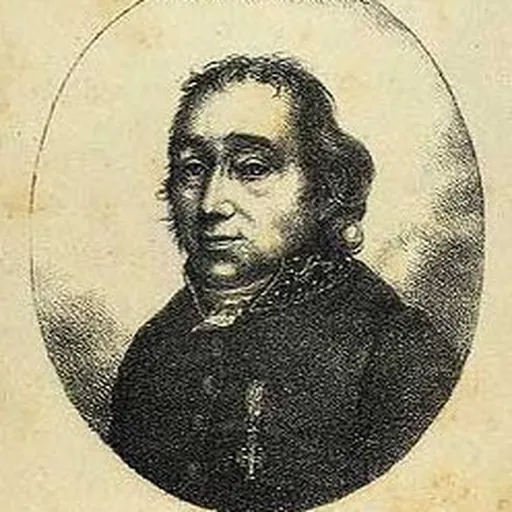
About Erik Viborg
Lived 1759 – 1822 (aged 63). Erik Viborg was a Danish botanist, veterinarian and university teacher.
Erik Nissen Viborg (5 April 1759 – 25 September 1822) was a Danish veterinarian and botanist.A genus of legumes Wiborgia was named by Carl Peter Thunberg in honour of Viborg.
Early life and education Viborg was born on 5 April 1759 in , Sønderjylland, the son of parish priest Carl Viborg (1706–82) and Marie Sophie Friis (1721–89). He was taught privately by his father at home. In 1777 he enrolled at the University of Copenhagen where he initially studied theology and Oriental languages. After three years, he gave up the study of theology and turned to the study of physics, mathematics and natural history.
His studies of natural history introduced him to who endorsed him to pursue a career in veterinary sciences. After a year of study at the Cetenary School in Christianshavn, Viborg was employed as an assistant teacher with an annual salary of 200 Danish rigsdaler.
Career From 1784 to 1787, Viborg travelled in Europe. After his return, he won a prize from the Royal Danish Academy of Sciences and Letters for his thesis about the ‘sand plants’ (mainly Marram grass) and their use as sand-binders in protection of agricultural lands from aeolian sand. He was then appointed teacher (with the title of professor) at the Veterinary School (1787–1790). In 1796, King Christian VII of Denmark sent Viborg to Poland and Romania to purchase stallions for the Frederiksborg stud farm. When the chair of botany was installed in 1797 at the University of Copenhagen, Viborg became its first holder, surpassing Martin Vahl. This was probably achieved more through ties to the upper circles than through scientific merit. After the death of Abildgaard in 1801, Viborg became professor and rector of the Veterinary School, a position he held to his death. In 1816, he was elected a foreign member of the Royal Swedish Academy of Sciences.
The legume genus Wiborgia Thunb. was named for him.
Awards In 1809 Viborg was created a knight of the Order of the Dannebrog.
Don’t just read it —
keep it.
Full-length biographies made to live with: read them, listen on the way to work, watch them tonight.
- E-book
- Audio
- Video
Instant download · yours to keep · every purchase keeps this site free
Important facts
People in Erik Viborg's life
Named in this biography and alive at the same time
Related people
Same field, nearest in time




Contemporaries
People whose lives overlapped Erik Viborg's




Frequently asked questions
Who was Erik Viborg?
Danish botanist (1759-1822)
When was Erik Viborg born?
Erik Viborg was born on 5 April 1759 in Bedsted.
When did Erik Viborg die?
Erik Viborg died on 25 September 1822 in Copenhagen.
What was Erik Viborg's occupation?
Erik Viborg was a botanist, veterinarian and university teacher.
What nationality was Erik Viborg?
Erik Viborg was Danish.
Sources & further reading
Cite this page
APA: Biography.guide. (2026). Erik Viborg. https://biography.guide/erik-viborg/
MLA: "Erik Viborg." Biography.guide, https://biography.guide/erik-viborg/.
Chicago: "Erik Viborg." Biography.guide. https://biography.guide/erik-viborg/.
Data last updated: 2026-09-20 · Spot an error? Report a correction.
Portrait: Wikimedia Commons · author & licence
Page generated 2026-09-27 04:57 UTC