
Erich von Falkenhayn
Chief of Germany's General Staff during the first two years of the First World War
About Erich von Falkenhayn
Lived 1861 – 1922 (aged 60). Erich von Falkenhayn was a German politician, military personnel, military advisor, military attaché, soldier and military commander.
Erich Georg Sebastian Anton von Falkenhayn (11 September 1861 – 8 April 1922) was a German general and Ottoman Field Marshal who served as Prussian Minister of War and Chief of the German General Staff during the First World War. Falkenhayn replaced General Helmuth von Moltke the Younger in September 1914 after his invasion of France was stopped at the First Battle of the Marne and was in turn removed on 29 August 1916 after the failure of his offensive strategy in the west at the Battle of Verdun, the opening of the Battle of the Somme, the Brusilov Offensive and the Romanian entry into the war. Having planned to win the war before 1917, the German army was reduced to hanging on.
Falkenhayn was given important field commands in Romania and Syria. As a commander in the Middle East, he prevented a planned Ottoman deportation of Jews from Palestine. His reputation as a war leader was attacked in Germany during and after the war, especially by the faction supporting Field Marshal Paul von Hindenburg. Falkenhayn held the belief that Germany could not win the war by a decisive battle but would have to reach a compromise peace; his enemies said he lacked the resolve necessary to win a decisive victory. Falkenhayn's relations with the Chancellor Theobald von Bethmann Hollweg were troubled and undercut Falkenhayn's plans.
Early life Falkenhayn was born in Burg Belchau, a village near Graudenz, now Białochowo in Poland, to Fedor von Falkenhayn (1814–1896) and Franziska von Falkenhayn, née von Rosenberg (1826–1888). His ancestors could be traced to 1504. His brother Arthur (1857–1929) became tutor of Crown Prince Wilhelm and another brother Eugen (1853–1934) became a Prussian General of Cavalry. His only sister Olga von Falkenhayn was the mother of Field Marshal Fedor von Bock.
Military career
Becoming a cadet at the age of 11, Falkenhayn joined the Army in 1880 as Second Lieutenant. He served as an infantry and staff officer. He became First Lieutenant in 1889 and (captain) in 1893, subsequently transferring to the topographical department of the German General Staff.
Prussian Minister of War (1913–1914) On 8 July 1913 Falkenhayn became Prussian Minister of War, succeeding Josias von Heeringen, who was considered to be inactive.
Chief of Staff 1914 Falkenhayn succeeded Helmuth von Moltke the Younger, who was considered mentally unstable, as Chief of the (the German General Staff) on 14 September 1914. Falkenhayn was 53 years old, making him the youngest man to become chief of staff. Falkenhayn continued in office as minister of war for another five months. Falkenhayn moved OHL to Mézières, to put OHL at the centre of the right wing of the German armies in the west and ordered the southern armies to dig in, part of the beginning of trench warfare. The responsibility of Falkenhayn increased when the Kaiser failed to decide a grand strategy. Falkenhayn did not want diplomatic interference in the course of war. For the first few weeks, lack of success led to widespread criticism. Falkenhayn recognized the pending failure of the Schlieffen-Moltke Plan and attempted to outflank the British and French in the Race to the Sea, a series of meeting engagements in northern France and Belgium, in which each side made reciprocal attempts to turn the other's flank, until they reached the North Sea coast and ran out of room for manoeuvre.
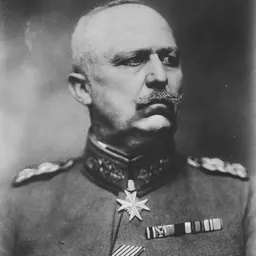
In November 1914, Falkenhayn acknowledged that Germany would not be able to gain a decisive victory. He advocated a mild peace with the Russian Empire to Bethmann Hollweg, the better to concentrate against the French and British. Neither Bethmann Hollweg nor the generals on the Eastern Front, such as Paul von Hindenburg, Erich Ludendorff or Max Hoffmann, supported the idea since they believed that negotiation with the Russian Empire was impossible. Falkenhayn did not perceive the need to deploy troops on the Vistula, he favoured sending troops to East Prussia, where the Russians took advantage of the weakening 8th Army.
1915 A Breakthrough Army for an offensive down the Somme river valley, consisting of nine new divisions, was formed in the first quarter of 1915 but three divisions were not ready in time. The new army was transferred to the Eastern Front and was renamed the 11th Army. The army had success during the Second Battle of the Masurian Lakes but raising divisions was difficult because of the shortage of junior officers and equipment.
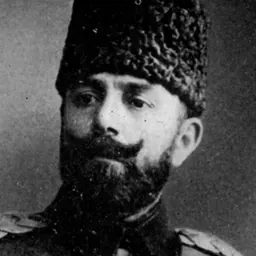
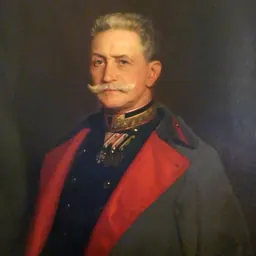
Falkenhayn found that the (Imperial German Flying Corps, ), needed to be expanded. Falkenhayn noticed that the scepticism of the Ministry of War to airships, was justified. He tried to use the airships and develop rapidly the air force. Wild von Hohenborn was appointed minister of war and on 20 January 1915, Falkenhayn was promoted to . As the chief of staff, Falkenhayn had many enemies because of his strategic thinking but he had Franz Conrad von Hötzendorf, chief of staff of the Austro-Hungarian Army, as his uneasy ally. They differed on war aims; Hötzendorf wanting a war against Russia, Falkenhayn against France. Falkenhayn attempted to keep Italy out of the war but failed. The evacuation of the population of Jerusalem during the harsh winter months had also been planned by Djemal Pasha and was thwarted by German officers including Falkenhayn. As an Army commander, he witnessed the end of the war in Belarus. In December 1918 he oversaw the withdrawal of the 10th Army to Germany. The formation disbanded in February 1919 and Falkenhayn retired from the army following the dissolution of his army.
Don’t just read it —
keep it.
Full-length biographies made to live with: read them, listen on the way to work, watch them tonight.
- E-book
- Audio
- Video
Instant download · yours to keep · every purchase keeps this site free
Important facts
People in Erich von Falkenhayn's life
Named in this biography and alive at the same time





Related people
Same field, nearest in time




Contemporaries
People whose lives overlapped Erich von Falkenhayn's


Frequently asked questions
Who was Erich von Falkenhayn?
Chief of Germany's General Staff during the first two years of the First World War (1861-1922)
When was Erich von Falkenhayn born?
Erich von Falkenhayn was born on 11 September 1861 in Białochowo.
When did Erich von Falkenhayn die?
Erich von Falkenhayn died on 8 April 1922 in Lindstedt Castle.
What was Erich von Falkenhayn's occupation?
Erich von Falkenhayn was a politician, military personnel, military advisor, military attaché, soldier and military commander.
What nationality was Erich von Falkenhayn?
Erich von Falkenhayn was German.
Sources & further reading
· Wikipedia: Erich von Falkenhayn
· DBpedia: Erich von Falkenhayn
Cite this page
APA: Biography.guide. (2026). Erich von Falkenhayn. https://biography.guide/erich-von-falkenhayn/
MLA: "Erich von Falkenhayn." Biography.guide, https://biography.guide/erich-von-falkenhayn/.
Chicago: "Erich von Falkenhayn." Biography.guide. https://biography.guide/erich-von-falkenhayn/.
Data last updated: 2026-09-20 · Spot an error? Report a correction.
Page generated 2026-09-27 05:22 UTC