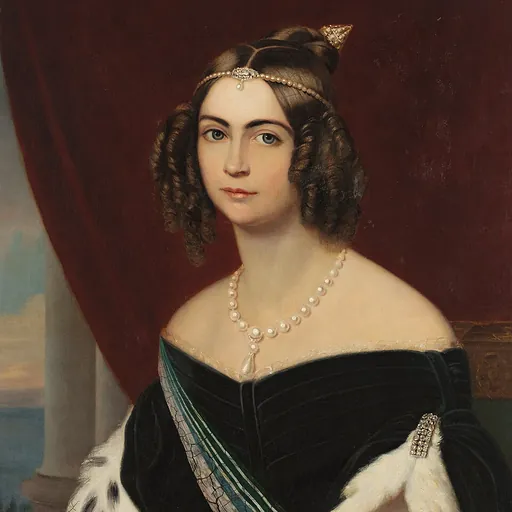
About Empress Amélie of Brazil
Lived 1812 – 1873 (aged 60). Empress Amélie of Brazil was a French and Italian consort.
Amélie of Leuchtenberg (; ; 31 July 1812 – 26 January 1873) was Empress of Brazil as the wife of Pedro I of Brazil.
She was the granddaughter of Josephine de Beauharnais, Empress of the French. Her father, Eugène de Beauharnais, was the only son of Empress Josephine and her first husband Alexandre, Viscount of Beauharnais. He thus became a stepson of Napoleon Bonaparte when his mother married the future emperor. The mother of Empress Amélie was Princess Augusta, daughter of Maximilian I, King of Bavaria.
Early life Amélie of Leuchtenberg was born in Milan on 31 July 1812 to Eugène de Beauharnais, Duke of Leuchtenberg, and Princess Augusta of Bavaria. She spent her early childhood in the Napoleonic Kingdom of Italy. In 1814, when Amélie was two years old, French emperor Napoleon Bonaparte was defeated, and her family moved to Munich in the Kingdom of Bavaria, where she grew up.
Princess Augusta personally directed Amélie's education. Contemporary observers regarded her as one of the best educated and best prepared princesses in the German states. As Amélie approached adulthood, Princess Augusta considered a royal marriage that would preserve the standing of the House of Leuchtenberg. When a marriage to Emperor Pedro I of Brazil was arranged, Augusta personally prepared her daughter for life at the Brazilian court.
Family Amélie belonged to the House of Beauharnais. Through her father, she was a granddaughter of Joséphine de Beauharnais and a step-granddaughter of Napoleon Bonaparte. Through her mother, she was a granddaughter of Maximilian I Joseph of Bavaria.
Like many members of her family, Amélie grew up among Europe's ruling dynasties. Her sister Josephine of Leuchtenberg became queen consort of King Oscar I of Sweden, while her brother Auguste de Beauharnais, 2nd Duke of Leuchtenberg married Queen Maria II of Portugal. Marriage
After the death of his first wife, the Austrian archduchess Maria Leopoldina, in December 1826, Emperor Pedro I of Brazil (and King Pedro IV of Portugal) sent the Marquis of Barbacena to Europe to find him a second wife. His task was not easy; several factors complicated the search. First, Dom Pedro had stipulated four conditions: a good family background, beauty, virtue and culture. Conversely, the emperor of Brazil did not have a particularly good image in Europe: his relationship with the Marchioness of Santos was notorious, and few eligible princesses were expected to be eager to leave the courts of Europe to marry a widower who had a tarnished reputation as a husband, becoming step-mother to his five children. To make matters worse, the former father-in-law of Dom Pedro, Francis I of Austria, had a low opinion of his son-in-law's political views, and apparently acted to prevent a new marriage to ensure that his grandchildren would inherit the throne of Brazil if they survived infancy.
After refusals by eight princesses that turned the ambassador into an object of scorn in the courts of Europe, Barbacena, in agreement with the Emperor, lowered his requirements, seeking for Dom Pedro a wife merely "good and virtuous". Amélie now became a good possibility, but their encounter was brought about not by Barbacena, but by Domingos Borges de Barros, Viscount of Pedra Branca, minister in Paris, to whom she had been pointed out. She came from a distinguished and ancient line on her mother's side, the Wittelsbachs, but her father, an exile who shared in the disgrace of Napoleon Bonaparte's deposition as emperor, was not an optimal marital match. However, that was her sole "defect". The princess was tall, very beautiful, well proportioned, with a delicate face. She had blue eyes and brownish-golden hair. António Teles da Silva Caminha e Meneses, Marquis of Resende, sent to verify the beauty of the young lady, praised her highly, saying that she had "a physical air that like that the painter Correggio gave us in his paintings of the Queen of Sheba".
The marriage contract was signed on 29 May 1829 in England, and ratified on 30 June in Munich by Amélie's mother, the Duchess of Leuchtenberg, who had tutored her daughter personally. On 30 July of that year, in Brazil, a treaty of marriage between Pedro I and Amélie of Leuchtenberg was promulgated. Upon confirming the marriage, Dom Pedro definitively broke his links to the Marchioness of Santos and, as evidence of his good intentions, instituted the Order of the Rose, with the motto "Amor e Fidelidade" ("Love and Fidelity"). A proxy marriage ceremony on 2 August in the chapel of the Palais Leuchtenberg in Munich was a simple affair with few in attendance,
Their marriage was a happy one, unlike Dom Pedro's first, and she reportedly had a good relationship with her legitimate stepchildren as well. Her beauty, good sense, and kindness promptly won the affections of both her husband and his children by his first marriage. She made sure that the latter had a good family environment and received a good education. Shortly after the marriage, a French traveler reported "it appears that the empress continues to exercise her influence over the children of Dom Pedro. The happy results are already apparent, she has already made considerable renovations to the palace, and order has commenced to reign; the princesses' education is supervised and directed personally by the empress", with the same care going to the heir to the throne, little Prince Pedro de Alcântara (later Emperor Pedro II of Brazil); the proof of this last being that he soon began to call her "mamãe" ("mommy").
Her presence was also important in restoring her husband's popularity and giving him courage during a difficult period for the new empire, but the popular enthusiasm generated by the marriage was short-lived.
Amélie soon established residence in Paris, with Maria da Glória and with Dom Pedro's illegitimate daughter Isabel Maria, Duchess of Goiás, whom Amélie ended up adopting as her own daughter. On 30 November 1831 Amélie gave birth to Princess Maria Amélia, who would prove to be her only child.
Meanwhile, Dom Pedro I, as Duke of Braganza, began a bloody battle against his brother Dom Miguel I of Portugal for the Portuguese crown, in the name of his daughter Maria da Glória. With Miguel defeated and exiled from Portugal, Dom Pedro and his family established themselves first at Ramalhão Palace and later at Queluz Palace.
Widowhood and final years
The venturesome life of Dom Pedro had undermined his health; he contracted tuberculosis, and died on 24 September 1834.
Amélie never remarried; she moved to the Palácio das Janelas Verdes ("Palace of Green Windows", also known as the Palácio de Alvor-Pombal, now housing Portugal's National Museum of Ancient Art) and dedicated herself to charitable works and to her daughter's education. Maria Amélia showed herself to be very intelligent and to be a talented musician. Prior to that, Maria Amélia's status and place in the line of succession had been doubtful, because she was conceived in Brazil while her father, Pedro I, was still the emperor, but was born abroad, after his abdication, and Brazil's Constitution invested the Imperial Parliament to settle doubts pertaining to the imperial succession. Soon after the start of his personal reign, Pedro II requested that Parliament should recognize his sister's rights. On 5 July 1841, Pedro II finally signed into law the statute approved by the Brazilian Parliament, recognizing Maria Amélia as a Brazilian princess.
Photograph of Amélie by Francisco Augusto Gomes, 1861. She wore black for the rest of her life in mourning for her husband, brother, and daughter Princess Maria Amélia became engaged to Archduke Maximilian of Austria (later Emperor Maximilian of Mexico) at the beginning of 1852, but shortly afterward began to show symptoms of tuberculosis. Because of the disease, she and her mother moved to Funchal, on Madeira Island, in search of healthier airs, arriving on 31 August 1852. Nonetheless, the princess died there of tuberculosis at the age of 22 on 4 February 1853. Her death profoundly affected her mother, who visited Maria Amélia's tomb every year on the anniversary of her death, and financed the construction of a still-extant hospital in Funchal named "Princesa Dona Maria Amélia", and left her properties in Bavaria to Archduke Maximilian, "whom [she] would have been happy to have as a son-in-law, if God had saved her beloved daughter Maria Amélia." After Maria Amélia's death, Amélie settled again in Lisbon.
Health issues, death, and burial
Amélie had suffered from angina pectoris since 1834, following her husband's death, and presented lesions on her lungs. By 1871, her health had severely deteriorated, a condition about which her stepson, Pedro II, was constantly informed.
Exhumation In 2012, researchers from the University of São Paulo exhumed Amélie's remains alongside those of Pedro I and Maria Leopoldina. The investigation revealed that Amélie's body had undergone extensive preservation through mummification, with skin, hair, and internal organs remaining intact. Forensic examinations identified an incision in the jugular vein used to inject aromatic preservatives, such as camphor and myrrh, during the original 19th century embalming. Lead forensic archaeologist Valdirene Ambiel noted that the casket's hermetic seal further prevented decomposition by blocking microorganisms. Before reinterment, the body underwent a modern re-embalming process based on the original methods.
Arms
Ancestry
Descendants With Dom Pedro I of Brazil, formerly also Pedro IV of Portugal: Princess Maria Amélia of Brazil (1 December 1831 – 4 February 1853)
Cultural representations Amélie of Leuchtenberg is the protagonist of a novel by Ivanir Calado, Imperatriz no Fim do Mundo: Memórias Dúbias de Amélia de Leuchtenberg ("Empress at the End of the World: Dubious Memoirs of Amélie of Leuchtenberg," 1997), and has been played on film and television by: Maria Cláudia, in the film "Independência ou Morte" ("Independence or Death", 1972) Cida Marques, in the miniseries "Entre o Amor e a Espada" ("Between Love and the Sword", 2001) Cláudia Abreu, in the miniseries "O Quinto dos Infernos" ("The Fifth Circle of Hell", 2002)
Don’t just read it —
keep it.
Full-length biographies made to live with: read them, listen on the way to work, watch them tonight.
- E-book
- Audio
- Video
Instant download · yours to keep · every purchase keeps this site free
Important facts
Family & relationships
People in Empress Amélie of Brazil's life
Named in this biography and alive at the same time




Related people
Same field, nearest in time


Contemporaries
People whose lives overlapped Empress Amélie of Brazil's





Frequently asked questions
Who was Empress Amélie of Brazil?
Empress consort of Brasil (1812–1873)
When was Empress Amélie of Brazil born?
Empress Amélie of Brazil was born on 31 July 1812 in Milan.
When did Empress Amélie of Brazil die?
Empress Amélie of Brazil died on 26 January 1873 in Lisbon.
What was Empress Amélie of Brazil's occupation?
Empress Amélie of Brazil was a consort.
What nationality was Empress Amélie of Brazil?
Empress Amélie of Brazil was French and Italian.
Sources & further reading
· Wikipedia: Empress Amélie of Brazil
· DBpedia: Amélie of Leuchtenberg
Cite this page
APA: Biography.guide. (2026). Empress Amélie of Brazil. https://biography.guide/empress-amelie-of-brazil/
MLA: "Empress Amélie of Brazil." Biography.guide, https://biography.guide/empress-amelie-of-brazil/.
Chicago: "Empress Amélie of Brazil." Biography.guide. https://biography.guide/empress-amelie-of-brazil/.
Data last updated: 2026-09-28 · Spot an error? Report a correction.
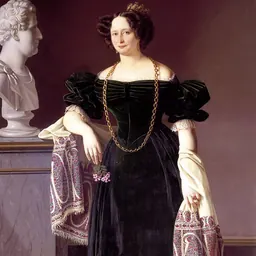
Portrait: Wikimedia Commons · author & licence
Page generated 2026-10-04 13:08 UTC