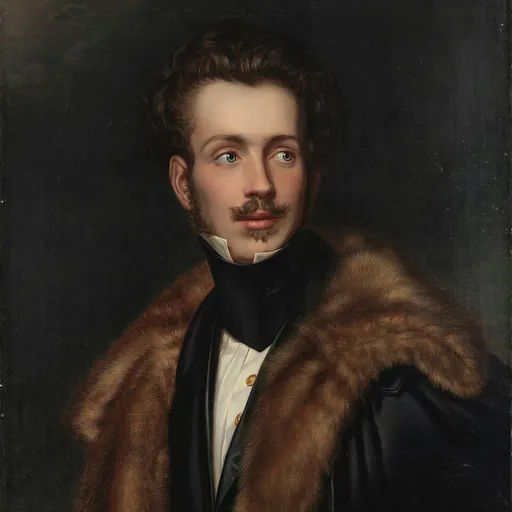
About Auguste de Beauharnais
Lived 1810 – 1835 (aged 24). Auguste de Beauharnais was an aristocrat and consort.
Auguste Charles Eugène Napoléon de Beauharnais, Duke of Leuchtenberg (9 December 1810 – 28 March 1835) was the first prince consort of Maria II of Portugal. Besides being the 2nd Duke of Leuchtenberg and 2nd Prince of Eichstätt, he also held the Brazilian noble title of Duke of Santa Cruz.
Family Being born in Milan, Lombardy, Auguste was the eldest son of Eugène de Beauharnais, Napoleon I's stepson, and Princess Augusta of Bavaria. His dynastic connections were exceptional, considering his paternal lineage: among his sisters were Joséphine, Queen consort of Oscar I of Sweden, and Amélie, Empress consort of his future father-in-law Pedro I of Brazil. Later, his brother Maximilian would wed Grand Duchess Maria Nikolaevna of Russia, eldest daughter of Tsar Nicholas I.
Duke of Leuchtenberg His maternal grandfather, King Maximilian I of Bavaria, had given Eugène the title "Duke of Leuchtenberg" on 14 November 1817, after the loss in 1815 of his Napoleonic titles and the associated expectancies of the Kingdom of Italy and the Grand Duchy of Frankfurt. Despite the promise of an independent principality inserted into the final treaty, the Congress of Vienna adjourned without creating a state for Eugène, so Auguste and his siblings had no inheritance. To the empty Leuchtenberg ducal title had been added the estate of Eichstätt in dowry, made a nominal principality, also by King Maximilian. Eugène's eldest son Auguste was heir to this modest property, which he inherited when Eugène died on 21 February 1824.
On 4 February 1831 Leuchtenberg was one of three candidates for the throne of the newly independent Belgium, his Napoleonic connections allaying the concerns of some of the Great Powers worried that the breakaway Roman Catholic realm might otherwise ally itself too closely with the likewise Catholic and revolutionary "bourgeois monarchy" of Orléans France. But in the election by the Belgian National Congress, Auguste came in second after the younger son of the King of the French, Prince Louis, Duke of Nemours, though ahead of the Habsburg candidate, Archduke Charles, Duke of Teschen. As some involved in the decision were leery of Bonapartism, none of these men attained the Belgian throne, which went to Britain's candidate, Prince Leopold of Saxe-Coburg.
He escorted his sister Amélie to Brazil for her marriage to Emperor Pedro I and was created Duke of Santa Cruz by his new brother-in-law on 5 November 1829.
Prince consort of Portugal On 26 May 1834, young Queen Maria II of Portugal was restored to the throne of Portugal, gifted to her by the abdication – and subsequent conquest in war – of her father, Emperor Pedro I of Brazil, who had to do battle against the usurpation of his rebellious younger brother, Dom Miguel.
Maria's childhood betrothal to Dom Miguel was broken so that a more pliant husband could be found to beget a new Portuguese dynasty, one whose loyalty might prove more trustworthy if he had no other prospects, such that he would be entirely beholden for his dynastic fortune to Portugal's constitutional regime. The Queen obligingly settled on Auguste de Beauharnais who, once again, proved unthreatening to the Great Powers because of his lack of membership in an already reigning dynasty and lack of conflicting foreign obligations or ambitions. He was also the eldest brother of Maria's stepmother Empress Amélie.
Auguste and Maria II were married by proxy in Munich on 1 December 1834. The groom was almost twenty-four years old and the bride fifteen years old. On his wedding day his bride conferred upon him the Portuguese style of "His Royal Highness The Prince Consort of Portugal".
He arrived in Portugal shortly thereafter, and the couple were wed in person in Lisbon on 26 January 1835. However Auguste fell ill and died only two months later. The suddenness of this upon his arrival led to rumors that he had been poisoned, however no names of any suspects were ever produced.
Childless at the time of his death, Auguste left as heir in Bavaria his younger brother, who became the 3rd Duke of Leuchtenberg, and briefly Auguste's successor in ownership of Eichstätt which, however, he returned to the Bavarian king in 1855 upon deciding to make his home in Russia, the realm of his own father-in-law.
A year later Maria II married Ferdinand of Saxe-Coburg-Gotha, a nephew of the Coburg prince who had beat out her first husband in competition for the constitutional crown of Belgium. Grand Cross of the Tower and Sword Kingdom of Spain: Knight of the Golden Fleece, 1835 Sweden-Norway: Knight of the Seraphim, 14 March 1824
Ancestry
Don’t just read it —
keep it.
Full-length biographies made to live with: read them, listen on the way to work, watch them tonight.
- E-book
- Audio
- Video
Instant download · yours to keep · every purchase keeps this site free
Important facts
Family & relationships
People in Auguste de Beauharnais's life
Named in this biography and alive at the same time
Related people
Same field, nearest in time

Contemporaries
People whose lives overlapped Auguste de Beauharnais's





Frequently asked questions
Who was Auguste de Beauharnais?
Portuguese prince (1810-1835)
When was Auguste de Beauharnais born?
Auguste de Beauharnais was born on 9 December 1810 in Milan.
When did Auguste de Beauharnais die?
Auguste de Beauharnais died on 28 March 1835 in Lisbon.
What was Auguste de Beauharnais's occupation?
Auguste de Beauharnais was an aristocrat and consort.
What nationality was Auguste de Beauharnais?
Auguste de Beauharnais's recorded nationality: Kingdom of Portugal.
Sources & further reading
· Wikipedia: Auguste de Beauharnais
· DBpedia: Auguste, Duke of Leuchtenberg
Cite this page
APA: Biography.guide. (2026). Auguste de Beauharnais. https://biography.guide/auguste-de-beauharnais/
MLA: "Auguste de Beauharnais." Biography.guide, https://biography.guide/auguste-de-beauharnais/.
Chicago: "Auguste de Beauharnais." Biography.guide. https://biography.guide/auguste-de-beauharnais/.
Data last updated: 2026-09-22 · Spot an error? Report a correction.
Portrait: Wikimedia Commons · author & licence
Page generated 2026-09-27 05:04 UTC