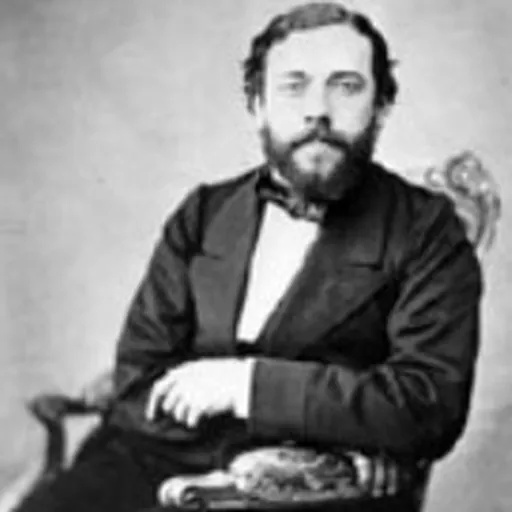
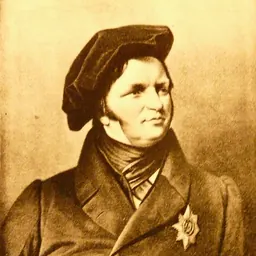
Émile Durand
French musical theorist, teacher and composer
About Émile Durand
Lived 1830 – 1903 (aged 73). Émile Durand was a French composer, musicologist, music educator and university teacher.
Émile Durand (; 16 February 18307 May 1903) was a French musical theorist, teacher and composer. He was better known for his theoretical writings than for his compositions.
Biography Émile Durand was born in 1830, at Saint-Brieuc, Côtes-d'Armor, in the Brittany region of France, and moved south with his family to Montpellier when he was 12 years old. He entered the Paris Conservatoire in 1845 at age 15, in the class of Napoléon Alkan (brother of Charles-Valentin Alkan). François Bazin and Fromental Halévy were among his other noteworthy teachers. In 1853, he won the second Grand Prix de Rome with his cantata Le Rocher d'Appenzell.
He joined the conservatoire as a teacher of music theory and harmony, succeeding his own teacher Bazin in 1871. Camille Erlanger and Arthur Goring Thomas.
Durand favored writing popular songs (chansons) and art songs (mélodies), although he also produced a few lighter works for stage early in his career, including the opéra comique L'Elixir de Cormelius in 1868, and the operetta L'Astronome de Pont-Neuf in 1869.
He remained attached to the region of his birth throughout his life. As a member of cultural and social groups such as "The Bretons de Paris," also called "La Pomme", he participated in their Celtic dinners, cultural and musical celebrations. The influence of his musical colleagues Louis-Albert Bourgault-Ducoudray, Guy Ropartz, and Louis Tiercelin, members of the Breton Renaissance Movement, is particularly evident in his Chants d'Armorique composed in 1889.
At the request of the publisher Leduc, Durand spent the last twenty years of his life writing his major theoretical works for which he is best remembered: Traité d'harmonie théorique et pratique (1881), Traité d'accompagnement pratique au piano (1884) and Traité de composition musicale (1899). May 1903, and he was buried at Père Lachaise Cemetery in Paris.
Selected compositions L'Elixir de Cormelius, Opéra comique, 1868 (libretto by Henri Meilhac and Arthur Delavigne, f.p. Fantaisies Parisiennes, 3 February 1868) L'Astronome de Pont-Neuf, pochade musicale, 1869 (libretto by Jules Moinaux, f.p. Variétés, 18 February 1869) Sourires de Bretagne, fantaisie for oboe, violin, and clarinet, 1888 numerous songs, including the well-known composition Comme à vingt ans (1858), sung by Théodore Botrel works for piano.
Selected writings Treatises on music theory and harmony: Traité d’harmonie théorique et pratique, 1881 Traité d’accompagnement pratique au piano, 1884 Traité de composition musicale, 1899 Solfège élémentaire Solfège melodique Traite de transposition
Don’t just read it —
keep it.
Full-length biographies made to live with: read them, listen on the way to work, watch them tonight.
- E-book
- Audio
- Video
Instant download · yours to keep · every purchase keeps this site free
Important facts
People in Émile Durand's life
Named in this biography and alive at the same time




Related people
Same field, nearest in time

Contemporaries
People whose lives overlapped Émile Durand's



Frequently asked questions
Who was Émile Durand?
French musical theorist, teacher and composer (1830-1903)
When was Émile Durand born?
Émile Durand was born on 16 February 1830 in Saint-Brieuc.
When did Émile Durand die?
Émile Durand died on 7 May 1903 in Neuilly-sur-Seine.
What was Émile Durand's occupation?
Émile Durand was a composer, musicologist, music educator and university teacher.
What nationality was Émile Durand?
Émile Durand was French.
Sources & further reading
Cite this page
APA: Biography.guide. (2026). Émile Durand. https://biography.guide/emile-durand/
MLA: "Émile Durand." Biography.guide, https://biography.guide/emile-durand/.
Chicago: "Émile Durand." Biography.guide. https://biography.guide/emile-durand/.
Data last updated: 2026-09-20 · Spot an error? Report a correction.
Portrait: Wikimedia Commons · author & licence
Page generated 2026-09-27 04:58 UTC