
About Emi Kinuko
Lived 1923 – 2015 (aged 91–92). Emi Kinuko was a Japanese painter and contemporary artist.
Kinuko Emi (江見絹子, Emi Kinuko; born Ogino Kinuko, 荻野絹子, on June 7, 1923, died on January 13, 2015) was a Japanese painter. Emi is best known for her abstract painting in bold colors featuring the motif of four classical elements (fire, air, water, and earth). At the 31st Venice Biennale in 1962, Emi's work was exhibited in the Japan Pavilion alongside that of four male artists, making her the first Japanese woman artist to be shown at the country's Pavilion. She had retrospective exhibitions at the Yokohama Civic Art Gallery in 1996, the Museum of Modern Art, Kamakura in 2004 and Himeji City Museum of Art in 2010. Emi's works are in the collection of the National Museum of Art, Osaka, the Museum of Contemporary Art Tokyo, the Museum of Modern Art, Kamakura & Hayama, Yokohama Museum of Art, and Takamatsu Art Museum, among others. Emi's daughter, Anna Ogino, is an Akutagawa Prize-winning novelist and emeritus professor of French literature at Keio University, Tokyo, who serves as the custodian of her mother's works and legacy.
Biography
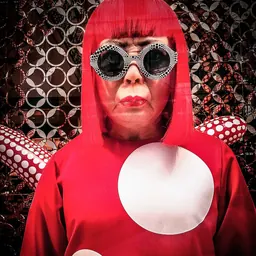
Early life and education (1923–1950) Emi was born on June 7, 1923, in Akashi, Hyōgo Prefecture. From 1941 to 1943, Emi studied under Hiroshi Ikawa (伊川寛), a Western-style oil painter who later became a member of the Second Era Society (Niki-kai; 二紀会), and from 1945 to 1949, she studied at the Kobe Municipal Western Painting Institute (神戸市立洋画研究所). Meanwhile, in 1952, her work was accepted to the annual salon of the Women Artists Association (Joryū Gaka Kyōkai; 女流画家協会), which led to her membership in the association. Emi later traveled to New York and then to Paris, where she stayed until August 1955. In Paris, Emi frequented the Louvre Museum and she "was astonished by the evidently long tradition of concrete expression in European painting, especially in regard to the nude." These visits prompted a great shift in her practice to semi-abstraction, in which the subject is captured in a simplified form. visited Emi's solo show and described her Symbol (象徴) as follows: "Expressive elements are restrained, and an architectural structure consisting of colored rectangular planes and lines is outstanding. Nevertheless, a method of painting powerfully with the palette knife has been intensified and, in conjunction with a collage-like structure, strongly evokes a feeling for materials. This result in a space filled with energy. This particular work consists of two adjoining canvases, and the painter has thoughtfully considered the contrast and balance of left and right." Despite such applause by the influential male critic, Emi "subsequently reversed the two canvases that comprise Symbol and incorporated space between them when they were shown in the Second Shell Art Award Exhibition of 1958." She also participated in the 41st Pittsburgh International Exhibition of Contemporary Painting and Sculpture in 1958 and the 3rd Guggenheim International Award in 1960. At the 31st Venice Biennale in 1962, Emi became the first Japanese female artist to exhibit at the Japan Pavilion (commissioner: Atsuo Imaizumi). Although her work was shown alongside four male artists—Minoru Kawabata, Kumi Sugai, Tadashi Sugimata, and Ryōkichi Mukai—her presence was far ahead of its time. The second woman, after Emi, to represent Japan at the Venice Biennale was Yayoi Kusama in 1993, notably also the first Japanese woman artist to hold solo show at the country's Pavilion. She was also honored by Kanagawa Prefecture in 1978 (神奈川県県民功労者表彰) and the Minister of Education in 1984 (地域文化功労者文部大臣表彰) for her contribution to local cultural activities. The Museum of Modern Art, Kamakura & Hayama Nara Prefectural Museum of Art The National Museum of Art, Osaka Okawa Museum of Art Yokohama Museum of Art
Don’t just read it —
keep it.
Full-length biographies made to live with: read them, listen on the way to work, watch them tonight.
- E-book
- Audio
- Video
Instant download · yours to keep · every purchase keeps this site free
Important facts
People in Emi Kinuko's life
Named in this biography and alive at the same time



Related people
Same field, nearest in time


Contemporaries
People whose lives overlapped Emi Kinuko's
Frequently asked questions
Who was Emi Kinuko?
Japanese painter
When was Emi Kinuko born?
Emi Kinuko was born in 1923 in Hyōgo Prefecture.
When did Emi Kinuko die?
Emi Kinuko died on 13 January 2015.
What was Emi Kinuko's occupation?
Emi Kinuko was a painter and contemporary artist.
What nationality was Emi Kinuko?
Emi Kinuko was Japanese.
Sources & further reading
Cite this page
APA: Biography.guide. (2026). Emi Kinuko. https://biography.guide/emi-kinuko/
MLA: "Emi Kinuko." Biography.guide, https://biography.guide/emi-kinuko/.
Chicago: "Emi Kinuko." Biography.guide. https://biography.guide/emi-kinuko/.
Data last updated: 2026-09-20 · Spot an error? Report a correction.
Page generated 2026-09-27 05:04 UTC