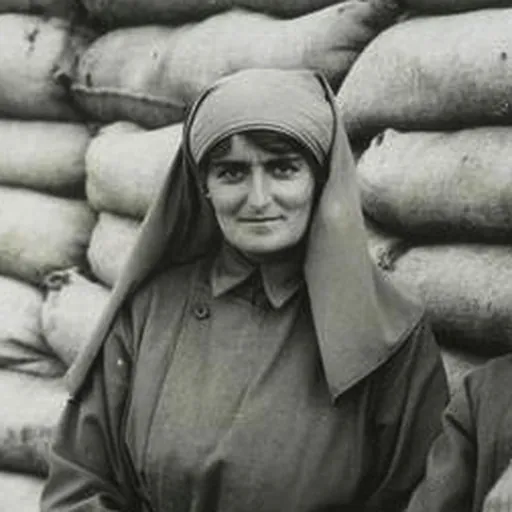
About Elsie Knocker
Lived 1884 – 1978 (aged 93). Elsie Knocker was a British nurse and photographer.
Elsie Knocker, later Baroness de T'Serclaes, ( Elizabeth Blackall Shapter; 29 July 1884 – 26 April 1978) was a British nurse and ambulance driver in World War I who, together with her friend Mairi Chisholm, won numerous medals for bravery and for saving the lives of thousands of soldiers on the Western Front in Belgium. Dubbed "The Madonnas of Pervyse" by the press, the two were among the most photographed women of the war.
Biography
Early life She was born Elizabeth Blackall Shapter in Exeter, Devon on 29 June 1884, the youngest of five children to Dr. Thomas Lewis and Charlotte Shapter (née Bayly). During her childhood she picked up the nickname, "Elsie". She was orphaned at an early age. Her mother died when she was four years old and her father died from tuberculosis two years later. She was subsequently adopted by Lewis Edward Upcott, a teacher at Marlborough College, and his wife Emily who sent her to be educated at St. Nicholas's, Folkestone, and then at the exclusive Château Lutry in Switzerland.
Hospital service and first marriage After training at the Emily Jackson Children's Hip Hospital in Sevenoaks, she married Leslie Duke Knocker in 1906, with whom she had a son, Kenneth Duke, a year later.
Being a divorcee/widow and single mother, however, hardly kept Knocker away from her passions. She became an ardent amateur motorbike enthusiast and when riding wore a dark green leather skirt and long leather coat buttoned all the way down with a belt "to keep it all together" designed by Dunhill. She earned the name "Gypsy" because of her love of the open road and membership of the Gypsy Motorcycle Club. She possessed a number of motorbikes including a Scott, a Douglas solo, and a Chater-Lea with a sidecar which would travel with her to the Western Front.
World War I When war was declared in 1914, Knocker wrote to her friend and fellow motorcycle fanatic, Mairi Chisholm, that there was "work to be done",
War service, 1914–1915 In the early evening of 25 September 1914, Knocker, Chisholm and the other volunteers (which included Lady Dorothie Feilding and May Sinclair) followed Dr. Munro down the gang-plank of the S.S. Princess Clementine at Ostend, West Flanders.
No longer affiliated with the Belgian Red Cross, they were forced to raise their own funds. With donations they arranged for the cellar to be reinforced with concrete and had a steel door fitted, supplied by Harrods. Through sheer perseverance Knocker was able to arrange for the two of them to be officially seconded to the Belgian garrison stationed there. Equipped with cameras, both women photographed not only each other but also much of the suffering around them.
In January 1915, they were rewarded for their courageous work on the front lines when they were both decorated by King Albert I of Belgium with the Order of Léopold II, Knights Cross (with palm).
Second marriage, 1916 In January 1916, Knocker was married again, to Baron Harold de T'Serclaes, a pilot in the Belgian Flying Corps, and a devout Roman Catholic. The newly formed Baroness wrote of her marriage: "So much of me went into my work that I suppose I was easily swept along on a tide of glamour and welcome frivolity. Perhaps I had a desire just to drift for once, not to struggle. It was pleasant to imagine that all would turn out well, and after fifteen months' risking my life at the Front, marriage seemed a comparatively small risk to take. I did want someone to take some of the burden off my shoulders and thought how good it would be for Kenneth to have a father. After a lightning honeymoon we hardly saw one another again. I was too busy at Pervyse, and my husband had to return to his squadron".
Fellow corps volunteer May Sinclair said of Knocker: "She had an irresistible inclination towards the greatest possible danger."
As word spread of their deeds they began to receive visits from journalists, photographers and VIP's, becoming among the most photographed women of the war. Both women were gassed during the German offensive in March 1918 and had to return home. Working with RAF Fighter Command, she rose to the rank of Squadron Officer in March 1942, and was twice Mentioned in Despatches. She left the RAF in October 1942 following her son's death and because she needed to look after her elderly foster-father.
Later life After the Second World War, the Baroness participated in raising funds for the RAF Association and the Benevolent Fund.
She lived in the Earl Haig Homes in Park Lane, Ashtead, Surrey, from approximately 1926 until her death. There she had a detached house on the edge of the estate, reached by a flight of steps from Park Lane, and called ‘Pervyse’.
Late in life, she began breeding Chihuahuas and was always accompanied by three or four of them. She was greatly concerned about the welfare of both animals and the conservation of Ashtead Common where she could often be seen walking her pets, "flamboyantly dressed with large earrings and a voluminous dark cloak".
On 26 April 1978, she died, aged 93 of pneumonia and senile dementia.
Memorials In November 2014, a statue of Knocker and Mairi Chisholm was unveiled in the garden of the Hotel Ariane in Ypres, Belgium. In November 2017 Knocker was recognised with a blue plaque on the house where she was born in Exeter.
Gallery
Don’t just read it —
keep it.
Full-length biographies made to live with: read them, listen on the way to work, watch them tonight.
- E-book
- Audio
- Video
Instant download · yours to keep · every purchase keeps this site free
Important facts
People in Elsie Knocker's life
Named in this biography and alive at the same time




Related people
Same field, nearest in time



Contemporaries
People whose lives overlapped Elsie Knocker's



Frequently asked questions
Who was Elsie Knocker?
British nurse and ambulance driver
When was Elsie Knocker born?
Elsie Knocker was born on 29 June 1884 in Exeter.
When did Elsie Knocker die?
Elsie Knocker died on 26 April 1978 in Ashtead.
What was Elsie Knocker's occupation?
Elsie Knocker was a nurse and photographer.
What nationality was Elsie Knocker?
Elsie Knocker was British.
Sources & further reading
Cite this page
APA: Biography.guide. (2026). Elsie Knocker. https://biography.guide/elsie-knocker/
MLA: "Elsie Knocker." Biography.guide, https://biography.guide/elsie-knocker/.
Chicago: "Elsie Knocker." Biography.guide. https://biography.guide/elsie-knocker/.
Data last updated: 2026-09-21 · Spot an error? Report a correction.
Portrait: Wikimedia Commons · author & licence
Page generated 2026-09-27 04:59 UTC