
About Ellison Brown
Lived 1914 – 1975 (aged 60). Ellison Brown was an American athletics competitor and athlete.
Ellison Myers Brown (September 22, 1913 – August 23, 1975),
Early life and education Brown was born on September 22, 1913, in the Potter Hill section of Westerly, Rhode Island, to Narragansett parents Byron Otis Brown (1879–1943) and Grace Ethel (Babcock) Brown (1882–1935). Brown had three sisters: Myra, Alice aka "Nina," and Grace; and three brothers: Franklin, Elwin and Clifford.
Brown received minimal formal education. He studied at the Tomaquag School in Alton for three years but left school by the seventh grade.
Athletic training Brown was first noticed for his running talent when he was 12 years old. As Native American runner Horatio "Chief" Stanton was training for an upcoming race, his trainer Thomas "Tippy" Salimeno, Sr. watched as the boy ran, following after Stanton and trying to keep pace.
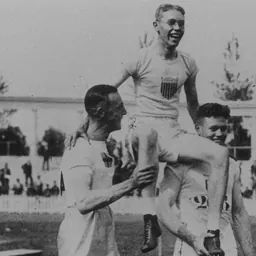
Salimeno took the young athlete under his wing when Brown turned 16 and began to train him, his first official steps to an illustrious career in marathon running that eventually saw Brown win the Boston Marathon in both 1936 and 1939 and become a member of the 1936 U.S. Olympic team. Salimeno once said, "Tarzan ran against people, not against numbers. He probably could have broke other records, but I never pushed him. When you're in a race you don't go out for records, you go out to win."
Career Heartbreak Hill and 1936 Boston Marathon victory Heartbreak Hill, an ascent over 0.4-mile (600 m) between the 20- and 21-mile (32 and 34 km) marks of the Boston Marathon, near Boston College, is the last of four "Newton Hills." These begin at the mark and challenge contestants with late climbs after the course's general downhill trend to that point. Though Heartbreak Hill itself rises only vertically (from an elevation of ), it comes at a point in the marathon distance where muscular glycogen stores are most likely to be depleted—a phenomenon referred to by marathoners as "hitting the wall."
Brown had taken off so fast at the start of the 1936 Boston Marathon that the press followed the second runner John A. Kelley until the 20-mile mark, and it was on this hill that Kelley caught up to Brown. As Kelley overtook Brown, an amazing feat given the steady record-breaking pace Brown had set, Kelley patted Brown on the back. What followed was a struggle between Brown, who took the lead on the downhills, and Kelley, who took the lead on the uphills, until Brown finally took the lead again to win the race and Kelley faded to a fifth-place finish. This struggle inspired reporter Jerry Nason to name the last Newton hill "Heartbreak Hill" because Brown "broke Kelley's heart" there. which he later said was to prove to critics and detractors that he had not quit in the Berlin Olympics earlier that summer.
1939 Boston Marathon victory In 1939, Brown was the first runner to break the 2:30 mark on the post-1926 Boston course. According to official data from the Boston Athletic Association, many runners prior to 1926 finished the Boston Marathon in times under 2:30 (see List of winners of the Boston Marathon). Those runners competed on courses known to be shorter than the IAAF-defined marathon distance of 42.195 kilometers. After the 17-mile mark in the 1939 race, Brown also broke every checkpoint record. He would later qualify for the 1940 U.S. Olympic team but the games were canceled due to World War II's outbreak in Europe.
Other notable moments in the Boston Marathon In one of his earliest appearances as a runner in the 1935 race, Brown arrived in an outfit sewn together from one of his mother's old dresses by his sisters and worn sneakers that were falling apart. It was just two days after his mother had died.
Approximately 21 miles into the race, Brown removed his sneakers, threw them into the crowd and ran the rest of the race (approximately five miles) barefoot, finishing thirteenth.
By 1938, Brown had become known as one of the Boston Marathon's most unconventional competitors. In the 1938 race, Brown was leading on a warm day when, midway through the course, he left the road, waved to the crowd, and jumped into Lake Cochituate to cool off. He then returned to the course and finished the race, though other runners had passed him by that point. That year's race was won by fellow Rhode Islander Les Pawson of Pawtucket, Rhode Island, one of Brown's rivals and friends.
Brown was also seen arriving shortly before the start of the 1939 Boston Marathon eating hot dogs and drinking milkshakes just before the race; he claimed that he had missed breakfast. Incidents like these led members of the media to write harshly about Brown. Most sports writers of the time period when Brown first started running competitively would use racist language, such as describing him as a "penniless redskin who would rather fish than work."
Death and legacy Many varied accounts of the events on the evening of August 23, 1975, which led to Brown's death, have been told. Some state that he was in the wrong place at the wrong time, waiting for a ride home, or that an altercation may have been taking place. However, amidst whatever confusion and circumstances there may have been, he was killed when a van hit him outside a Westerly bar.
A life-size bronze statue of Brown— tall and weighing —commissioned by a non-profit organization, was first unveiled in Westerly on January 2, 2026, at an indoor location, due to be moved in the spring of 2026 to Rooney Park near downtown Westerly.
Don’t just read it —
keep it.
Full-length biographies made to live with: read them, listen on the way to work, watch them tonight.
- E-book
- Audio
- Video
Instant download · yours to keep · every purchase keeps this site free
Important facts
People in Ellison Brown's life
Named in this biography and alive at the same time

Related people
Same field, nearest in time

Contemporaries
People whose lives overlapped Ellison Brown's




Frequently asked questions
Who was Ellison Brown?
Native American runner and Olympian
When was Ellison Brown born?
Ellison Brown was born on 22 September 1914.
When did Ellison Brown die?
Ellison Brown died on 23 August 1975.
What was Ellison Brown's occupation?
Ellison Brown was an athletics competitor and athlete.
What nationality was Ellison Brown?
Ellison Brown was American.
Sources & further reading
Cite this page
APA: Biography.guide. (2026). Ellison Brown. https://biography.guide/ellison-brown/
MLA: "Ellison Brown." Biography.guide, https://biography.guide/ellison-brown/.
Chicago: "Ellison Brown." Biography.guide. https://biography.guide/ellison-brown/.
Data last updated: 2026-09-20 · Spot an error? Report a correction.
Page generated 2026-09-27 05:31 UTC