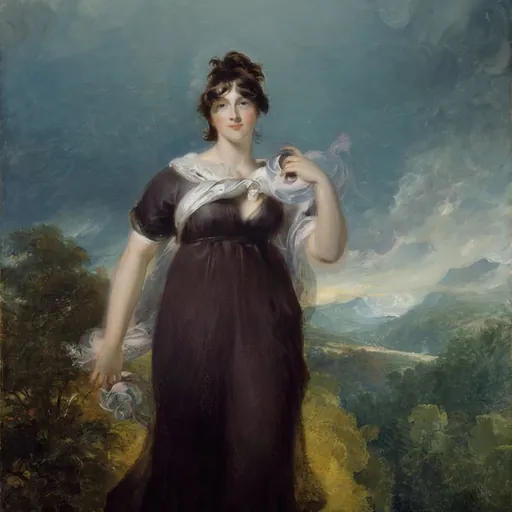
Elizabeth Conyngham, Marchioness Conyngham
British noble, mistress of King George IV
About Elizabeth Conyngham, Marchioness Conyngham
Lived 1769 – 1861 (aged 92). Elizabeth Conyngham, Marchioness Conyngham was a British pharmacologist.
Elizabeth Conyngham, Marchioness Conyngham (; 29 March 1770 – 11 October 1861) was an English courtier and noblewoman. She is thought to be the last mistress of King George IV of the United Kingdom.
Early life She was born in 1769 (O.S.). Her father was Joseph Denison, owner of the Denbies estate in Surrey, who had made a fortune in banking. Her mother was Elizabeth Butler.
On 5 July 1794, Elizabeth married Henry Conyngham, Viscount Conyngham, an Irish peer. They had five children together, three sons and two daughters:
Henry Francis Conyngham, Earl of Mount Charles (6 April 1795 – 26 December 1824) Francis Conyngham, 2nd Marquess Conyngham (11 June 1797 – 17 July 1876) Lady Elizabeth Henrietta Conyngham (died 24 August 1839), married Charles Gordon, 10th Marquess of Huntly Lady Maria Harriet Conyngham (1810 - died 3 December 1843), married William Somerville, 1st Baron Athlumney Albert Denison, 1st Baron Londesborough (21 October 1805 – 15 January 1860)
Despite her beauty, she was considered vulgar, shrewd, greedy, and unsuited to aristocratic society on account of her common background; however, she attracted lovers and admirers, including the Russian Grand Duke, the future Nicholas I.
Royal mistress Elizabeth, Countess Conyngham The Conynghams were not well connected, but according to the Duke of Wellington, Elizabeth decided as early as 1806 to become a mistress of the Prince of Wales, the future King George IV. She probably became his lover in 1819, when he was prince regent, but finally supplanted her predecessor, Isabella Seymour-Conway, Marchioness of Hertford, after he became king in 1820. He became besotted with her, constantly "kissing her hand with a look of most devoted submission." While his wife Caroline of Brunswick was on trial in 1820 as part of efforts to divorce her, the king could not be seen with Lady Conyngham and was consequently "bored and lonely." During his coronation, George was seen continually "nodding and winking" at her.
Lady Conyngham's liaison with the king benefited her family. In the coronation honours of 1821, her husband, already a marquess of Ireland, was created Baron Minster in the Peerage of the United Kingdom and sworn to the Privy Council. He was also given several other offices, including Lord Steward of the Household and the lieutenancy of Windsor Castle. Her second son was made Master of the Robes and First Groom of the Chamber.
Lady Conyngham had Whiggish sympathies, but usually did not concern herself with political ambition; she concentrated rather on furthering the financial position of her family. But on one occasion, she requested that her son's tutor be made Canon of St. George's Chapel, Windsor, and the prime minister, Lord Liverpool, threatened to resign over the matter. Arguments with Lady Castlereagh further worsened the relationship between the king and Lord Liverpool's government. She also disliked Benjamin Bloomfield, Keeper of the Privy Purse, and was successful in having him removed in 1822. His successor, William Knighton, was a close friend of the king who successfully cleared all his debts later in his reign. Dorothea Lieven, wife of the Russian ambassador, dismissed her with contempt as having "not an idea in her head...not a word to say for herself...nothing but a hand to accept pearls and diamonds, and an enormous balcony to wear them on."
Later life and death Portrait of Lady Elizabeth Conyngham, the Marchioness's daughter, commonly misidentified as the Marchioness herself. The portrait, painted by Sir Thomas Lawrence in the early 1820s, is in the Museu Calouste Gulbenkian, Lisbon. Another portrait commonly misidentified as the Marchioness, called "Lady Elizabeth Conyngham" and attributed to Sir Thomas Lawrence. In fact it is a 1775 portrait of Mrs. Lowndes-Stone by Sir Thomas Gainsborough, also located in the Museu Calouste Gulbenkian, Lisbon. As his life progressed, the king became dependent on Lady Conyngham on account of his temper and poor health. However weary she became of his company, his affection for her never ceased. The relationship came to an end with George's sudden death in 1830; she immediately moved from Windsor Castle to Paris. Although the king had bequeathed her all his plate and jewels, she refused the entire legacy. The marquess broke his staff of office at George's funeral and was never to hold another one in the next reign. Lady Conyngham lived until 1861, dying near Canterbury at the age of 91. Although she was excluded from court during the reigns of King William IV and Queen Victoria, her son Francis Conyngham, 2nd Marquess Conyngham, was Lord Chamberlain to William. Along with William Howley, Archbishop of Canterbury, he brought the news of William's death to Princess Victoria and was the first to address her as Your Majesty. The 2nd Marquess's daughter, Jane Churchill, was later a Lady of the Bedchamber to Queen Victoria and one of her closest friends.
Don’t just read it —
keep it.
Full-length biographies made to live with: read them, listen on the way to work, watch them tonight.
- E-book
- Audio
- Video
Instant download · yours to keep · every purchase keeps this site free
Important facts
People in Elizabeth Conyngham, Marchioness Conyngham's life
Named in this biography and alive at the same time




Related people
Same field, nearest in time


Contemporaries
People whose lives overlapped Elizabeth Conyngham, Marchioness Conyngham's





Frequently asked questions
Who was Elizabeth Conyngham, Marchioness Conyngham?
British noble, mistress of King George IV
When was Elizabeth Conyngham, Marchioness Conyngham born?
Elizabeth Conyngham, Marchioness Conyngham was born on 31 July 1769 in London.
When did Elizabeth Conyngham, Marchioness Conyngham die?
Elizabeth Conyngham, Marchioness Conyngham died on 11 October 1861 in Canterbury.
What was Elizabeth Conyngham, Marchioness Conyngham's occupation?
Elizabeth Conyngham, Marchioness Conyngham was a pharmacologist.
What nationality was Elizabeth Conyngham, Marchioness Conyngham?
Elizabeth Conyngham, Marchioness Conyngham was British.
Sources & further reading
· Wikipedia: Elizabeth Conyngham, Marchioness Conyngham
· DBpedia: Elizabeth Conyngham, Marchioness Conyngham
Cite this page
APA: Biography.guide. (2026). Elizabeth Conyngham, Marchioness Conyngham. https://biography.guide/elizabeth-conyngham-marchioness-conyngham/
MLA: "Elizabeth Conyngham, Marchioness Conyngham." Biography.guide, https://biography.guide/elizabeth-conyngham-marchioness-conyngham/.
Chicago: "Elizabeth Conyngham, Marchioness Conyngham." Biography.guide. https://biography.guide/elizabeth-conyngham-marchioness-conyngham/.
Data last updated: 2026-09-22 · Spot an error? Report a correction.
Portrait: Wikimedia Commons · author & licence
Page generated 2026-09-27 05:04 UTC