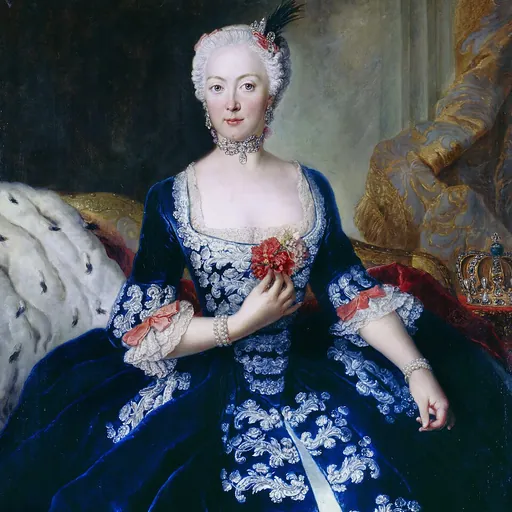
Elisabeth Christine of Brunswick-Wolfenbüttel-Bevern
Queen of Prussia and Electress of Brandenburg
About Elisabeth Christine of Brunswick-Wolfenbüttel-Bevern
Lived 1715 – 1797 (aged 81). Elisabeth Christine of Brunswick-Wolfenbüttel-Bevern was a German queen.
Elisabeth Christine of Brunswick-Wolfenbüttel-Bevern (8 November 1715 – 13 January 1797) was Queen of Prussia (Queen in Prussia until 1772) and Electress of Brandenburg as the wife of Frederick the Great. She was the longest-serving Prussian queen, with a tenure of more than 46 years. She was praised for her charity work during the Seven Years' War.
Crown princess
In 1730, Crown Prince Frederick of Prussia tried to flee from the tyrannical regime of his father, King Frederick William I, but was caught and imprisoned. To regain his freedom, he was required to marry Elisabeth Christine, daughter of Ferdinand Albert II, Duke of Brunswick-Wolfenbüttel and his wife Antoinette, in 1733. Elisabeth's maternal aunt Elisabeth Christine was the wife of Charles VI, Holy Roman Emperor. The match had thus been sought diplomatically by the Austrian court as well as by the "imperial party" around the king. This was in sharp contrast to the "English party" around Queen Sophie Dorothea, sister of King George II of Great Britain, and Crown Prince Frederick himself. They were seeking a marriage to the Queen's niece, Princess Amelia of Great Britain, which would result in a strong alliance between Prussia and Great Britain and was considered by the somewhat vain young prince a more "brilliant" match than the "provincial" Elisabeth Christine.
However, on 12 June, 17-year-old Elisabeth Christine was married to Frederick at her father's summer palace, Schloss Salzdahlum in Wolfenbüttel, Germany. On their wedding night, Frederick spent a reluctant hour with his wife and then walked about outside for the rest of the night. Due to the circumstances behind their betrothal, he was well known to have resented the marriage from the very beginning. During the first years of his reign, he did somewhat revive the court life, but after Sanssouci Palace in Potsdam was completed in 1747, he spent his life more isolated in Sanssouci in the summer and the City Palace, Potsdam in the winter, and only appeared at the official royal court in Berlin at special occasions such as royal birthdays and visits of foreign princes. Despite his personal contempt for representational court life, however, he realized its importance in the system of state and therefore did not abolish court life in Prussia, but rather left all court duties to Elisabeth.
Despite the fact that Frederick entrusted the role of representation to her, he did not always give her the funds necessary to play this role, and it caused surprise to foreigners that the king did not give the queen funds necessary to entertain more lavishly. As the king became more spartan over the years, the receptions of the queen became more underfunded, Charpentier once joking: "The Queen must have a grand gala tonight; I saw an old lamp lighted on the staircase as I passed!" nor to a large celebration that the king gave in August 1749 in honor of his mother in Sanssouci.
In 1763, when after the Seven Years' War, Frederick saw his wife for the first time in six years, he only told her "Madame has become more stout" and then turned to his waiting sisters. Despite his lack of interest in her person, he demanded that she should be respected in her capacity as a queen, but his separation from her along with her aroused pity made it hard for her to receive respect from the nobility: on one occasion, the opera singers refused to appear at her concert and she forced Frederick to demand that she be treated with respect. aroused public patriotism during the War of Bavarian Succession. Her political works were included in the royal library and the king presented her with his own ideas. Elisabeth is noted to have acted as an intermediary and interceded in favor of supplicants. She particularly supported the French émigrés community in Berlin. Spalding commented: "her memory will always be blessed as a touching example of the noblest mental qualities, the most enlightened and lively piety, and the most wonderfully active benevolence." boxstyle_1 = background-color: #fcc; boxstyle_2 = background-color: #fb9; boxstyle_3 = background-color: #ffc; boxstyle_4 = background-color: #bfc; boxstyle_5 = background-color: #9fe; 1 = 1. Elisabeth Christine of Brunswick-Wolfenbüttel-Bevern 2 = 2. Ferdinand Albert II, Duke of Brunswick-Wolfenbüttel 3 = 3. Duchess Antoinette of Brunswick-Wolfenbüttel 4 = 4. Ferdinand Albert I, Duke of Brunswick-Wolfenbüttel-Bevern 5 = 5. Princess Christine of Hesse-Eschwege 6 = 6. Louis Rudolph, Duke of Brunswick-Wolfenbüttel 7 = 7. Princess Christine Louise of Oettingen-Oettingen 8 = 8. Augustus II, Duke of Brunswick-Wolfenbüttel 9 = 9. Duchess Elisabeth Sophie of Mecklenburg-Güstrow 10 = 10. Frederick, Landgrave of Hesse-Eschwege 11 = 11. Countess Palatine Eleonora Catherine of Kleeburg 12 = 12. Anthony Ulrich, Duke of Brunswick-Wolfenbüttel 13 = 13. Princess Elisabeth Juliana of Schleswig-Holstein-Sonderburg-Norburg 14 = 14. Albert Ernest I, Prince of Oettingen-Oettingen 15 = 15. Duchess Christine Friederike of Württemberg
Don’t just read it —
keep it.
Full-length biographies made to live with: read them, listen on the way to work, watch them tonight.
- E-book
- Audio
- Video
Instant download · yours to keep · every purchase keeps this site free
Important facts
Family & relationships
People in Elisabeth Christine of Brunswick-Wolfenbüttel-Bevern's life
Named in this biography and alive at the same time

Related people
Same field, nearest in time



Contemporaries
People whose lives overlapped Elisabeth Christine of Brunswick-Wolfenbüttel-Bevern's




Frequently asked questions
Who was Elisabeth Christine of Brunswick-Wolfenbüttel-Bevern?
Queen of Prussia and Electress of Brandenburg (1715–1797)
When was Elisabeth Christine of Brunswick-Wolfenbüttel-Bevern born?
Elisabeth Christine of Brunswick-Wolfenbüttel-Bevern was born on 8 November 1715 in Wolfenbüttel.
When did Elisabeth Christine of Brunswick-Wolfenbüttel-Bevern die?
Elisabeth Christine of Brunswick-Wolfenbüttel-Bevern died on 13 January 1797 in Schönhausen Palace.
What was Elisabeth Christine of Brunswick-Wolfenbüttel-Bevern's occupation?
Elisabeth Christine of Brunswick-Wolfenbüttel-Bevern was a queen.
What nationality was Elisabeth Christine of Brunswick-Wolfenbüttel-Bevern?
Elisabeth Christine of Brunswick-Wolfenbüttel-Bevern was German.
Sources & further reading
· Wikipedia: Elisabeth Christine of Brunswick-Wolfenbüttel-Bevern
· DBpedia: Elisabeth Christine of Brunswick-Wolfenbüttel-Bevern
Cite this page
APA: Biography.guide. (2026). Elisabeth Christine of Brunswick-Wolfenbüttel-Bevern. https://biography.guide/elisabeth-christine-of-brunswick-wolfenbuttel-bevern/
MLA: "Elisabeth Christine of Brunswick-Wolfenbüttel-Bevern." Biography.guide, https://biography.guide/elisabeth-christine-of-brunswick-wolfenbuttel-bevern/.
Chicago: "Elisabeth Christine of Brunswick-Wolfenbüttel-Bevern." Biography.guide. https://biography.guide/elisabeth-christine-of-brunswick-wolfenbuttel-bevern/.
Data last updated: 2026-09-22 · Spot an error? Report a correction.
Portrait: Wikimedia Commons · author & licence
Page generated 2026-09-27 05:02 UTC