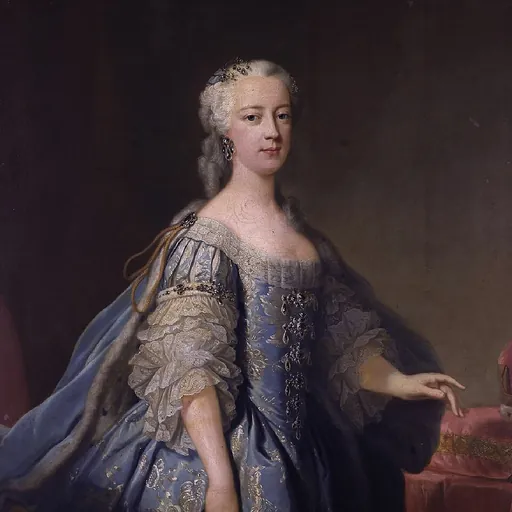
About Princess Amelia of Great Britain
Lived 1711 – 1786 (aged 75). Princess Amelia of Great Britain was a German and British aristocrat and arch nobility.
Princess Amelia of Great Britain (Amelia Sophia Eleonore; 10 June 1711 (New Style) – 31 October 1786) was the second daughter of King George II of Great Britain and Queen Caroline. Born in Hanover, she moved to England when her grandfather George I became king. Amelia lived a solitary existence and died in 1786, the last surviving child of her parents.
Early life Princess Amelia Amelia was a sickly child and her mother employed Johann Georg Steigerthal and Hans Sloane to treat her, as well as secretly asking the physician John Freind for advice. In 1722 her mother, who had progressive ideas, had Amelia and her sister Caroline inoculated against smallpox by an early type of immunisation known as variolation, which had been brought to England from Constantinople by Lady Mary Wortley Montagu and Charles Maitland. On 11 June 1727, George I died and her father succeeded him as George II. She lived with her father until his death in 1760.
Amelia's aunt Sophia Dorothea, Queen of Prussia, suggested Amelia as a suitable wife for her son Frederick (later known as Frederick the Great). Correspondence, planning and negotiations dragged on for years from 1723, accompanied by numerous intrigues and diplomatic interventions by Austria, but his father Frederick William I of Prussia finally backed away from the plan in 1732 and forced his son to marry Elisabeth Christine of Brunswick-Bevern instead. In 1724 Amelia and her sister the Princess Royal were among the final four candidates for marriage to Louis XV of France. However, as this required her to convert to Catholicism, her father prevented the match.
Amelia greatly enjoyed riding and hunting. She was disliked by artistic fops such as Lord Hervey, and Lady Pomfret considered her "one of the oddest princesses that ever was known; she has ears shut to flattery and her heart open to honesty."
Amelia may have been the mother of the composer Samuel Arnold (1740–1802) through an affair with a commoner of the name Thomas Arnold.
Later life In 1751, Princess Amelia became ranger of Richmond Park after the death of Robert Walpole, 2nd Earl of Orford. Immediately afterwards, the Princess caused major public uproar by closing the park to the public, only allowing few close friends and those with special permits to enter.
This continued until 1758, when a local brewer, John Lewis, took the gatekeeper, who stopped him from entering the park, to court. The court ruled in favour of Lewis, citing the fact that, when Charles I enclosed the park in the 17th century, he allowed the public right of way in the park. Princess Amelia was forced to lift the restrictions.
The Princess was generous in her gifts to charitable organisations. In 1760 she donated £100 to the society for educating poor orphans of clergymen (later the Clergy Orphan Corporation) to help pay for a school for 21 orphan daughters of clergymen of the Church of England. In 1783 she agreed to become an annual subscriber of £25 to the new County Infirmary in Northampton.
In 1761, Princess Amelia became the owner of Gunnersbury Estate, Middlesex, purchased from the estate of Henry Furnese. Princess Amelia used Gunnersbury as her summer residence. She added a chapel and at some time between 1777 and 1784 she commissioned a bath house, extended as a folly by a subsequent owner of the land in the 19th century, which still stands today with a Grade II English Heritage listing and is known as Princess Amelia's Bathhouse.
She also owned a property in Cavendish Square, Soho, London, where she died unmarried on 31 October 1786, at which time she was the last surviving child of King George II and Queen Caroline. A miniature of her first cousin, Frederick the Great, was found on her body. The great king originally intended for her had died two months earlier. She was buried in the Henry VII Lady Chapel in Westminster Abbey.
Legacy
Amelia Island in Florida, in the United States, is named for her, as is Amelia County in Virginia.
Arms On 31 January 1719, as a grandchild of the sovereign, Amelia was granted use of the arms of the realm, differenced by a label argent of five points ermine. On 30 August 1727, as a child of the sovereign, Amelia's difference changed to a label argent of three points ermine.
Ancestors
Don’t just read it —
keep it.
Full-length biographies made to live with: read them, listen on the way to work, watch them tonight.
- E-book
- Audio
- Video
Instant download · yours to keep · every purchase keeps this site free
Important facts
Family & relationships
People in Princess Amelia of Great Britain's life
Named in this biography and alive at the same time

Related people
Same field, nearest in time
Contemporaries
People whose lives overlapped Princess Amelia of Great Britain's

Frequently asked questions
Who was Princess Amelia of Great Britain?
Princess of Great Britain (1711-1786)
When was Princess Amelia of Great Britain born?
Princess Amelia of Great Britain was born on 10 June 1711 in Herrenhausen Palace.
When did Princess Amelia of Great Britain die?
Princess Amelia of Great Britain died on 31 October 1786 in Soho.
What was Princess Amelia of Great Britain's occupation?
Princess Amelia of Great Britain was an aristocrat and arch nobility.
What nationality was Princess Amelia of Great Britain?
Princess Amelia of Great Britain was German and British.
Sources & further reading
· Wikipedia: Princess Amelia of Great Britain
· DBpedia: Princess Amelia of Great Britain
Cite this page
APA: Biography.guide. (2026). Princess Amelia of Great Britain. https://biography.guide/princess-amelia-of-great-britain/
MLA: "Princess Amelia of Great Britain." Biography.guide, https://biography.guide/princess-amelia-of-great-britain/.
Chicago: "Princess Amelia of Great Britain." Biography.guide. https://biography.guide/princess-amelia-of-great-britain/.
Data last updated: 2026-09-26 · Spot an error? Report a correction.
Portrait: Wikimedia Commons · author & licence
Page generated 2026-10-04 10:52 UTC