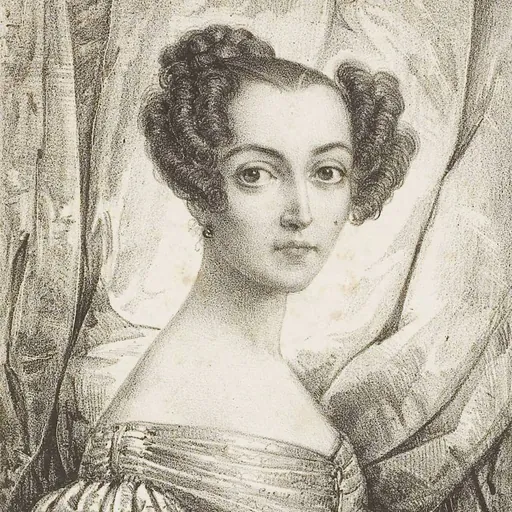
About Elisa Mercœur
Lived 1809 – 1835 (aged 25). Elisa Mercœur was a French writer, poet and essayist.
Élisa Mercœur (24 June 1809 in Saint-Sébastien-sur-Loire, 7 January 1835 in Paris) was a French writer, poet and essayist and was one of the most prominent names in Breton Romanticism. After Mercœur's death in 1835, her mother posthumously edited her work to ensure it survived for posterity It wasn't until 1990 with the publication of Geoffroy Daniel's biography "Elisa Mercoeur Nantaise romantique" that she began to be more widely known.
Life Mercoeur's mother was Adèlaïde (or Adèle) Aumand, an embroiderer who was born in 1780 in Nantes. Her father was Jules-François Barré, a solicitor in the Vendée department of the Les Landes-Genusson region. Further research was carried out by the Franciscan Ubald d'Alençon (1872-1927) in 1925. An article by Paul Caillaud in the Annales de Bretagne journal (1952) gives a detailed account. located in the Saint-Clément district near the lycée and La Bouteillerie Cemetery, by Jean Favret, an employee of the orphanage. The baby carried a piece of paper with these words:
"Élisa, born 24 June 1809, not registered in civil acts. Heaven and gentle humanity will watch over her. Her parents may be happy enough to claim her one day."
At 4 p.m. on 28 June, Jean Favret presented the baby to Police Commissioner Sébastien-Barthélemy Benoist, who was primarily responsible for orphans in the Lycée district, and who, in view of the information presented, gave her the name Élisa Mercœur. The baby was then taken to the orphanage. On 21 April 1811, as she had wished, her mother, Adélaïde Aumand, took Élisa back from the orphanage; in the Memoirs, this event appears as "she was twenty-one months old when I was left alone to raise her".
Du sommeil de la mort tout prêt à s'endormir… Mon père retenait son âme délirante Par les liens du souvenir.
Poised to fall into the sleep of death, my father yet holds his delirious soul by the ties of memory
Child prodigy Mercœur was only twenty-one months old when her mother remained alone to raise her, with more than limited resources. A friend of the family came to their aid and took care of the child's educational expenses. According to her mother, Mercœur was a little wonder. At six years old, she was already constructing subjects for tales and comedy. At eight, she wanted to compose a tragedy in five acts and in verse for the Comédie-Française. At twelve years old, Mercœur gave her young companions lessons in history, geography, writing, English and French. She also read Virgil openly and knew a little Greek and Italian.
The first time that Mercœur had the opportunity to reveal her literary talent to the public was the day of the debut, on the theatre of Nantes, of a famous singer. Élisa Mercœur wrote a piece of eighteen verses in one go and sent it to her address. The next day, the whole town applauded this poetic essay published by an unofficial friend in the newspaper Le Lycée Armoricain. At the age of sixteen, Mercœur who published a number of other poems, was quickly given the nickname the "Armorican Muse".
Published poet
Mercœur, who was looking for recognition and encouraged by her friends, decided to approach a printer Mélinet-Malassis in Nantes in 1825. Camille Mélinet agreed to print her first poem "Dors, mon Ami" Due to the quality of her work, Mélinet took an interest in Mercœur and offered her a contract to print further pieces on a monthly basis in the Lycée Armoricain, a newspaper that appeared between 1823 and 1831,
At the end of 1825, Mélinet encouraged Mercœur to compete for the prizes being awarded by the in both the years of 1825 and 1826. The subjects were on the Lighthouse of the Plateau du Four for 1825 and the Combat of the Thirty for 1826. While Mercœur didn't win anything, her work did get an honourable mention. It states:
"We believe that, in the order of creation, women have been destined for a nobler role and we will never complain that she is cultivated by the arts and letters. Let her exhibit at the salon, let her cheer on our theaters, let her thoughts be applauded. Women, teach us by enchanting consolations of the earth, celebrate your joys and loves, drag us into your sweet dreams" However, she was sidelined for the next ceremony and didn't understand the reason why it happened as she didn't understand the current political situation in pre-revolutionary France. Combined the reasons reinforced her decision to leave Nantes. However, Camille Mélinet tried to warn her about life in Paris, believing she could prosper in Nantes and encouraged her to become a teacher, through which she could make a living but the warning fell on deaf ears. In Paris, Élisa Mercœur became a regular in literary salons and attracted the praises of Alphonse de Lamartine, Alfred de Musset, Victor Hugo and Chateaubriand. She also became friends with Mélanie Waldor and Juliette Récamier.
In Paris, Mercœur came under the influence of Alexandre Soumet who convinced her to write a tragedy and dedicate herself to theatre instead of poetry. The next day, she learned that Boabdil was accepted by the actors, but rejected by Baron Taylor, who found the play very well done, but could not, he said, hope to attract the Parisian public and interest them in the story of a King of Granada. where she attacked men who abuse women and are not sanctioned by society. The poet Pierre-Jean de Béranger came to visit her there. While there she tried to kill herself. The old priest of the village, whom she saw frequently, took her confession and granted her the Holy Sacraments. Shortly after her return to Paris, she died in the arms of her mother, to whom she had said a few days before: "If God calls me to him, a thousand tales will be told about my death; some will say that I died of misery; love others! Tell those who tell you that Mr. Taylor's refusal to play my tragedy alone caused the poor child to die!"
Her funeral in the Père-Lachaise cemetery was attended by Chateaubriand and Pierre-Simon Ballanche. Other female poets, Victoire Babois, , Anaïs Ségalas, Amable Tastu, and Mélanie Waldor attended in mourning.
Analysis Mercœur was recognised as a talented poet during her lifetime. She represented herself as a genius within the meaning of her poetry and the feminine persona, qualities inherent in Romanticism that she invoked in her poetry. The representation of genius during her life was limited to the male personality and was particularly harmful to women who were generally excluded from male-dominated society. Women were thought to have feelings while men had thoughts. Lastly there is a small dead-end street in Séné called the Allée Élisa Mercœur.
Don’t just read it —
keep it.
Full-length biographies made to live with: read them, listen on the way to work, watch them tonight.
- E-book
- Audio
- Video
Instant download · yours to keep · every purchase keeps this site free
Important facts
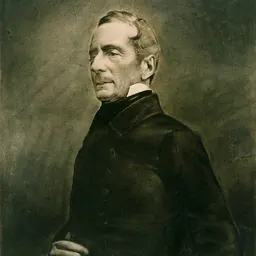
People in Elisa Mercœur's life
Named in this biography and alive at the same time



Related people
Same field, nearest in time

Contemporaries
People whose lives overlapped Elisa Mercœur's




Frequently asked questions
Who was Elisa Mercœur?
French writer (1809–1835)
When was Elisa Mercœur born?
Elisa Mercœur was born on 24 June 1809 in Saint-Sébastien-sur-Loire.
When did Elisa Mercœur die?
Elisa Mercœur died on 7 January 1835 in former 10th arrondissement of Paris.
What was Elisa Mercœur's occupation?
Elisa Mercœur was a writer, poet and essayist.
What nationality was Elisa Mercœur?
Elisa Mercœur was French.
Sources & further reading
Cite this page
APA: Biography.guide. (2026). Elisa Mercœur. https://biography.guide/elisa-mercoeur/
MLA: "Elisa Mercœur." Biography.guide, https://biography.guide/elisa-mercoeur/.
Chicago: "Elisa Mercœur." Biography.guide. https://biography.guide/elisa-mercoeur/.
Data last updated: 2026-09-23 · Spot an error? Report a correction.
Portrait: Wikimedia Commons · author & licence
Page generated 2026-09-27 05:08 UTC