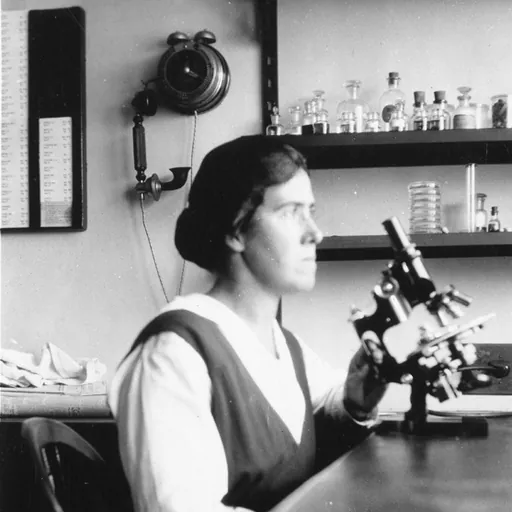
Eleanor Carothers
American zoologist, geneticist, and cytologist
About Eleanor Carothers
Lived 1882 – 1957 (aged 74–75). Eleanor Carothers was an American zoologist, geneticist and cell biologist.
Estrella Eleanor Carothers (4 December 1882 – 1957) was an American zoologist, geneticist, and cytologist known for her work with grasshoppers. She discovered important physical evidence for the concept of Chromosome_segregation giving direct observational support for Mendelian independent assortment, vital to modern understanding of genetics.
Early life and education Carothers was born on December 4, 1883, in Newton, Kansas to Z. W. Carothers and Mary Bates. She studied at the Nickerson Normal College and went on to earn her Bachelor of Arts degree and her Master's degree from the University of Kansas, in 1911 and 1912 respectively.
Research career She began her career as a Pepper Fellow at Pennsylvania State University, where she stayed from 1913 to 1914. That year, she was appointed an assistant professor of zoology there, and graduated with her Ph.D. in 1916. Carothers stayed on as assistant professor until 1936, though she also had an overlapping appointment as an independent investigator for the Marine Biological Laboratory, which lasted from 1920 until 1941. In 1936 she moved to the University of Iowa and was a research associate there until 1941. Her work there was funded by the Rockefeller Foundation.
Later life
Carothers retired from the University of Iowa in 1941 and moved from Iowa to Kingman, Kansas, where she continued to conduct research for the Woods Hole Marine Biological Lab. In 1954, she moved to Murdock, Kansas, where she lived and researched for the remainder of her life. Carothers died in 1957 at the age of 75.
Awards and honors In 1921, Carothers was awarded the Ellen Richards Research Prize by the Naples Table Association. She received a starred entry for her work on grasshopper embryos in the fourth edition of American Men of Science, published in 1927, a rare and significant award for a female scientist at the time.
Major publications
Don’t just read it —
keep it.
Full-length biographies made to live with: read them, listen on the way to work, watch them tonight.
- E-book
- Audio
- Video
Instant download · yours to keep · every purchase keeps this site free
Important facts
Related people
Same field, nearest in time




Contemporaries
People whose lives overlapped Eleanor Carothers's



Frequently asked questions
Who was Eleanor Carothers?
American zoologist, geneticist, and cytologist
When was Eleanor Carothers born?
Eleanor Carothers was born on 4 December 1882 in Newton.
When did Eleanor Carothers die?
Eleanor Carothers died in 1957.
What was Eleanor Carothers's occupation?
Eleanor Carothers was a zoologist, geneticist and cell biologist.
What nationality was Eleanor Carothers?
Eleanor Carothers was American.
Sources & further reading
· Wikipedia: Eleanor Carothers
Cite this page
APA: Biography.guide. (2026). Eleanor Carothers. https://biography.guide/eleanor-carothers/
MLA: "Eleanor Carothers." Biography.guide, https://biography.guide/eleanor-carothers/.
Chicago: "Eleanor Carothers." Biography.guide. https://biography.guide/eleanor-carothers/.
Data last updated: 2026-09-22 · Spot an error? Report a correction.
Portrait: Wikimedia Commons · author & licence
Page generated 2026-09-27 05:02 UTC