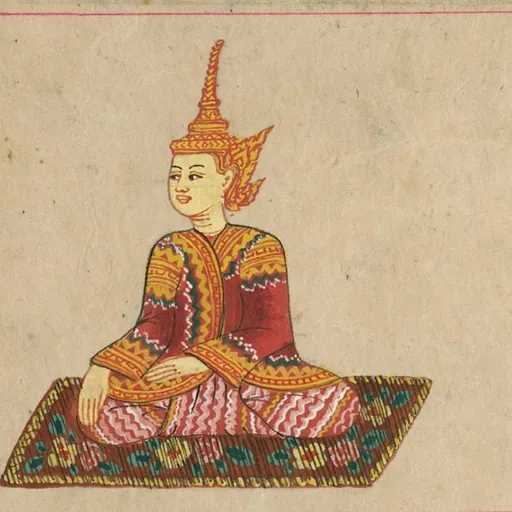
About Ekkathat
Lived 1709 – 1767 (aged 57–58). Ekkathat was a Thai sovereign, politician and military officer.
Ekkathat (, , ) or Borommoracha III or King of Suriyamarin Throne Hall was the 6th monarch of the Ban Phlu Luang dynasty, the 33rd and the last monarch of Ayutthaya Kingdom, ruling from 1758 to 7 April 1767, prior to the fall of Ayutthaya. Moreover, he was called by the people in his time as "Khun Luang Khiruean" , which meant "the king with skin disease," due to his chloasma.
Early life Ekkathat was born in 1718 during the reign of his uncle King Thaisa. Ekkathat's father Prince Phon of the Front Palace was the younger brother and Wangna or heir presumptive to King Thaisa. Ekkathat's mother was Princess Consort Phlap, one of two main consorts of Prince Phon and a daughter of Chaophraya Bamroe Phuthorn , a prominent nobleman in the reign of King Phetracha. Ekkathat had one younger brother Uthumphon and five sisters who shared the same mother. Ekkathat also had an older half-brother Prince Thammathibet who was born to another main consort of Prince Phon.
In 1732, King Thaisa became ill. Prince Phon, younger brother of King Thaisa and Ekkathat's father, mobilized his forces
Three sons of Borommakot; Thammathibet, Ekkathat and Uthumphon, who were born to two main queens of Borommakot, were given the superior rank of Kromma Khun, meaning that they could appoint their servants to the rank of Khun. Five other sons of Borommokot, who were born to his secondary consorts, were given the inferior rank of Kromma Muen, uniting Upper and Lower Burma under the new Burmese dynasty after seventeen years of internal warfare.
Ascension Brief reign of Uthumphon
In April 1758, King Borommakot fell gravely ill. Ekkathat, who had been a Buddhist monk at Wat Lamut temple, upon learning that his father King Borommakot was on his deathbed, decided to leave the Wat Lamut temple to return to Ayutthaya. Prince Ekkathat stayed at Suan Kratai Pavilion – residence of his younger brother Prince Uthumphon of the Front Palace. Ekkathat visited and took a glimpse of his ailing father. After reigning for twenty-five years, King Borommakot died on that day, on the fifth waning of the sixth month, Year 1120 of Culāsakaraj Era, 29 April 1758, to peacefully convince the Three Princes to surrender. The senior monk Phra Thepmuni led the virtuous monks to speak to the Three Princes, beseeching them to cease their belligerent actions to prevent the civil war.
About a week later, on the eleventh waning of the sixth month Ekkathat, however, decided to push for his own claims to the throne against his younger brother the new king Uthumphon. Prince Ekkathat or Prince Anurak Montri defiantly stayed at Suriyat Amarin Pavilion in the royal palace, not returning to Wat Lamut temple despite being a Buddhist monk. Uthumphon was sensitive of his elder brother contesting for the throne as Ekkathat imposed political pressure on Uthumphon. Finally, Uthumphon gave in. Uthumphon abdicated on 22 May 1758, earning Uthumphon the epithet Khun Luang Hawat , meaning the King Who Sought Temple.
Enthronement Ekkathat, at the age of forty, left monkhood to take the throne, becoming the last king of Ayutthaya. Ekkathat was officially enthroned on the waxing of the eight month (癬王), while Vietnamese sources called Ekkathat Phong Vương (chữ hán: 瘋王) or 'Leper King'.
The new king Ekkathat made his mother Queen Phiphitmontri the Dowager Queen with title Kromphra Thephamat . Ekkathat also granted Prince Athit, son of the deceased Prince Thammathibet, a Krom title of Kromma Muen Phithakphubet. Prince Kromma Muen Thepphiphit, half-brother of Ekkathat, who had been supporting Uthumphon since his proposal to make Uthumphon the new Wangna previously in 1757, decided to become a Buddhist monk was known as Khamen Padong or "Forest Cambodia", pertaining the non-state nature of the Northern Khmer people, along with the brethren Austroasiatic Kuy people, in the area. These Northern Khmer people had lived during the days of Angkor and remained in the area after the collapse. Ekkathat sent officials to retrieve the white elephant with cooperation from local Northern Khmer-Kuy community leaders. Aung Zeiya was enthroned as King Alaungpaya and founded the new Burmese Konbaung dynasty in 1752. The new militaristic Burmese dynasty emerged powerful. After the Burmese conquest of the Mon Hanthawaddy Kingdom by King Alaungpaya in 1757 and subsequent persecutions by the Burmese, a large number of Mon people fled to take refuge in Siam. The new Burmese regime then viewed Siam as being supportive of the Mon resistance against Burma.
In late 1758, King Alaungpaya of Burma went on his campaign to invade Manipur. However, simultaneously, the Mons of Lower Burma rebelled during the Burmese king's absence. The Mon rebellion was quickly suppressed by the local Burmese authorities in early 1759. A French ship carrying the Mon rebels took off from Syriam and landed at the Siamese port of Mergui on the Tenasserim Coast. After returning from his campaign in Manipur, King Alaungpaya departed from his royal capital of Shwebo in July 1759, along with his entire family and entourage, to take a religious pilgrimage to Rangoon in Lower Burma to dedicate a Zayat pavilion and to make other Buddhist merits at the Shwedagon Pagoda. (modern Mueang Prachuap Khiri Khan district) against the Burmese, Siamese commanders simply retreated to Ayutthaya. Alaungpaya and his vanguard quickly swept through the Western Siamese towns of Kuiburi, Pranburi, Phetchaburi and Ratchaburi The Chinese–Siamese mercenary forces, however, were quickly defeated by the Burmese under Minkhaung Nawrahta. This Siamese defeat allowed Minkhaung Nawrahta to approach the northern section of Ayutthaya's city walls at Phaniat or the elephant khedda.
Wat Na Phramen Temple, just off the northern walls of Ayutthaya, was the place where the Burmese stationed their cannons to fire onto Ayutthaya in April 1760. Chaophraya Aphairacha the Chief Minister told Ekkathat and Uthumphon that they should not send out Siamese forces against the besieging Burmese but rather waited for the rainy season to arrive, this group of Mon refugee men at Nakhon Nayok, called Mon Mai or the "New Mons", arose in rebellion due to oppression by local Siamese officials. The Mon rebels took position of Khao Nangbuat Mountain in modern Sarika, Mueang Nakhon Nayok district to the northeast of Nakhon Nayok town. Lacking modern firearms, the Mon rebels armed themselves only with melee wooden sticks.
King Ekkathat and Ayutthayan royal court responded by sending the royal forces of 2,000 men In 1718, James Collison, a representative of Joseph Colett the British governor of Madras, arrived in Ayutthaya in the reign of King Thaisa to settle some trade disputes.
After the death of Alaungpaya in 1760, his son and successor the new Burmese king Naungdawgyi sent Burmese forces of 7,500 men under Abaya Kamani and Minhla Thiri (who later became Maha Nawrahta) in October 1762 bringing the two Lao kingdoms of Luang Prabang and Vientiane under Burmese suzerainty. Burmese conquests of Lanna and Laos enabled the Burmese to access vast manpower resources, swelling up the Burmese-Lanna army of Nemyo Thihapate to 43,000 men The Siamese put up substantial resistances at Sawankhalok and Phitsanulok but were overwhelmed by the downpouring and more resilient Burmese. Most of Northern Siamese towns offered little resistance. With Phitsanulok resisting strong, Nemyo Thihapate's vanguard under Satpagyon Bo went down in the less-defended pathway through Tak and Kamphaeng Phet. Nemyo Thihapate then proceeded to take position at Nakhon Sawan north of Ayutthaya. Three months later, in October 1765, Maha Nawrahta himself led his main Tavoy column of 20,000 men to enter Central Siam from the west. Ekkathat had commanded the governors of Phitsanulok and Nakhon Ratchasima, two major Siamese peripheral cities, to bring their forces to defend Ayutthaya. However, Chaophraya Phitsanulok Rueang the governor of Phitsanulok told the king that he had to return to attend the funeral of his mother at his hometown of Phitsanulok. Ekkathat could do nothing with this powerful governor who simply deserted the war to return to Phitsanulok.
Upon realizing the perils of deadly Burmese invasion, Abraham Werndlij the Dutch opperhoofd of Ayutthaya decided to pack up and left Ayutthaya in October 1765 and the arrival of wet rainy season to ward off the Burmese. Meanwhile, when the Burmese were besieging Ayutthaya, in February 1766, a local Siamese resistance emerged against Burmese occupation in Bang Rachan, composing of local Siamese fighting men and some venerable monks as spiritual leaders. Bang Rachan defenders, however, fought against a local Burmese garrison in Wiset Chaichan rather than the main Burmese forces. According to Thai chronicles written later in 1795 in Siamese patriotic tone, the Bang Rachan encampment managed to resist the attempts of local Burmese garrison to subjugate them seven times, only falling to the Burmese on the eighth attack on 20 June 1766 (2nd waning of eighth lunar month).
Burmese Siege of Ayutthaya For whole seven months, from February to September 1766, there was no major battles between the Burmese besiegers and Ayutthayan defenders as the Siamese resorted to traditional strategy of passive stand inside of the Ayutthaya citadel. Ayutthayan defenders initially flared well as they were blessed with plentiful food resources. French missionaries described the situation in Ayutthaya as "only the beggars suffer from hunger". The Siamese simply waited out for the rainy season to come. When the rainy season arrived in May, the Siamese expected the Burmese to leave but the Burmese had other plans. Maha Nawrahta insisted that the Burmese besiegers should not relinquish their position at the advent of the wet season but rather persevered in the swampy inundated outskirts of Ayutthaya. Maha Nawrahta ordered the Burmese to move their food supplies and resources to unflooded high grounds, constructed boat vessels for transport and even cultivated rice. to leave Ayutthaya to the east in January 1767. The situation became increasingly desperate in Ayutthaya as the food became depleted and Ayutthayan people simply surrendered to the besieging Burmese to escape hunger.
Last defenses of Ayutthaya Due to the intervening Qing Chinese invasion of Burma, in January 1767, King Hsinbyushin, who did not set foot into Siam in this campaign, ordered the Burmese besiegers to hasten their conquest of Ayutthaya to surround Ayutthaya and to escalate the siege. Ekkathat recruited Chinese mercenaries under Luang Aphaiphiphat to fight against the Burmese in last resort as the last line of defense. The Chinese mercenaries fortified themselves at Khlong Suan Phlu Ekkathat's body was buried in a mound in front of Wiharn Mongkhon Bophit temple in April 1767. Seven months later, in November 1767, Phraya Tak ordered the body of Ekkathat to be exhumed and given proper ceremonies. Ekkathat's body was hurriedly buried by the Burmese at a mound named "Khok Phra Men" , in front of a revered Siamese temple called "Phra Wihan Phra Mongkhonlabophit" . After the Burmese conquest of Ayutthaya, Nemyo Thihapate the supreme Burmese commander left Ayutthaya about two months later in June 1767 in November 1767. Ekkathat's younger brother Uthumphon survived as a Buddhist monk and spent about thirty years in exile in Ava and Amarapura, Burma until his eventual death in 1796.
Issue Consort and Concubines Children 1. Maengmao, Princess Wimonphat Princess Siri Chanthrathewi (or Noi) 2. Royal Concubine Pheng Princess Satansarin (or Praphan Suriyawong)Prince Prawet Kuman (or Praphai Kuman) 3. Royal Concubine Maen Princess Sura (or Rutchathewi)Prince Suthat (or Kumara) Unknown mother Prince SetPrincess Dok Maduea
Ancestry
Don’t just read it —
keep it.
Full-length biographies made to live with: read them, listen on the way to work, watch them tonight.
- E-book
- Audio
- Video
Instant download · yours to keep · every purchase keeps this site free
Important facts
Family & relationships
People in Ekkathat's life
Named in this biography and alive at the same time
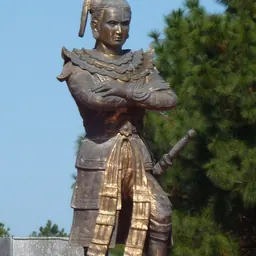


Related people
Same field, nearest in time

Contemporaries
People whose lives overlapped Ekkathat's





Frequently asked questions
Who was Ekkathat?
King of Ayutthaya
When was Ekkathat born?
Ekkathat was born in 1709 in Phra Nakhon Si Ayutthaya.
When did Ekkathat die?
Ekkathat died in 1767 in Phra Nakhon Si Ayutthaya.
What was Ekkathat's occupation?
Ekkathat was a sovereign, politician and military officer.
What nationality was Ekkathat?
Ekkathat was Thai.
Sources & further reading
Cite this page
APA: Biography.guide. (2026). Ekkathat. https://biography.guide/ekkathat/
MLA: "Ekkathat." Biography.guide, https://biography.guide/ekkathat/.
Chicago: "Ekkathat." Biography.guide. https://biography.guide/ekkathat/.
Data last updated: 2026-09-23 · Spot an error? Report a correction.
Portrait: Wikimedia Commons · author & licence
Page generated 2026-09-27 05:07 UTC