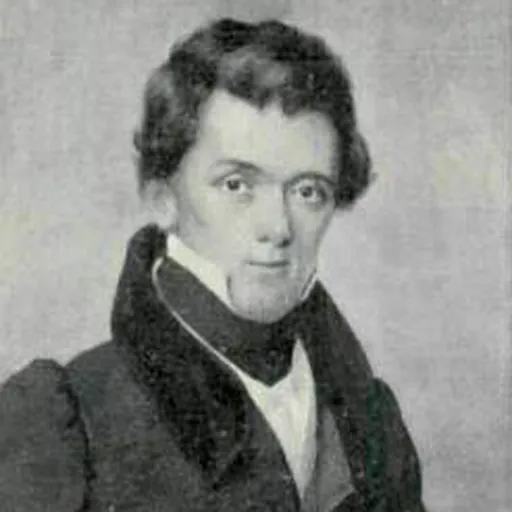
About Edwin James
Lived 1797 – 1861 (aged 64). Edwin James was an American botanist, non-fiction writer, translator, surgeon, geologist and editor.
Edwin P. James (August 27, 1797 – October 28, 1861), a 19th-century American botanist, geologist, linguist, and medical practitioner, was an important figure in the early exploration of the American West. James was also known for his time spent creating relationships with Native Americans in the United States, and also aiding African Americans to escape slavery.
James is primarily remembered for his participation in the expedition of 1820 led by Major Stephen Harriman Long, into still largely unknown territory acquired in the Louisiana Purchase. James served during the expedition's more productive second year. That expedition "was the first scientific survey of the region and dramatically increased the country’s geographical knowledge of the West." James was primarily responsible for producing the report, Account of an Expedition from Pittsburgh to the Rocky Mountains, Performed in the Years 1819, 1820, published in 1823.
During the expedition, James accomplished the first recorded mountain ascent in North America to over 14,000 ft. elevation, and was the first to collect many alpine plant species, including what he called "the mountain Columbine" Aquilegia coerulea, later to become the state flower of Colorado, now with the common name Colorado Blue Columbine.
The expedition's extensive collection of information on flora, fauna, geology and geography, as recounted in James' Account, is reminiscent of the efforts, just two decades earlier, by Alexander von Humboldt in Central and South America. A copy of Humboldt's Personal Narrative of Travels of the Equinocial Regions of the New Continent was carried by the Long expedition.
The Account influenced the literature of the Far West. Historian William H. Goetzmann suggested "the most important literary event of 1823 was the publication of Dr. Edwin James's Account of an Expedition." In a more recent homage to James, Lyndgaard said: "The passages that deal with landscape description, bison, and Native Americans, especially the Pawnee, were immediately recognized for their quality, and were thus mined by novelists as well as celebrated by reviewers."
Early life and education Born in Weybridge, Vermont, to Mary (Emmes) and Daniel James, a deacon. The youngest child, he grew up in a log house set among wooded hills. James inherited several of his father's traits. He was thoughtful, studious, and had "untiring perseverance". He was "accustomed to cull treasures of rich thought from works of nature and a wide range of readings."
Expedition to the Rocky Mountains
The second year of the Long Expedition began June 6, 1820 when the members, now including 22-year-old Edwin James, left the overwintering camp, Engineer Cantonment, near the eastern border of the current state of Nebraska. They headed west toward the Rockies, following, for the most part, the Platte River, then south along the Rocky Mountain Front Range, before heading east toward the expedition's ending location (which occurred on September 13, 1820) at Fort Smith, in what is now western Arkansas.
On July 13, James and two others set out to climb Pikes Peak. As James writes in his Account:
On the morning of the 14th... we continued the ascent, hoping to be able to reach the summit of the Peak, and return to the same camp in the evening... A little above the point where the timber disappears entirely, commences a region of astonishing beauty... covered with a carpet of low but brilliantly flowering alpine plants... We now found it would be impossible to reach the summit of the mountain, and return to our camp of the preceding night, during that part of the day which remained; but as we could not persuade ourselves to turn back, after having so nearly accomplished the ascent, we resolved to take our chance of spending the night, on whatever part of the mountain, it might overtake us... We met, as we proceeded, such numbers of unknown and interesting plants, as to occasion much delay in collecting, and were under the disagreeable necessity of passing by numbers which we saw in situations difficult of access. used the phrase "a region of astonishing beauty", from the above, for the title of his 2003 book on Rocky Mountains botanical history. After reaching the Peak, James describes the natural history of the summit, and goes on to describe the view in all directions in some detail, including smoke in a valley to the north "supposed to indicate the encampment of a party of Indians." (In South America, Alexander von Humboldt reached around 5,800 m / 19,000 ft on Mt. Chimborazo in 1802.) For a time, the mountain was called "James Peak".
Due to traversing a largely uncharted country, it was not always clear from James' journal exactly where each camp and collecting site was. The expedition's path was retraced 170 years later, using James' diary and scenic paintings of the expedition's artist, Samuel Seymour. In spite of considerable change over the years, sites were located with accuracy. The James Peak Wilderness and its summit in Colorado were named for James.
Native American subagent and linguist While, with the Army he interacted with Native Americans, most notably the Ojibwe with whose language he became familiar. A Euro-American, John Tanner, captured by the Ojibwe as a child and raised among them, worked closely with James in the production of the New Testament in the Ojibwe language and in the telling of Tanner's life story.
Edwin was an Indian subagent to the Potawatomi in Bellevue, Nebraska, where he created grade-school spellers for the children’s education.
In 1836, James established a medical practice, he built a large stone house four miles west of Burlington, Iowa in Union Township, He hid escaped enslaved people in baskets, barrels, and sacks. James, Edwin (1823, Philadelphia edition) . James, Edwin (1823, London edition). in three volumes.
James, Edwin (ed). (1830) James, Edwin, with John Tanner. (1833)
Don’t just read it —
keep it.
Full-length biographies made to live with: read them, listen on the way to work, watch them tonight.
- E-book
- Audio
- Video
Instant download · yours to keep · every purchase keeps this site free
Important facts
People in Edwin James's life
Named in this biography and alive at the same time




Related people
Same field, nearest in time


Contemporaries
People whose lives overlapped Edwin James's






Frequently asked questions
Who was Edwin James?
American botanist and geologist (1797-1861)
When was Edwin James born?
Edwin James was born on 27 August 1797 in Weybridge.
When did Edwin James die?
Edwin James died on 28 October 1861 in Burlington.
What was Edwin James's occupation?
Edwin James was a botanist, non-fiction writer, translator, surgeon, geologist and editor.
What nationality was Edwin James?
Edwin James was American.
Sources & further reading
· DBpedia: Edwin James (scientist)
Cite this page
APA: Biography.guide. (2026). Edwin James. https://biography.guide/edwin-james-botanist/
MLA: "Edwin James." Biography.guide, https://biography.guide/edwin-james-botanist/.
Chicago: "Edwin James." Biography.guide. https://biography.guide/edwin-james-botanist/.
Data last updated: 2026-09-22 · Spot an error? Report a correction.
Portrait: Wikimedia Commons · author & licence
Page generated 2026-09-27 05:03 UTC