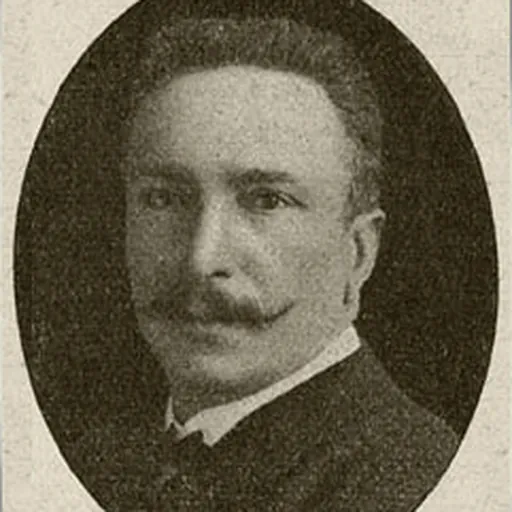
About Edward Potjes
Lived 1860 – 1931 (aged 70). Edward Potjes was a Dutch composer, music educator and pianist.
Edward Potjes (born Eduard Adriaan Nicolaas; in French Edouard-Adrien-Nicolas) was a Dutch-born composer and piano virtuoso.
Born in Nijmegen (the Netherlands) on 13 August 1860, Potjes began his music studies at the age of 7. He received the rudiments of piano from P. Van Merkestein, and learned harmony and counterpoint from Grégoire Van Dyck in Boxmeer. From 1878 to 1880 he attended composition classes by Richard Hol. After that, at Cologne, he was pupil of Ferdinand Hiller (composition) and of Jacob Kwast (piano). He graduated from the University of Belgium in 1887.
After completing his studies, Potjes established in Antwerp as a music teacher and in 1885 he had the opportunity to be heard by Liszt; following his advice he applied for the position of piano teacher at the Strasbourg Pādagogium and was accepted.
Potjes was regarded as a virtuoso, receiving positive reception for his concert performances. it can be cited his recital in Liège dedicated to the members of the Legia in January 1896; the one he presented in January 1897 at the Salle Pleyel in Paris, where his performances of a varied repertoire (Bach, Tausig, Liszt, Chopin, Saint-Saëns, Rachmaninoff, Schumann, Beethoven, etc.) were well received. And the "Piano Recital Beethoven", at the Cercle des Concerts d'hiver in January 1899, where he performed four Beethoven sonatas to a positive reception.
On 1 December 1930, the Seattle Symphony Orchestra, in concert, played his tone poem "Easter Morning" from his opera "Salome's Jewel Box". Potjes died on 4 January 1931 at Columbus Hospital, in Seattle, United States.
Works
Edward Potjes was a prolific composer. Following is a list of his compositions up to 1901:
1. Grande valse for piano (op. 1) (Ed. A. Uhrig, Cologne) 2. Liedercyclus, in German (op. 2) 3. Andante for piano (op. 3) (Ed. Augener et Cie., London) 4. Ballade, id. (op. 4) (Ed. Schott frères, Bruxels) 5. Pastorale, id. (op. 5) (Ed. Augener et Cie., London) 6. 2de. valse-caprice, id. (op. 6) (id.) 7. Trost der Gerechtigheid, aria (op. 7) 8. Drei lieder (op. 8) (Ed. Schott frères, Bruxels) : A) Liebster! Nur dich sch'n B) Christgeschenk C) Ich wollte dasz der Frieden 9. Villanella, for piano (op. 9) (Ed. Augener et Cie., London) 10. Deux danses (op. 10), id. : A) Danse des Aulnes B) Danse hongroise 11. Valse brillante, in G flat major, id. (op. 11) (id.) 12. Nocturne in F sharp major, id. (op. 12) 13. Berceuse for guitar and piano (op. 13) (id.) 14. Deux danses (op. 14) (Ed. Augener et Cie., London) : A) Danse hongroise B) Petite valse 15. Trois morceaux (op. 15) (Ed. Holzmann, Zürich) : A) Gavotte B) Nocturne C) Air de Ballet 16. Illustrations, id., based on the novel by Bulwer Lytton : The last days of Pompeii (op. 16) 17. Messe for soprano, tenor and bass, with organ accomp. (harp and strings ad libitum) (op. 17) 18. Quatre consolations, for piano (op. 18) 19. Bal champêtre, six dances for piano (op. 19) (Ed. Augener et Cie., London) : A) Marche B) Valse C) Intermède (Les Gnomes) D) Mazurka E) Polka F) Galop 20. Fantaisie hongroise Czardas for four-hand piano (op. 20) 21. Illusions de jeunesse, for piano (op. 21) (Ed. Augener et Cie., London) : A) Sérénade B) Danse féerique C) Idylle D) Rêverie E) Prière F) Bonheur accompli (valse) 22. Deux morceaux, id. (op. 22) : A) La Babillarde B) L'Espiègle 23. Sonate, id. (op. 23) 24. Envoi de fleurs, works for piano (op. 24) (Ed. Me. Beyer, Ghent) : A) Lilas B) Aubépine C) Pensée D) Pervenche E) Oeillet F) Rose 25. Paraphrase de concert, work for piano based on an air (op. 25) 26. Sonate, for piano and guitar (op. 26) (id.) 27. Quintette, for piano, 2 guitars, contralto and cello (op. 27) (id.) 28. Cinq pièces, for piano (op. 28) (Ed. Teerlinck, Ghent) : A) Luronne B) Berceuse C) Sérénade D) Marche nuptiale E) Mutine 29. Cinq pièces, for piano (album for the youth) (op. 29) (Ed. Me. Beyer, Ghent) : A) Chant de Noël B) La Gracieuse C) La Danse des Bayadères D) Romance E) Les Patineurs
Compositions without indication of opus 1. Feuillet d'Album (Ed. Augener et Cie., London) 2. Angelus, lied in Flemish (Ed. Faes, Antwerp) 3. Lamentation, air dramatique 4. Chanson d'hiver, for voice and piano (Ed. Teerlinck, Ghent) 5. Ariane, grand opera in three acts, text by Charles Duprez
Don’t just read it —
keep it.
Full-length biographies made to live with: read them, listen on the way to work, watch them tonight.
- E-book
- Audio
- Video
Instant download · yours to keep · every purchase keeps this site free
Important facts
People in Edward Potjes's life
Named in this biography and alive at the same time
Related people
Same field, nearest in time



Contemporaries
People whose lives overlapped Edward Potjes's


Frequently asked questions
Who was Edward Potjes?
Dutch composer
When was Edward Potjes born?
Edward Potjes was born on 13 August 1860 in Nijmegen.
When did Edward Potjes die?
Edward Potjes died on 4 January 1931 in Seattle.
What was Edward Potjes's occupation?
Edward Potjes was a composer, music educator and pianist.
What nationality was Edward Potjes?
Edward Potjes was Dutch.
Sources & further reading
Cite this page
APA: Biography.guide. (2026). Edward Potjes. https://biography.guide/edward-potjes/
MLA: "Edward Potjes." Biography.guide, https://biography.guide/edward-potjes/.
Chicago: "Edward Potjes." Biography.guide. https://biography.guide/edward-potjes/.
Data last updated: 2026-09-20 · Spot an error? Report a correction.
Page generated 2026-09-27 05:10 UTC