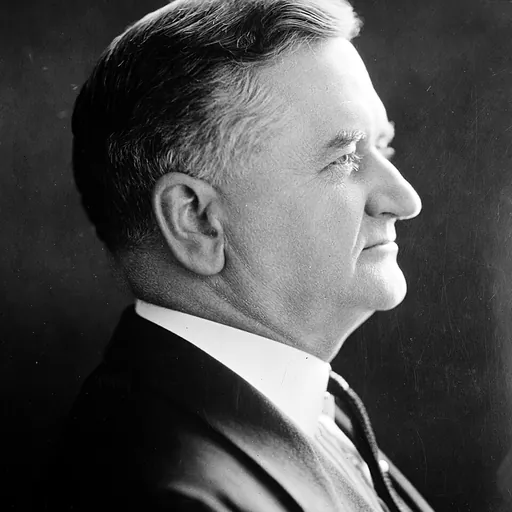
About Edward L. Jackson
Lived 1873 – 1954 (aged 80). Edward L. Jackson was an American politician, lawyer, judge, governor, jurist and major.
Edward L. Jackson (December 27, 1873 – November 18, 1954) was an American attorney, judge and politician, elected the 32nd governor of the U.S. state of Indiana from January 12, 1925, to January 14, 1929. He had also been elected as Secretary of State of Indiana.
Jackson repeatedly associated with Ku Klux Klan leaders, but there is no evidence he ever joined. He became involved in several political scandals. In 1927 he was investigated and tried on bribery charges related to having tried to bribe the previous governor, but was not convicted as the statute of limitations had expired. After finishing his term in office, he left in disgrace and never ran again for public office.
Early life and education Edward Jackson was born on December 27, 1873, in Howard County, Indiana, the son of Presley and Mary Howell Jackson. His family were members of the Disciples of Christ church. His father was a mill worker. As a boy, Edward delivered newspapers and attended public schools.
After completing school he took a job in a factory producing stakes.
Marriage and family After beginning his career as a lawyer, Jackson married Rosa Wilkinson on February 20, 1897. The couple had two daughters, Helen and Gertrude. Rosa died in October 1919 during the influenza epidemic.
Law career Jackson began reading the law as a legal apprentice after he finished school. He passed the bar and opened a law office in Kennard in 1893. His business was not very successful at first, and he worked in a brickyard to earn a steady income, especially to support his family.
By 1898, his law office had become a full-time position. He worked on many cases for the Henry County prosecutor's office.
Political career In 1901, Jackson ran successfully for the prosecutor's position and served until 1906. He was elected as a county circuit court judge in 1907 and remained on the court until 1914, during which time he gained a strong political base of support.
Ku Klux Klan After leaving the military, Jackson opened a new law office in Lafayette, Indiana. In 1920 Governor of Indiana James P. Goodrich appointed Jackson as Secretary of State after the incumbent William Roach died in January 1920.
In 1922, he campaigned for the office and was elected. Jackson was interested in running for higher office, and began to seek out supporters for his coming bid for the governorship. There is no evidence that Jackson ever was a member of the KKK. However, he was approached by D. C. Stephenson, Grand Dragon of the Indiana Klan, who discussed issues of interest to the Klan, such as eliminating the influence of Catholics, Jews and 'coloreds'.
Jackson soon found his deal with Klan leaders to be troublesome, as the Klan began demanding specific actions from him. He granted the Klan a state charter, to the disgust of Republican Governor Warren T. McCray
Governor Both McCray and his successor, Emmett Forest Branch, declined to run for governor in 1924, leaving Jackson as the Republican front runner. Jackson's main opponent for the Republican nomination was Samuel Lewis Shank, the strongly anti-Klan mayor of Indianapolis who had banned masked parades in the city. Democrats had long dominated the Catholic and Jewish vote in Indiana, but most African-Americans still voted Republican despite the Republican Party's abandonment of civil rights since the Compromise of 1877. Jackson was accused of suppressing the black vote in the primary and defeated Shank in the primary by a margin of more than two to one. After the primary, Shank granted the Klan the right to march in Indianapolis because he believed that Indiana voters now desired to be ruled by the Klan. The Klan celebrated Jackson's victory by doing a march through the black areas of Indianapolis that may have attracted as many as 100,000 onlookers. Stephenson declared at the march that "We must put over Jackson our very right to existence" and "The fiery cross is going to burn at every crossroads in Indiana, as long as there is a white man left in the state." Stephenson claimed to control 85% of the delegates at the state Republican convention, and the state Republican Party came to increasingly be viewed as little more than a Klan organization.
Indiana Democratic politicians were divided on whether to take a stand against the Klan or to remain neutral on the Klan. Although few Democratic politicians in Indiana had joined the Klan, many rank and file Democratic voters in Indiana had joined the Klan, and some Indiana Democratic politicians were concerned about alienating pro-Klan voters. Irish Catholics counter-argued that an anti-Klan stance would attract the vote of not only African Americans, but also more tolerant white Protestants. Democratic gubernatorial nominee Carleton McCullouch, who wanted to take a neutral position on the Klan, compromised with anti-Klan Democrats at the state Democratic convention by agreeing to a "Freedom and Liberty" plank that did not technically mention the Klan by name, but declared that the Indiana Republican Party had "retired from the political arena", the Republican Party had "been delivered into the hands of an organization which has no place in politics and which promulgates doctrines which tend to break down the safeguards which the Constitution throws around every citizen" and that 1920s Indiana Republicans were "repungant to the principles of government" advocated by Civil War Indiana Republicans Abraham Lincoln and Oliver Morton.
Both McCullouch and Jackson made little mention of the Klan after their respective party's conventions, as McCulloch was concerned about alienating pro-Klan voters and Jackson was concerned about alienating black voters. The Klan issue nonetheless remained the unspoken elephant in the room that dominated the gubernatorial election and Indiana life as a whole. McCullouch dominated Jackson among the traditionally Republican black voters on election day. However, Jackson won the election by 3% by dominating in working class white Protestant districts, including in white Protestant districts that had voted Democratic in previous elections.
Jackson was inaugurated on January 12, 1925. He stressed the need to run the government economically. His administration oversaw the payoff of the state's US$3.5 million debt and a significant reduction in taxes. He also increased attention on the Department of Conservation. The Indiana Dunes State Park and the George Rogers Clark Memorial were established with his support.
The following year Indiana Attorney General Arthur L. Gilliom arrested Edward Shumaker, the leader of the Indiana Anti-Saloon League. He charged Shumaker with contempt of court because of newsletters he was circulating that attacked the Indiana Supreme Court; he accused them of lax enforcement of prohibition laws. He was convicted and sentenced to serve time on the Indiana work farm. As Shumaker was the leader of a key Republican support group, Jackson pardoned him. Gilliom took the pardon to court and had the pardon overturned by the Supreme Court. Shumaker was required to serve his term. He demanded that Jackson pardon him, but the governor refused. Angered, Stephenson started talking to reporters in 1927 from the Indianapolis Times and provided names of people who had been paid bribes by the Klan and taken part in other illegal activity. He had kept a "black box" of records that provided evidence for many of his accusations. He exposed Jackson's attempt to bribe McCray with $10,000 years earlier.
Don’t just read it —
keep it.
Full-length biographies made to live with: read them, listen on the way to work, watch them tonight.
- E-book
- Audio
- Video
Instant download · yours to keep · every purchase keeps this site free
Important facts
People in Edward L. Jackson's life
Named in this biography and alive at the same time




Related people
Same field, nearest in time





Contemporaries
People whose lives overlapped Edward L. Jackson's


Frequently asked questions
Who was Edward L. Jackson?
American politician (1873–1954)
When was Edward L. Jackson born?
Edward L. Jackson was born on 27 December 1873 in Howard County.
When did Edward L. Jackson die?
Edward L. Jackson died on 18 November 1954 in Orleans.
What was Edward L. Jackson's occupation?
Edward L. Jackson was a politician, lawyer, judge, governor, jurist and major.
What nationality was Edward L. Jackson?
Edward L. Jackson was American.
Sources & further reading
· Wikipedia: Edward L. Jackson
Cite this page
APA: Biography.guide. (2026). Edward L. Jackson. https://biography.guide/edward-l-jackson/
MLA: "Edward L. Jackson." Biography.guide, https://biography.guide/edward-l-jackson/.
Chicago: "Edward L. Jackson." Biography.guide. https://biography.guide/edward-l-jackson/.
Data last updated: 2026-09-23 · Spot an error? Report a correction.
Portrait: Wikimedia Commons · author & licence
Page generated 2026-09-27 05:06 UTC