
About Edward Digges
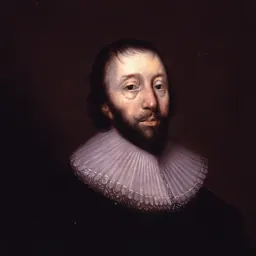
Lived 1620 – 1674 (aged 53–54). Edward Digges was an English barrister, governor and plantation owner.
Edward Digges (14 February 1620 – 15 March 1674/75) was an English barrister and colonist who became a premier tobacco planter and official in the Virginia colony. The son of the English politician Dudley Digges represented the colony before the Virginia Company of London and the royal government, as well as served for two decades on the colony's Council of State. Digges served as interim Colonial Governor of Virginia from March 1655 to December 1656, and for longer periods as the colony's receiver general and auditor-general. He is also known for planting mulberry trees and promoting the silk industry in the colony.
Early life and education Edward Digges' father, Sir Dudley DiggesBorn in Chilham Castle, Kent, England, and christened in Chilham parish on 29 March 1620, Edward Digges was the fourth son of Sir Dudley Digges (1583–1638) and his wife Mary Kempe (1583–?). Sir Dudley was the Master of the Rolls for King Charles I and an investor in the Virginia Company of London. On 13 June 1621, that company gave Sir Dudley a patent, and on 10 June 1622 he was identified as holding the patent for a particular plantation in Virginia, but this son would not arrive in Virginia for another two decades.
Edward Digges received an education appropriate to his class and entered Gray's Inn in 1637 to become a barrister.
Career
Digges emigrated to the Virginia Colony about 1650 and purchased from Captain John West a 1250-acre plantation in Hampton Parish, York County, Virginia, near Yorktown.
Tobacco planter Edward Digges had more success growing premium tobacco than manufacturing silk. He grew a sweet-scented tobacco variety which brought an unusually high price in London, and which he exported in casks marked "E.D.". However, these early efforts had not succeeded, so others showed little enthusiasm for the project. Digges, in contrast, became deeply absorbed in his project, and brought over two Armenians (now considered the first Armenians in America) to help him experiment with silk production. Digges even wrote a pamphlet entitled "The Reformed Virginia Silkworm", in which he claimed that "native silkworms could be kept outdoors on native mulberry trees and that Indians could be employed to care for the worms."
Digges sent a parcel of his silk to the Royal Society, by way of his cousin Dudley Palmer, one of the original Fellows of the Society. The letter accompanying the silk sample, stated his findings, for example:
Digges's efforts to create a silk industry in Virginia proved futile, despite him being awarded as a reward.
To this day numerous mulberry trees, which were used to raise the silk worms, still stand on what had been his plantation. In recognition of his efforts, as discussed below, Edward Digges was given a seat on the Virginia Governor's Council (also known as the "Council of State") in November 1654, for "having given a signal testimony of his fidelity to this colony and commonwealth of England."
Politician
Digges received his seat on the Virginia Governor's Council during the English Civil War, two years after Virginia's governor and legislature recognized the Cromwellian (or Parliamentarian) government. She survived her husband by more than a decade. Five children survived their parents. The daughter of a burgess and sister of Col. John Page of Middle Plantation, she had been raised at "Bedfont" plantation in Middlesex County. Her niece, Mary Page, married Col. Chiles, Speaker of the House of Burgesses.
Digges' will left legacies "to all my children being four boys and four girls", although only sons William, Dudley and Edward II, and a granddaughter would survive their mother.
During Bacon's Rebellion not long after his death, Mrs. Digges and her eldest son William Diggs suffered losses because of family loyalty to the King, and William fled to the Maryland colony, where he held offices as well as property before returning to Virginia.
The plantation which Digges had purchased from Capt. John West (known as the E. D. plantation) remained in the family until 1787, when it was sold. It was known as "Bellfield" by 1811, when it was advertised for sale as "Belfield, 1.000 acres in York Co., the only estate where the famous E.D. tobacco was raised, which never failed to bring in England one shilling when other tobacco would not bring three pence." It is currently under federal control as part of the Naval Weapons Station Yorktown.
Don’t just read it —
keep it.
Full-length biographies made to live with: read them, listen on the way to work, watch them tonight.
- E-book
- Audio
- Video
Instant download · yours to keep · every purchase keeps this site free
Important facts
People in Edward Digges's life
Named in this biography and alive at the same time


Related people
Same field, nearest in time




Contemporaries
People whose lives overlapped Edward Digges's





Frequently asked questions
Who was Edward Digges?
American politician 1620-
When was Edward Digges born?
Edward Digges was born in 1620 in Chilham Castle.
When did Edward Digges die?
Edward Digges died in 1674 in York County.
What was Edward Digges's occupation?
Edward Digges was a barrister, governor and plantation owner.
What nationality was Edward Digges?
Edward Digges was English.
Sources & further reading
Cite this page
APA: Biography.guide. (2026). Edward Digges. https://biography.guide/edward-digges-barrister/
MLA: "Edward Digges." Biography.guide, https://biography.guide/edward-digges-barrister/.
Chicago: "Edward Digges." Biography.guide. https://biography.guide/edward-digges-barrister/.
Data last updated: 2026-09-20 · Spot an error? Report a correction.
Page generated 2026-09-27 05:12 UTC