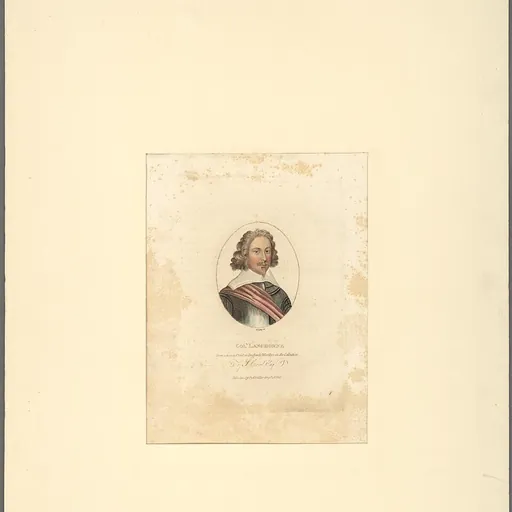
About Sir William Langhorne, 1st Baronet
Lived 1631 – 1715 (aged 83–84). Sir William Langhorne, 1st Baronet was a barrister.
Sir William Langhorne, 1st Baronet ( – 26 February 1715) was the Agent of Madras from January 1670 to 27 January 1678.
Family and early life William Langhorne was baptised on 26 July 1631 at St Gabriel Fenchurch, the son of William Langhorne and Mary née Oxenbridge.
Langhorne was born in a well-off family. His uncle Needham Langhorne left behind a vast fortune upon his death in 1673, his favourite property being the manor of Newton Bromswold in Northamptonshire. Langhorne was also a distant relation of first President of the United States George Washington.
Langhorne's father (also named William) was himself active in the East India Company, and had residences in Hitchin and in the parish of St Gabriel Fenchurch in the City of London. After taking his degree he became a barrister with his admission to Gray's Inn on 6 August 1664 but there is no evidence that he actively practised as a lawyer. Following his father's death he inherited stock in the East India Company, began to make money and was created a baronet (in the Baronetage of England) in 1668. A few months later, he was appointed as the Agent of Madras
Payment of tribute Despite its official existence as an independent entity, the Agency of Madras paid a tribute of 1200 pagodas to Neiknam Khan, the commander-in-chief of Golconda and later, his son Mirza Ibrahim Khan during the whole length of Langhorne's tenure. The Agency also paid an annual tribute to one Madan Pant who was the Prime Minister of Golconda. From 1674 onwards, the Agency also paid a regular tribute to the Naik of Chingleput and Pallavaram who were regarded as "old friends of the Company" apart from Lingappa, the Naik of Poonamallee.
Hostilities with Golconda Around this time, Lingappa, the Naik of Poonamallee turned against the British when they refused to pay tribute. He complained to Golconda on the arrogance of the British of Madras exhorting the Qutb Shah of Golconda to invade and capture Fort St George. However, as the Qutb Shah was making plans to invade Madras the invasion of the Marathas consumed his attention. Madras was spared from an invasion but restrictions were imposed on trade with the colony. Trade of rice and corn were forbidden and Madras was required to present a thousand hundred yards of cloth along with an increased tribute.
The Company yielded at once and presented Golconda as well as Lingappa Naik to appease. The influence that Lingappa wielded increased manifold and he held supreme power between Armaghaum and Bijapur.
Religious tolerance According to 19th-century historian James Talboys Wheeler, Langhorne was "far more tolerant of the religious opinions of others, than could have been expected in that intolerant age". He was reprimanded by the directors of the EIC "for firing your guns upon the naming of a church by the papists; we cannot approve thereof, and desire to give as little countenance and encouragement to that religion, as they do to ours; and we would have you discountenance, and discourage all of our nation that any ways incline to that profession."
Charges of private trade and recall In 1676, charges of private trade were brought forth against William Langhorne by the Directors of the company. Major James Puckle who was sent to investigate the charges concluded that Langhorne was receiving an annual sum of 20,000 pagodas from an Indian merchant of Fort St George called Casa Verona (Kasi Veeranna). Both denied the accusations. Other sources state that he had a private income of £7000 a year, well above the £300 allowed by the company. On India's independence, this became the Raj Bhavan and is the official residence of the governor of Tamil Nadu. It was also during this time that an Office of Archives was established to maintain the records of the Agency. The Council Room of Fort St George was allocated for this purpose. This later became the Madras Record Office. In 1909, the office was shifted to Egmore and has since become the Tamil Nadu State Archives. The Tamil Nadu State Archives is, therefore, one of the oldest record-keeping offices of the world and certainly the oldest such institution established by the British East India Company.
Don’t just read it —
keep it.
Full-length biographies made to live with: read them, listen on the way to work, watch them tonight.
- E-book
- Audio
- Video
Instant download · yours to keep · every purchase keeps this site free
Important facts
People in Sir William Langhorne, 1st Baronet's life
Named in this biography and alive at the same time
Related people
Same field, nearest in time





Contemporaries
People whose lives overlapped Sir William Langhorne, 1st Baronet's






Frequently asked questions
Who was Sir William Langhorne, 1st Baronet?
British Agent of Madras
When was Sir William Langhorne, 1st Baronet born?
Sir William Langhorne, 1st Baronet was born in 1631.
When did Sir William Langhorne, 1st Baronet die?
Sir William Langhorne, 1st Baronet died on 26 February 1715.
What was Sir William Langhorne, 1st Baronet's occupation?
Sir William Langhorne, 1st Baronet was a barrister.
Sources & further reading
· Wikipedia: Sir William Langhorne, 1st Baronet
· DBpedia: Sir William Langhorne, 1st Baronet
Cite this page
APA: Biography.guide. (2026). Sir William Langhorne, 1st Baronet. https://biography.guide/sir-william-langhorne-1st-baronet/
MLA: "Sir William Langhorne, 1st Baronet." Biography.guide, https://biography.guide/sir-william-langhorne-1st-baronet/.
Chicago: "Sir William Langhorne, 1st Baronet." Biography.guide. https://biography.guide/sir-william-langhorne-1st-baronet/.
Data last updated: 2026-09-22 · Spot an error? Report a correction.
Portrait: Wikimedia Commons · author & licence
Page generated 2026-09-27 05:04 UTC