
About Eduardo Cano
Lived 1823 – 1897 (aged 74). Eduardo Cano was a Spanish painter and artist.
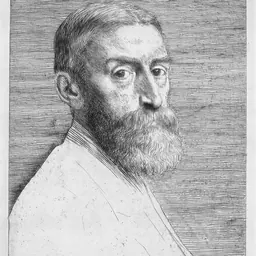
Eduardo Cano de la Peña (1823, Madrid - 4 April 1897, Seville) was a Spanish painter in the Romantic style; specializing in historical scenes.
Life and work His father was the architect. In 1826, his family moved to Seville, where his father had been appointed Municipal Architect.
He began by studying architecture at the Real Escuela de las Tres Nobles Artes de Sevilla, but soon followed his inclinations to become an artist instead and was eventually appointed an assistant professor. After both of his parents had died, he continued his studies in Madrid, at the Real Academia de Bellas Artes de San Fernando, under the direction of José and Federico Madrazo and Carlos Luis de Ribera y Fieve.
Later, he went to Paris, where he created two of his best known works. The first, Cristóbal Colón en el Convento de la Rábida, was awarded the gold medal at the Exposición Nacional of 1856, and is now in the Palacio del Senado. The second, Entierro del condestable Don Álvaro de Luna, also won a gold medal, at the Exposición Nacional in 1858, and is now in the Museo del Prado.
Upon returning to Seville, he was named Conservator of the Museo de Bellas Artes, as well as Professor of color and composition at the Escuela de Bellas Artes. His devotion to teaching led to his producing a relatively small number of works; estimated at approximately 150. He also directed all of the restorative work at the museum and acted as its representative on official occasions.
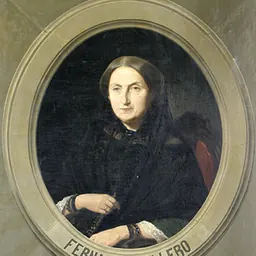
Although he is best known for his historical scenes, he also painted portraits, including one of the writer, Fernán Caballero (Cecilia Böhl de Faber). In addition, he created some works in Costumbrista style, watercolors, engravings, and some illustrations for the journal, El Museo Universal. Outside of the art world, he was a strong defender of Hispanic traditions, supported an equal education for men and women, and was an amateur musician.
Don’t just read it —
keep it.
Full-length biographies made to live with: read them, listen on the way to work, watch them tonight.
- E-book
- Audio
- Video
Instant download · yours to keep · every purchase keeps this site free
Important facts
more
Cano de la PenaPeople in Eduardo Cano's life
Named in this biography and alive at the same time
Related people
Same field, nearest in time


Contemporaries
People whose lives overlapped Eduardo Cano's




Frequently asked questions
Who was Eduardo Cano?
Spanish painter (1823-1897)
When was Eduardo Cano born?
Eduardo Cano was born on 20 March 1823 in Madrid.
When did Eduardo Cano die?
Eduardo Cano died on 4 April 1897 in Seville.
What was Eduardo Cano's occupation?
Eduardo Cano was a painter and artist.
What nationality was Eduardo Cano?
Eduardo Cano was Spanish.
Sources & further reading
· DBpedia: Eduardo Cano de la Peña
Cite this page
APA: Biography.guide. (2026). Eduardo Cano. https://biography.guide/eduardo-cano/
MLA: "Eduardo Cano." Biography.guide, https://biography.guide/eduardo-cano/.
Chicago: "Eduardo Cano." Biography.guide. https://biography.guide/eduardo-cano/.
Data last updated: 2026-09-20 · Spot an error? Report a correction.
Page generated 2026-09-27 05:19 UTC