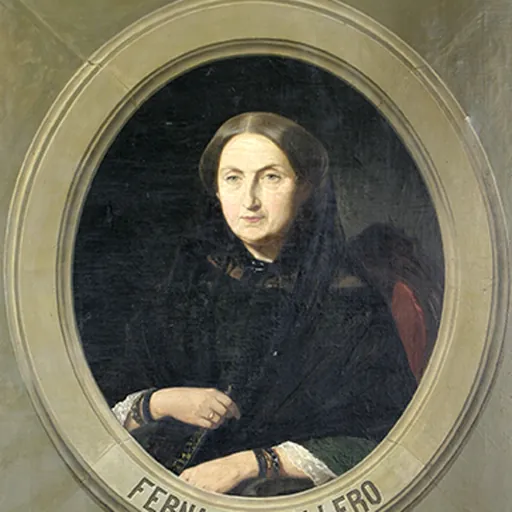
About Fernán Caballero
Lived 1796 – 1877 (aged 80). Fernán Caballero was a Spanish writer, folklorist and novelist.
Fernán Caballero (24 December 1796 – 7 April 1877) was the pseudonym of Spanish novelist Cecilia Francisca Josefa Böhl de Faber y Ruiz de Larrea. She was the daughter of German writer Johann Nikolaus Böhl von Faber and Spanish writer Frasquita Larrea. Her pen name was taken from the name of a village in the province of Ciudad Real.
Biography Caballero was born in Morges, Switzerland as Cecilia Francisca Josefa Böhl und Lütkens y Ruiz de Larrea.
She was the daughter of Johann Nikolaus Böhl von Faber, a German merchant from Hamburg, and Frasquita Larrea, a Spanish writer from Cádiz.
She was educated principally in Hamburg but visited Spain in 1815.
In 1816, she married Antonio Planells y Bardaxi, an infantry captain who was killed the same year.
In 1822 Caballero married Francisco Ruiz del Arco, Marqués de Arco Hermoso, an officer in one of the Spanish household regiments.
Upon the death of Arco in 1835, Caballero, now a marquesa, married Antonio Arrom y Morales de Ayala in 1837.
Arrom was appointed consul in Australia, engaged in business enterprises and made money; committed suicide in 1859.
Writings Caballero gained notoriety after the publishing of La Gaviota. She published an anonymous romance, Sole in 1840 written in German and the original draft of La Gaviota had been written in French.
This novel, translated into Spanish by , appeared as the feuilleton of El Heraldo (1849), and was received well. The book was translated into most European languages, Another notable work by the author is La Familia de Alvareda (which was written, first of all, in German).
The Catholic Encyclopedia describes Caballero's later works as overly didactic, at the cost of "much of her primitive simplicity and charm". Caballero herself claimed that, though she occasionally idealized circumstances, she was conscientious in choosing for her themes subjects which had occurred in her own experience. For many years she was the most popular of Spanish writers, and the sensation caused by her death at Seville on 7 April 1877 proved that her truthfulness still attracted readers who were interested in records of national customs and manners.
Her Obras completas are included in the Colección de escritores castellanos: a useful biography by Fernando de Gabriel Ruiz de Apodaca precedes the Últimas producciones de Fernán Caballero (Seville, 1878).
Don’t just read it —
keep it.
Full-length biographies made to live with: read them, listen on the way to work, watch them tonight.
- E-book
- Audio
- Video
Instant download · yours to keep · every purchase keeps this site free
Important facts
People in Fernán Caballero's life
Named in this biography and alive at the same time

Related people
Same field, nearest in time



Contemporaries
People whose lives overlapped Fernán Caballero's





Frequently asked questions
Who was Fernán Caballero?
Spanish women novelist (1796-1877)
When was Fernán Caballero born?
Fernán Caballero was born on 24 December 1796 in Morges.
When did Fernán Caballero die?
Fernán Caballero died on 7 April 1877 in Seville.
What was Fernán Caballero's occupation?
Fernán Caballero was a writer, folklorist and novelist.
What nationality was Fernán Caballero?
Fernán Caballero was Spanish.
Sources & further reading
Cite this page
APA: Biography.guide. (2026). Fernán Caballero. https://biography.guide/fernan-caballero/
MLA: "Fernán Caballero." Biography.guide, https://biography.guide/fernan-caballero/.
Chicago: "Fernán Caballero." Biography.guide. https://biography.guide/fernan-caballero/.
Data last updated: 2026-09-23 · Spot an error? Report a correction.
Portrait: Wikimedia Commons · author & licence
Page generated 2026-09-27 05:04 UTC