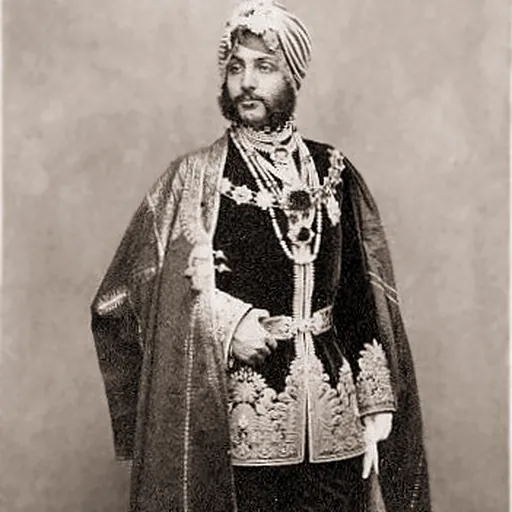
About Duleep Singh I
Lived 1838 – 1893 (aged 55). Duleep Singh I was an Indian sovereign.
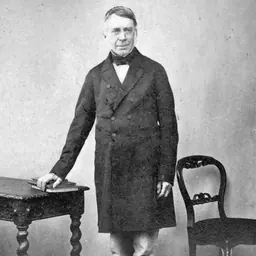
Maharaja Sir Duleep Singh (6 September 1838 – 22 October 1893), also spelled Dalip Singh, and later in life nicknamed the "Black Prince of Perthshire", was the last Maharaja of the Sikh Empire. He was Maharaja Ranjit Singh's youngest son, the only child of Maharani Jind Kaur.
He was placed in power in September 1843, at the age of five, with his mother ruling on his behalf, and after their defeat in the Anglo-Sikh War, under a British Resident. He was subsequently deposed by the British East India Company and thereafter exiled to Britain at age 15 where he was befriended by Queen Victoria, who is reported to have written of the Punjabi Maharaja: "Those eyes and those teeth are too beautiful". The Queen was godmother to several of his children.
His mother had effectively ruled when he was very young and he managed to meet her again on 16 January 1861, in Calcutta and return with her to the United Kingdom. During the last two years of her life, his mother told the Maharaja about his Sikh heritage and the Empire which once had been his to rule. In June 1861, he was one of the first 25 Knights in the Order of the Star of India.
Early years
After the death of Maharaja Ranjit Singh in 1839, Duleep Singh lived quietly with his mother, Jind Kaur Aulakh, at Jammu ruled by Gulab Singh, under the protection of the Vizier, Raja Dhian Singh. He and his mother were recalled to Lahore in 1843 after the assassinations of Maharaja Sher Singh and Dhian Singh, and on 16 September, at the age of five, Duleep Singh was proclaimed Maharaja of the Sikh Empire by the Panch (Military Council), with Maharani Jind Kaur as Regent. He was betrothed to Tej Kaur, the granddaughter of Sham Singh Attariwala. However, this betrothal would not be honored once he came under British guardianship.
Due to divisions and factionalism (including covert British activities), Jind Kaur was advised to weaken the strength and influence of the Sikh Army by pre-occupying it with a war with the East India Company, leading to the First Anglo-Sikh War. he was deposed at the age of ten. Duleep Singh was instructed that he was allowed to live anywhere but Punjab and was given a 120,000 rupee (£50,000 ) pension per annum. His property worth 15 million rupees was dispossessed of him by the British, including the famed Koh-i-Noor diamond. He would remain for weeks at a time in Landour at a grand hilltop building called The Castle, which had been lavishly furnished to accommodate him. Dalhousie celebrated his conversion to Christianity as it would destroy any remaining influence Duleep had in the Punjab, Duleep Singh was treated as a godson by Queen Victoria, often visiting Buckingham Palace.
Castle Menzies
On his return from Continental Europe in 1855 he was given an annual pension of £25,000 a year (approximately £ in today's value) provided he "remain obedient to the British Government," and was officially under ward of Sir John Spencer Login and Lady Login, who leased Castle Menzies in Perthshire, Scotland, for him. He spent the rest of his teens there, but at 19 he demanded to be in charge of his household. Eventually, he was given this and an increase in his annual pension.
In 1859 Lt Col James Oliphant was installed as Equerry to the Maharaja at the recommendation of Sir John Login. Oliphant was to be a possible replacement should anything happen to the Maharaja's most trusted friend Sir John Login (who did indeed die four years later in 1863).
In the 1860s, Singh moved from Castle Menzies to Grandtully Castle. Eventually Duleep Singh was given a £40,000 per year pension and an estate in the county of Suffolk.
Sir Samuel White Baker
While Sir Samuel White Baker was visiting the Duke of Atholl on his shooting estate in Scotland, he befriended Maharaja Duleep Singh. In 1858–1859, the two partnered an extensive hunting trip in central Europe and the Balkans, via Frankfurt, Berlin, Vienna and Budapest. On the last part of the voyage, Baker and the Maharajah hired a wooden boat in Budapest, which was eventually abandoned on the frozen Danube. The two continued into Vidin where, to amuse the Maharajah, Baker went to the Vidin slave market. There, Baker fell in love with a white slave girl, destined for the Ottoman Pasha of Vidin. Baker was outbid by the Pasha but bribed the girl's attendants. The two ran away in a carriage together and eventually, as Florence Baker, she became Baker's lover and later wife and accompanied him everywhere he journeyed.
Reunion with his mother In 1861, Duleep Singh was allowed to return to India on a short trip, returning with his mother. In 1863, he returned to India with the ashes of his mother after her death. Enroute to India he met Bamba Müller, the daughter of a German trader and an Abyssinian woman. Duleep Singh later married Bamba in Alexandria, with the couple living together in Suffolk and having children. (At the same time, he was known to have gradually developed a sense of regret for his circumstances in exile, including some inner turmoil about his conversion to Christianity and his forced departure from the Punjab). His mother stayed in Perthshire with him for a short time, before he rented the Grandtully Estate, near Aberfeldy. Following the death of his mother and Sir John Login in 1863, he returned to England.
Elveden Estate
Maharaja Duleep Singh (as he became in June 1861) bought (or the India Office purchased for him) a country estate at Elveden on the border between Norfolk and Suffolk, close to Thetford, in 1863. He enjoyed living in Elveden Hall and the surrounding area and restored the church, cottages, and school. He transformed the run-down estate into an efficient game preserve and it was here that he gained his reputation as the fourth best shot in England.
The house was remodelled into a quasi-oriental palace where he lived the life of a British aristocrat. Maharaja Duleep Singh was accused of running up large expenses and the estate was sold after his death to pay his debts. Today, Elveden is owned by Edward Guinness, 4th Earl of Iveagh, the head of the Anglo-Irish Guinness family of brewing fame; it remains an operating farm and private hunting estate.
Effort to restore his throne
In 1864, Duleep Singh married Bamba Müller in Alexandria and established his family home at Elveden Hall in Suffolk. He eventually became disaffected and embittered with the British and their social culture, suffering from debts and creditors after he and his family began living beyond their means. The main reason for him trying to restore the throne were financial issues, as he lost most of his capital in gambling and the British reduced his pension.
Duleep Singh reverted to Sikhism and began communicating with Sikh sardars and Indian princes from his homeland.
While in exile, he sought to learn more about Sikhism and was eager to return to India. Though previous efforts were thwarted by his handlers, he re-established contact with his cousin Sardar Thakar Singh Sandhawalia, who on 28 September 1884 left Amritsar for England along with his sons Narinder Singh and Gurdit Singh and a Sikh granthi (priest), Pratap Singh Giani. He also brought a list of properties held by Sir Duleep Singh in India. All this renewed his connection with Sikhism.
The British Government decided in 1886 against his return to India or his re-embracing Sikhism. Despite protests from the India Office, he set sail for 'home' on 30 March 1886. However, he was intercepted and arrested in Aden, then part of Aden Settlement, where the writ of the Viceroy of India began. He could not be stopped from an informal re-conversion ceremony in Aden, far less grand and symbolic than it would have been in India, done by emissaries sent by Sardar Thakar Singh Sandhawalia, who was earlier planning the Pahaul ceremony at Bombay.
In an auction at Bonhams, London in April 2007, the 74cm high white marble portrait bust of Singh by John Gibson, sculpted in Rome in 1859, sold for £1.5 million plus premium and tax.
A film titled Maharaja Duleep Singh: A Monument Of Injustice, was made in 2007, directed by P.S. Narula.
Heraldry
The Maharaja and his family used a coat of arms which was drawn up by Prince Albert, despite not being registered at the College of Arms. It contained a coronet, lions, and a shield with a cross, along with the motto "Prodesse quam conspicii" ("to do good rather than be conspicuous").
Family
Sir Duleep Singh married twice, first to Bamba Müller in 1864, and then to Ada Douglas Wetherill (1869-1930) in 1889. He had nine children in total.
He had seven children from his marriage to Bamba. Their first child and male heir died aged one day in 1865. The others were: Prince Victor Albert Jay Duleep Singh (10 Jan 1866–7 Jun 1918) Prince Frederick Victor Duleep Singh (23 Jan 1868–15 Aug 1926) Princess Bamba Sofia Jindan Duleep Singh (29 Sep 1869–10 Mar 1957) Princess Catherine Hilda Duleep Singh (27 Oct 1871–8 Nov 1942) Princess Sophia Alexandra Duleep Singh (8 Aug 1876–22 Aug 1948) Prince Albert Edward Alexander Duleep Singh (1879–1 May 1893)
He also had two children from his marriage to Wetherill: Princess Pauline Alexandrina Duleep Singh (26 Dec 1887–10 Apr 1941) Princess Ada Irene Beryl Duleep Singh (25 Oct 1889–14 Sep 1926)
All the eight children died without legitimate issue, ending the direct line of the Sikh Royalty.
There is a memorial at Eton College in England to Princes Victor and Frederick, Maharaja Sir Duleep Singh's two sons who studied at Eton in the 1870s. had been Duleep's mistress before he decided to return to India with his family, and upon being stopped in Aden by the British authorities he abandoned his family and moved to Paris, where she joined him. They married in Paris on 28 April 1889. She stayed with him through his years in Paris and also travelled with him to St. Petersburg, Russia, where he failed to persuade the Czar Alexander III of the benefits of invading India through the north and reinstalling him as ruler. She died in Sussex on 6 August 1930.
Queen Victoria and Maharaja Duleep Singh reconciled their differences before he died. Out of loyalty to Maharani Bamba, the Queen refused to receive Ada, whom she suspected had been involved with the Maharaja before Maharani Bamba's death in 1887.
Miscellany In 1854, Madame Blavatsky, the founder of the Theosophical Society, met her Master Morya in England, who was in her words, "in the company of a dethroned native prince". This "native prince" according to general consent was Sir Duleep Singh.
He was a member of the Freemasons and was admitted into the Grand Freemasonry Lodge of India in 1861.
On 21 October 1893, the day before Sir Duleep Singh's death, Prince Victor Duleep Singh, the eldest son of Sir Duleep Singh, had visions of his father looking at him through a picture frame.
Duleep Singh remembered his servant James Cawood who died in 1865 with a gravestone in Killin cemetery, Killin, Scotland.
Popular culture A 2017 film, The Black Prince, by the Indian-born film director Kavi Raz told the story of Duleep and his relationship with Queen Victoria.
Maharaja Duleep Singh's character is featured in Ubisoft's Assassin's Creed: Syndicate game. He is featured as a young Duleep Singh, which based on his real-life struggle as an exiled ruler in Victorian London.
Chitra Banerjee Divakaruni's 2021 novel The Last Queen: A Novel of Courage and Resistance describes Maharaja Duleep Singh through the eyes of his mother Jind Kaur.
Don’t just read it —
keep it.
Full-length biographies made to live with: read them, listen on the way to work, watch them tonight.
- E-book
- Audio
- Video
Instant download · yours to keep · every purchase keeps this site free
Important facts
Family & relationships
People in Duleep Singh I's life
Named in this biography and alive at the same time






Related people
Same field, nearest in time


Contemporaries
People whose lives overlapped Duleep Singh I's
Frequently asked questions
Who was Duleep Singh I?
last Maharaja of the Sikh Empire (1838-1893)
When was Duleep Singh I born?
Duleep Singh I was born on 6 September 1838 in Lahore Fort.
When did Duleep Singh I die?
Duleep Singh I died on 22 October 1893 in Paris.
What was Duleep Singh I's occupation?
Duleep Singh I was a sovereign.
What nationality was Duleep Singh I?
Duleep Singh I was Indian.
Sources & further reading
Cite this page
APA: Biography.guide. (2026). Duleep Singh I. https://biography.guide/duleep-singh-i/
MLA: "Duleep Singh I." Biography.guide, https://biography.guide/duleep-singh-i/.
Chicago: "Duleep Singh I." Biography.guide. https://biography.guide/duleep-singh-i/.
Data last updated: 2026-09-22 · Spot an error? Report a correction.
Portrait: Wikimedia Commons · author & licence
Page generated 2026-09-27 05:04 UTC